Section A
MCQs — 15 Questions
(+2 / -1)
1
arithmetic
easy
Define operation symbol a ⊗ b = b × a + a − b − 3. Find the value of 8 ⊗ 13.
Answer: B
8 ⊗ 13 = 13 × 8 + 8 − 13 − 3
= 104 + 8 − 13 − 3
= 96
2
arithmetic
easy
Basket A has 54 apples. Basket B has 18 apples. Cindy moves 6 apples at a time from Basket A to Basket B. How many times must she do this so that both baskets have the same number of apples?
Answer: D
After k moves: Basket A has 54 − 6k apples, Basket B has 18 + 6k apples.
Set them equal: 54 − 6k = 18 + 6k
36 = 12k
k = 3
3
spatial-reasoning
medium
Find the correct shadow of the picture shown above.
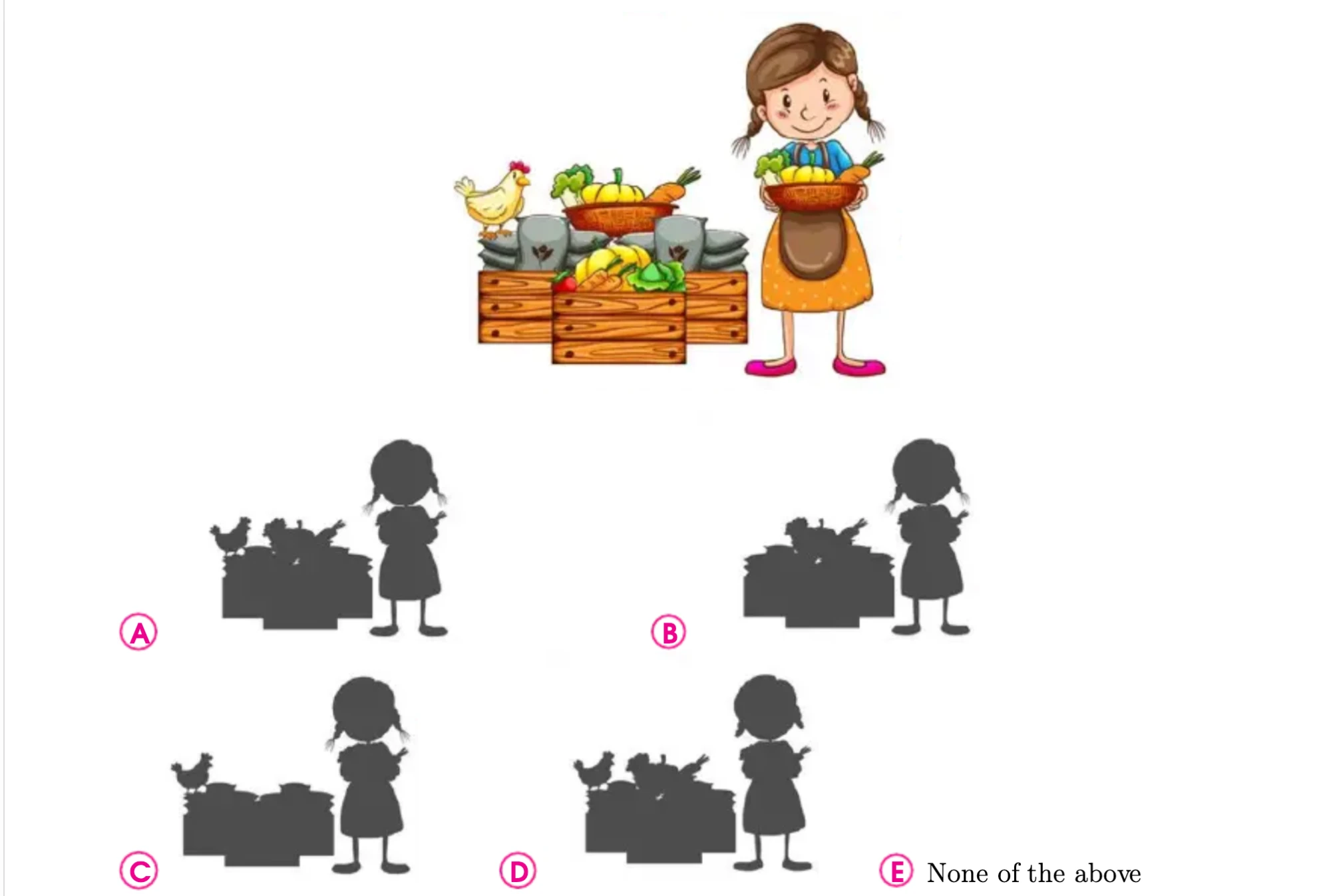
Options A–D are shown below the original picture (E is 'None of the above').
Answer: A
Compare each silhouette to the original picture: the chicken's position on top of the crates and the vegetable leaves sticking out above the crates.
Option C is missing the vegetable leaves on top of the crates.
Options B and D distort the shape/size of the chicken or leaves.
Only option A matches the original outline exactly.
4
sequences
medium
Find the sum of the first 48 numbers in: 1, 3, 5, 7, 8, 1, 3, 5, 7, 8, 1, 3...
Answer: A
The pattern repeats every 5 numbers: 1, 3, 5, 7, 8, with sum 1+3+5+7+8 = 24.
48 numbers = 9 full cycles (45 numbers) + 3 extra numbers (1, 3, 5).
9 × 24 = 216
216 + (1+3+5) = 216 + 9 = 225
5
combinatorics
medium
Choose 3 digits from 0, 2, 6, 8, 9 to form 3-digit numbers. How many numbers that can be divisible by 5 are there? (repetitions of digits are allowed).
Answer: C
A number is divisible by 5 only if its last digit is 0 or 5. Since 5 is not in the set {0,2,6,8,9}, the last digit must be 0.
First digit (can't be 0, since it's a 3-digit number): 4 choices (2, 6, 8, 9)
Middle digit: 5 choices (0, 2, 6, 8, 9)
Last digit: 1 choice (0)
Total = 4 × 5 × 1 = 20
6
geometry
easy
In the diagram below, a square of area 81 cm² is made up of three small identical rectangles. What is the perimeter of one small rectangle?
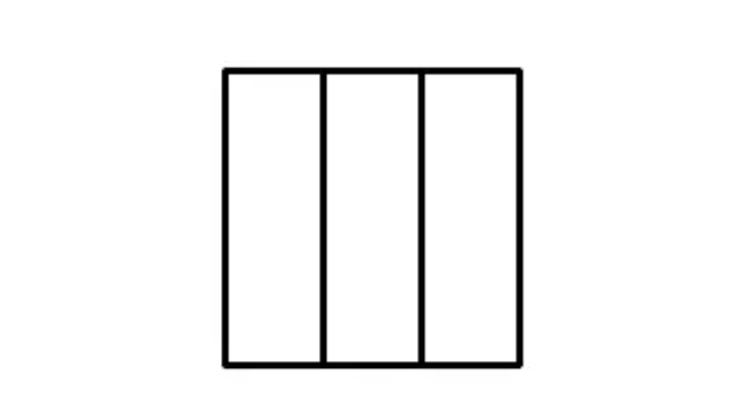
Answer: D
The square has area 81 cm², so its side length is √81 = 9 cm.
The square is split into 3 identical rectangles standing side by side, so each rectangle is 9 cm tall and 9 ÷ 3 = 3 cm wide.
Perimeter of one rectangle = 2 × (9 + 3) = 24 cm
7
age-problems
medium
Alan is 77 years old. Karen is 37 years old. How many years ago was Alan's age 3 times Karen's age?
Answer: D
Let x be the number of years ago. At that time: Alan's age = 77 − x, Karen's age = 37 − x.
Set up the equation: 77 − x = 3(37 − x)
77 − x = 111 − 3x
2x = 34
x = 17
8
logic
medium
One day, Alice discovered that someone had taken her shoes. There were four suspects in mind and she questioned each of them. The following were their replies:
Tweedledum: I did not take your shoes.
Tweedledee: White Rabbit took them!
White Rabbit: It wasn't me!
Mad Hatter: Either Tweedledee or Tweedledum did it!
If only the culprit was lying, who took Alice's shoes?
Answer: B
Test each suspect as the culprit — everyone else must be telling the truth.
If Tweedledum is guilty: Tweedledee's true statement says White Rabbit did it — contradiction.
If White Rabbit is guilty: Mad Hatter's true statement says Tweedledee or Tweedledum did it — contradiction.
If Mad Hatter is guilty: Tweedledee's true statement says White Rabbit did it — contradiction.
If Tweedledee is guilty: Tweedledum's statement (true, she's not him) ✓, White Rabbit's statement (true, not him) ✓, Mad Hatter's statement 'Tweedledee or Tweedledum did it' (true) ✓, and Tweedledee's own statement 'White Rabbit took them' is false, consistent with her being the liar.
Only Tweedledee being the culprit is consistent.
9
combinatorics
medium
A small zoo has a giraffe, an elephant, a lion and a bear. Lilly wants to plan a tour where she sees exactly two different animals. She does not want to start with the bear. How many different tours can she plan?
Answer: B
A tour is an ordered pair of two different animals (order matters — seeing giraffe then elephant is a different tour from elephant then giraffe).
Total ordered pairs from 4 animals: 4 × 3 = 12
Tours starting with the bear: 1 × 3 = 3 (bear first, then any of the other 3)
Tours not starting with the bear: 12 − 3 = 9
10
number-theory
easy
What is the greatest 3-digit number whose sum of digits is 13?
Answer: D
To make the number as large as possible, make the hundreds digit as large as possible: 9.
The remaining two digits must sum to 13 − 9 = 4. To maximize the number, make the tens digit as large as possible: 4, leaving the units digit as 0.
This gives 940 (9 + 4 + 0 = 13).
11
arithmetic
easy
Lisa and Macy shared $500 between them. Lisa received $238 more than her friend. How much did Macy receive?
Answer: C
Let Macy's share = m. Lisa's share = m + 238.
m + (m + 238) = 500
2m = 262
m = 131
12
spatial-reasoning
medium
At the right is a 4×4×4 cubic block of wood. Suppose all 6 faces of the cube are painted red and the cube is then cut into 1×1×1 cubes along the lines shown. How many 1×1×1 cubes will have red paint on just 2 faces?
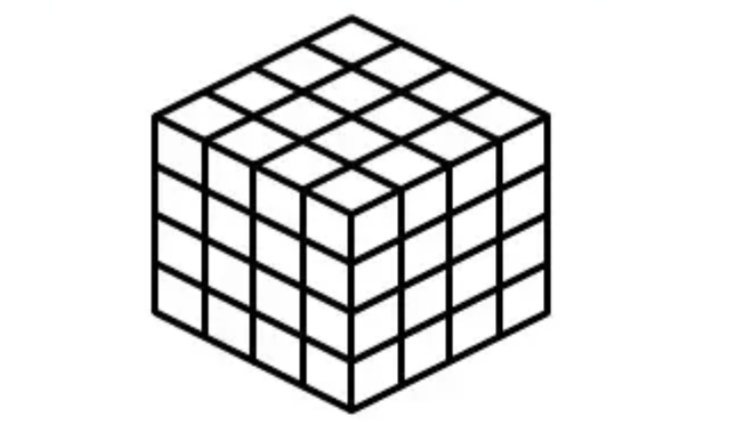
Answer: B
A small cube has paint on exactly 2 faces only if it sits on an edge of the big cube (not at a corner, not on a flat face interior).
Each edge of the 4×4×4 cube has 4 unit cubes, but the 2 at each end are corners (3 faces painted), leaving 4−2=2 edge cubes per edge.
A cube has 12 edges: 12 × 2 = 24
13
spatial-reasoning
medium
Find the missing piece of the picture below.
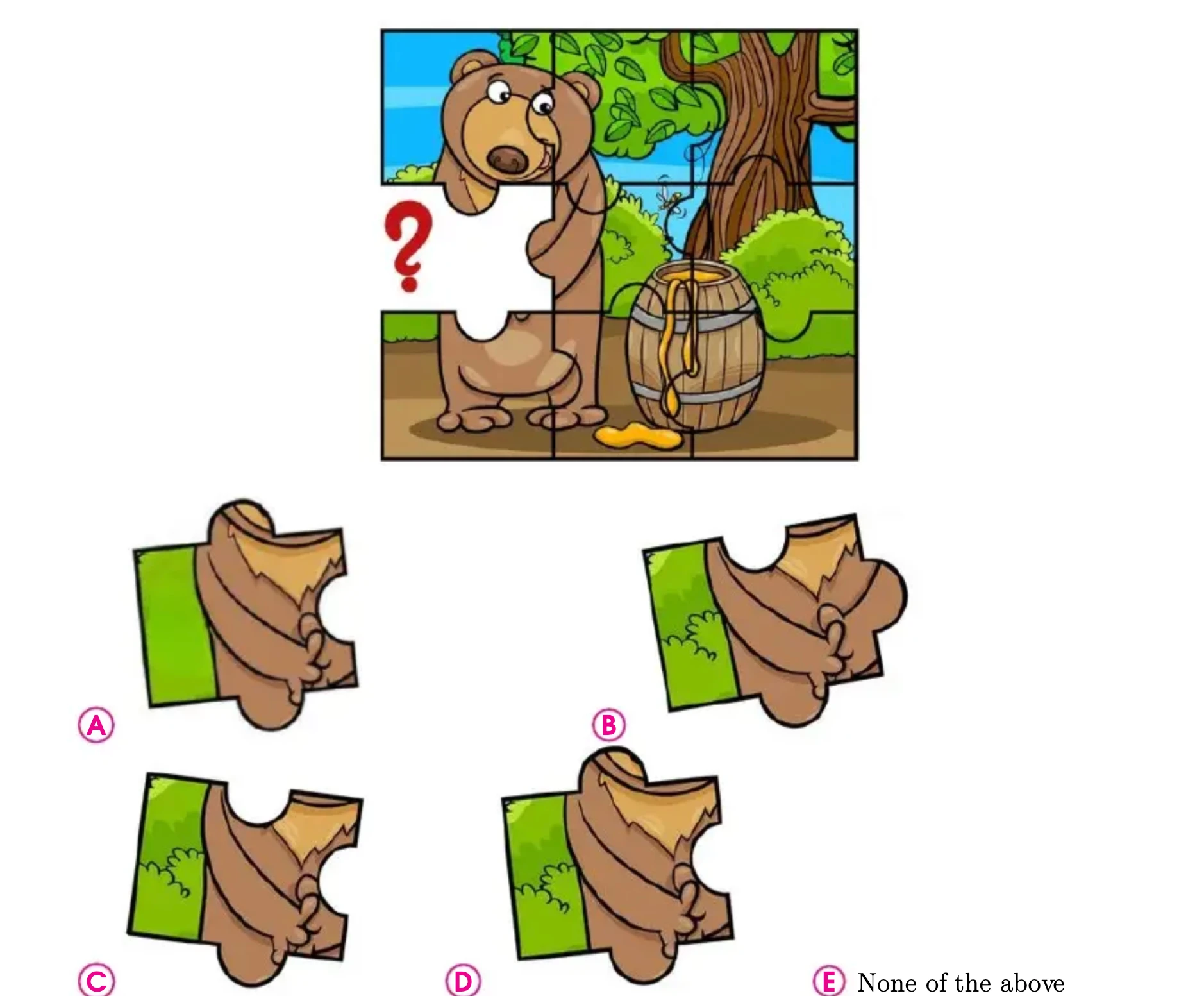
Options A–D are shown below the picture (E is 'None of the above').
Answer: C
Match the interlocking tab/notch shape of the missing piece to its neighbors: the top edge must have a notch (to receive the tab hanging down from the bear's chin piece above), the right edge must have a notch (to receive the round tab poking in from the arm piece), and the bottom edge must have a rounded tab (to fit into the belly piece below).
Only option C has this exact notch-notch-tab pattern; A and D have the pattern reversed (tab-notch-tab), and B has a tab instead of a notch on the right.
14
number-theory
medium
In how many ways can you write 23 as the sum of three different odd numbers?
Answer: A
List all sets of 3 different odd numbers (smallest to largest) that add to 23:
1+3+19, 1+5+17, 1+7+15, 1+9+13, 3+5+15, 3+7+13, 3+9+11, 5+7+11
That is 8 ways.
15
arithmetic
medium
In a straight row, 32 trees are planted at equal distance. The distance between the 1st and 16th tree is 30 meters. What is the distance between the 19th and 26th tree?
Answer: D
From the 1st to the 16th tree there are 16 − 1 = 15 equal gaps covering 30 m, so each gap = 30 ÷ 15 = 2 m.
From the 19th to the 26th tree there are 26 − 19 = 7 gaps.
7 × 2 = 14 m
Section B
Free-response — 10 Questions
(+4)
16
spatial-reasoning
medium
How many squares containing the star are there in the figure below?

Answer: 10
The star sits in the 2nd row, 2nd column of the 4×4 grid.
Count squares of each size that cover that cell:
1×1 squares: 1
2×2 squares: 4
3×3 squares: 4
4×4 squares: 1
Total = 1 + 4 + 4 + 1 = 10
17
age-problems
medium
Victor is 6 years old. His father is 38 years old. How many years' time will his father's age be 5 times Victor's age?
Answer: 2
Let x = number of years from now. Then: 38 + x = 5(6 + x)
38 + x = 30 + 5x
8 = 4x
x = 2
18
number-theory
hard
There once was a child whose parents never taught him the number 7. He grew up to be a wonderful person, but would always count 1, 2, 3, 4, 5, 6, 8, 9, 10 and so on, skipping all numbers that include a 7. One day he was given the task of numbering the pages in two books. By his count, the last page of the first book is 140. Knowing what you do about this child, how many pages are actually in this book?
Answer: 117
He labels the pages 1,2,3,... in order but skips every number containing the digit 7 (7, 17, 27, 37, 47, 57, 67, 70-79, 87, 97, 107, ...).
His last label is 140, so the actual page count equals how many numbers from 1 to 140 do NOT contain the digit 7.
Counting numbers from 1 to 140 that contain a 7: 7,17,27,37,47,57,67,70-79,87,97,107,117,127,137 → 23 numbers.
Actual pages = 140 − 23 = 117
19
arithmetic
easy
Find the value of 41 + 42 + 43 + ... + 60.
Answer: 1010
This is 20 consecutive numbers from 41 to 60.
Sum = (first + last) × count ÷ 2 = (41 + 60) × 20 ÷ 2
= 101 × 10
= 1010
20
arithmetic
medium
Some students form a rectangle. Joseph is in the fourth row if we count from the front and in the seventh row if we count from the back. He is in the third column if we count from left and in the ninth column if we count from the right. How many students are there?
Answer: 110
Total rows = 4 + 7 − 1 = 10 (Joseph's row is counted once from each side)
Total columns = 3 + 9 − 1 = 11
Total students = 10 × 11 = 110
21
algebra
hard
1 blue marble and 2 green marbles cost 16 cents. 1 red marble and 2 blue marbles also cost 16 cents. 1 green marble and 2 red marbles only cost 13 cents. How much does 1 green marble cost?
Answer: 5
Let b, g, r be the costs of blue, green, red marbles.
b + 2g = 16 ... (1)
r + 2b = 16 ... (2)
g + 2r = 13 ... (3)
From (1): b = 16 − 2g. Substitute into (2): r = 16 − 2b = 16 − 2(16−2g) = 4g − 16
Substitute into (3): g + 2(4g − 16) = 13 → 9g − 32 = 13 → 9g = 45 → g = 5
22
algebra
hard
Can you solve this math equation?
hamster × dog × hamster = 64
hamster + fish bowl + fish bowl = 50
dog × hamster = 16
fish bowl + cat box + dog = 49
cat box × dog + fish bowl = ?

Answer: 111
Let H=hamster, D=dog, F=fish bowl, C=cat box.
From H²D = 64 and DH = 16: divide to get H = 64/16 = 4, then D = 16/H = 4.
H + 2F = 50 → 4 + 2F = 50 → F = 23
F + C + D = 49 → 23 + C + 4 = 49 → C = 22
C × D + F = 22 × 4 + 23 = 88 + 23 = 111
23
spatial-reasoning
hard
The cube at the right is constructed of congruent boards, each being of the same size and shape. How many boards does the cube contain?

Answer: 54
Count the individual planks visible on the 3 visible faces (top, left, right), then double the total since the 3 hidden faces (bottom, back-left, back-right) are built the same way as the opposite faces that face them.
Visible boards: top face ≈ 5, left face ≈ 9, right face ≈ 13, totaling 27 on the visible half of the cube.
Doubling for the hidden half: 27 × 2 = 54.
Note: this figure is genuinely hard to count precisely from the image — double-check against an answer key if you have one.
24
number-theory
medium
If the 5-digit number 3367N is divisible by 15, what is the digit N?
Answer: 5
Divisible by 15 means divisible by both 3 and 5.
Divisible by 5: N must be 0 or 5.
Divisible by 3: digit sum 3+3+6+7+N = 19+N must be a multiple of 3.
N=0 → 19 (not divisible by 3). N=5 → 24 (divisible by 3, 24÷3=8). ✓
So N = 5
25
number-theory
hard
The sum of the 3-digit number AAA and the 2-digit number BB is the 4-digit number CD6E. A, B, C, D, and E are different digits. What 4-digit number does CD6E represent?
Answer: 1065
AAA = 111×A and BB = 11×B, and their sum is at most 999+99=1098, so the result is between 1000 and 1098 — meaning C=1 and D=0.
Column addition with C=1 forces a carry out of the hundreds column: A + (carry from tens) = 10, so A=9 (with a carry of 1 from the tens column).
Tens column: 9 + B + (carry from units) = 16 (since result tens digit is 6 and we carry 1 into hundreds).
Trying B=6 with a carry of 1 from the units column works: 9+6+1=16 ✓.
Units column: 9 + 6 = 15, giving units digit E=5 and carrying 1 into tens ✓.
Check: AAA=999, BB=66, sum=999+66=1065. So CD6E = 1065