Section A
Multiple Choice — 15 Questions
(+2 / -1)
1
arithmetic
easy
Calculate the following sum.
2021 + 1202 + 110
Answer: C
2021 + 1202 = 3223, and 3223 + 110 = 3333.
2
number-sense
easy
Take the smallest 3-digit number and add it to the largest 2-digit number. Subsequently, subtract from this sum the largest 1-digit number. What is the answer number obtained?
Answer: E
Smallest 3-digit number = 100, largest 2-digit number = 99, largest 1-digit number = 9. So 100 + 99 − 9 = 190, which is not among options A–D, so the answer is 'None of the above'.
3
patterns
medium
What comes next in the following pattern?
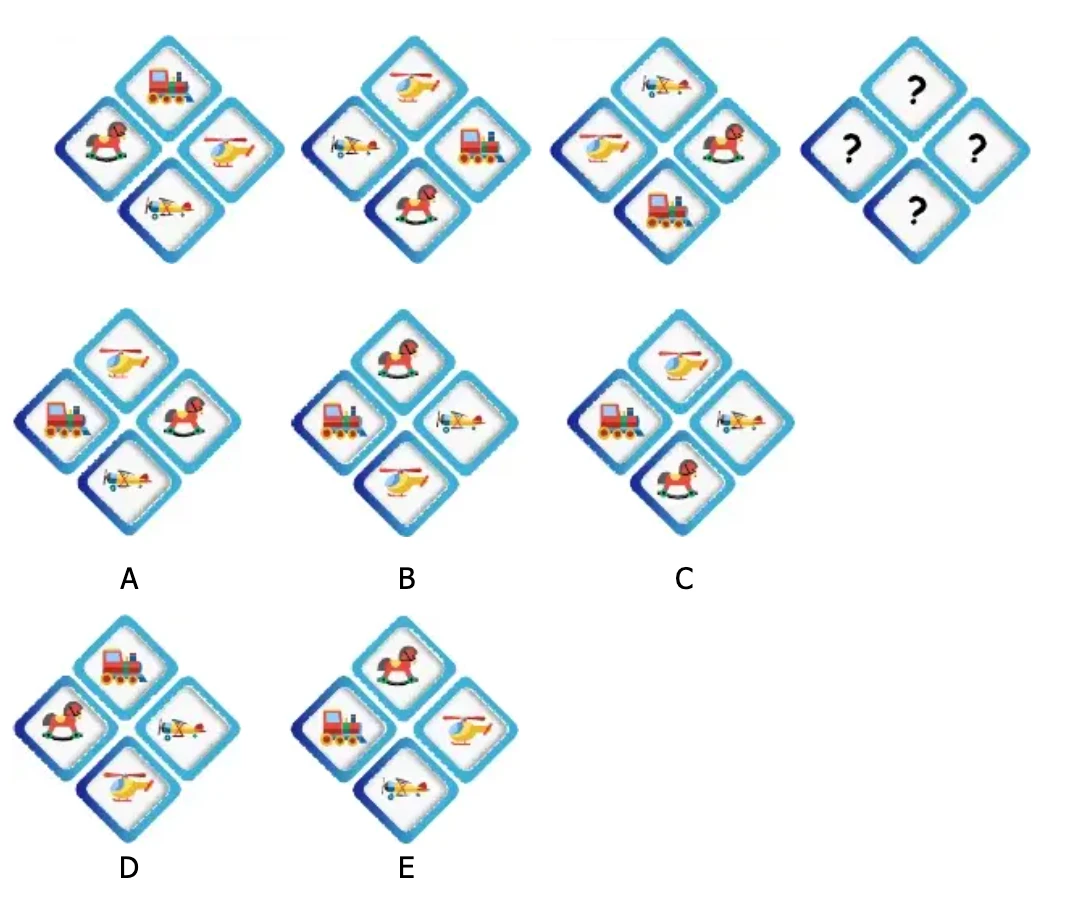
Options A–E are the diamond arrangements shown in the image.
Answer: B
Track each toy through the three given diamonds. The train goes top → right → bottom, so next it is on the left; the rocking horse ends on top, the plane on the right, and the helicopter on the bottom. That arrangement (top = rocking horse, left = train, right = plane, bottom = helicopter) is option B.
4
number-theory
medium
Starting from 1, which whole number is the 11th number that is not a multiple of 3?
Answer: A
Numbers that are not multiples of 3: 1, 2, 4, 5, 7, 8, 10, 11, 13, 14, 16, … The 11th of these is 16.
5
logic-arithmetic
medium
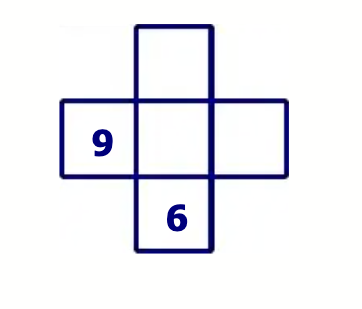
The squares in the diagram below (a plus/cross shape) must be filled with the numbers 6 to 10 so that the sum of the numbers in the row equals the sum of the numbers in the column. The number 9 is already in the left cell of the row and 6 is in the bottom cell. What is the sum of the numbers in the row?
Answer: B
The five numbers 6–10 add to 40. Row + Column = (all four outer cells) + 2×centre = 40 + centre, and this equals 2×(row sum), so the centre must be even. Testing, centre = 8 works: with 9 (left) and 6 (bottom) given, the top = 10 and right = 7. Row = 9 + 8 + 7 = 24 and Column = 10 + 8 + 6 = 24.
6
number-theory
medium
How many whole numbers from 1 to 201 consist of only even digits?
Answer: C
Even digits are 0,2,4,6,8. 1-digit: 2,4,6,8 → 4 numbers. 2-digit: tens ∈{2,4,6,8} and units ∈{0,2,4,6,8} → 4×5 = 20. 3-digit up to 201: only 200 qualifies → 1. Total 4 + 20 + 1 = 25.
7
patterns
medium
What is the next number in the pattern below?
4, 8, 8, 7, 12, 6, 16, 5, ___
Answer: C
There are two interleaved sequences. The odd positions go 4, 8, 12, 16, … (add 4), and the even positions go 8, 7, 6, 5, … (subtract 1). The next term is in an odd position, so it is 16 + 4 = 20.
8
optimisation
medium
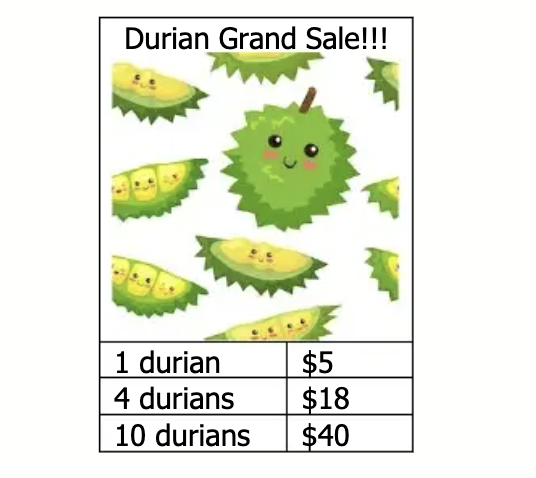
Given the following prices of durians, what is the least amount (in $) that must be spent to purchase 17 durians?
Durian Grand Sale!!!
1 durian = $5
4 durians = $18
10 durians = $40
Answer: B
Buy one 10-pack ($40) + one 4-pack ($18) + three singles (3×$5 = $15) = 17 durians for $40 + $18 + $15 = $73. Other combinations (e.g. 10 + 7 singles = $75, or four 4-packs + 1 single = $77) cost more, so $73 is the least.
9
divisibility
medium
The four-digit number 17X8 is divisible by 3. If X is an odd digit, find the value of X.
Answer: C
The digit sum 1 + 7 + X + 8 = 16 + X must be divisible by 3, so X can be 2, 5, or 8. The only odd value is 5.
10
spatial-reasoning
hard
Which figure shown below is the rotation of the figure on the right?
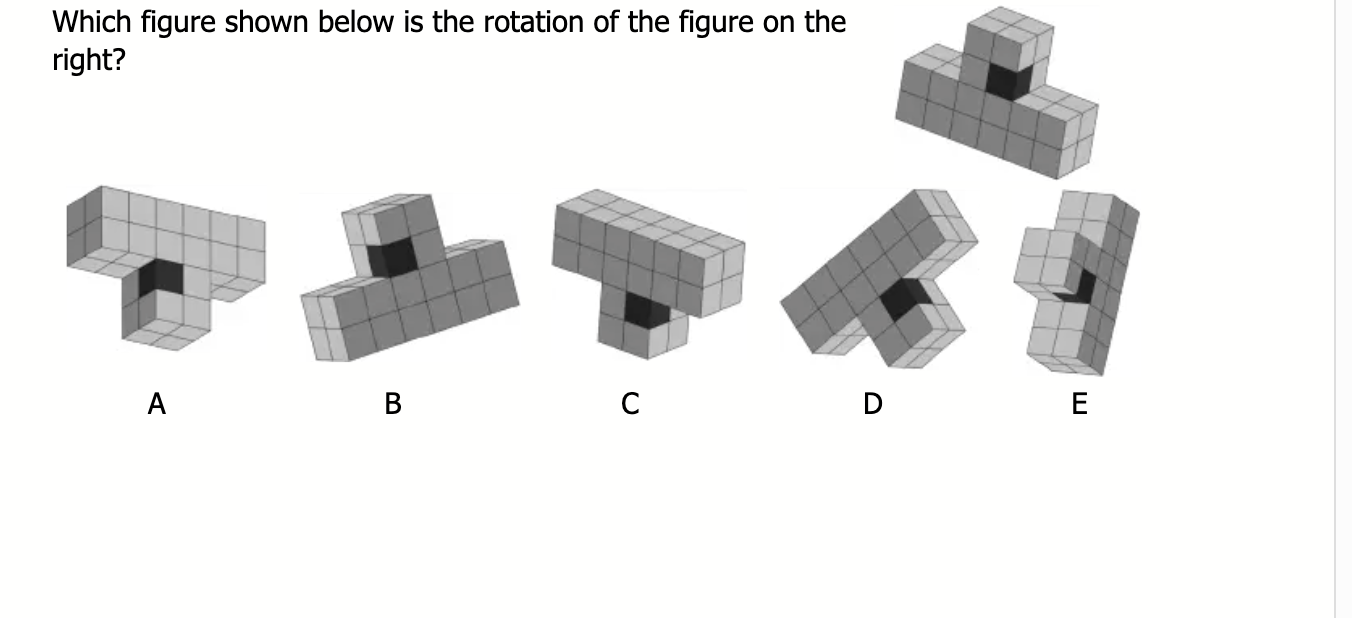
Options A–E are the 3-D block figures in the image.
Answer: A
The reference is a chiral polycube. Option A is the one that is a pure rotation (same handedness) of it — the raised cube and the recessed notch keep the same relative positions once turned. (Answer per the official key.)
11
logic
hard
Arden always tells the truth on Tuesdays, Wednesdays and Thursdays, always tells lies on Sundays, and tells either truth or lies on the rest of the days of the week. For five days in a row, he was asked what his grade was, and he gave the following answers: Primary 2, Primary 3, Primary 4, Primary 2 and Primary 5. Which grade was Arden from?
Answer: D
On his three truth days (Tue, Wed, Thu) he must give the same (true) grade, but no three consecutive answers match, so the 5-day window cannot contain all of Tue–Thu. Testing the windows, only Friday–Tuesday is consistent: the single truth day (Tuesday) gives 'Primary 5', and Sunday's answer 'Primary 4' is a lie (≠ Primary 5). So Arden is from Primary 5.
12
combinatorics
medium
Each of the box-shaped figures below is called a 'cuboid' and each is made of 6 cubes; the three figures shown are the same cuboid. How many different cuboids can be formed using exactly 20 identical cubes?
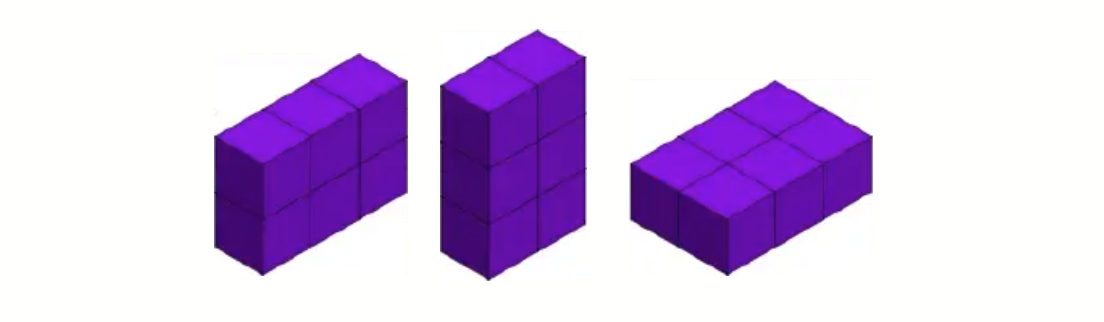
Answer: C
A cuboid is a length × width × height with the product 20 (dimensions in any order count as the same shape). The distinct factorisations are 1×1×20, 1×2×10, 1×4×5 and 2×2×5 — that is 4 different cuboids.
13
graph-theory
hard
Which of the following figures cannot be drawn without lifting the pen and without tracing the same line more than once?
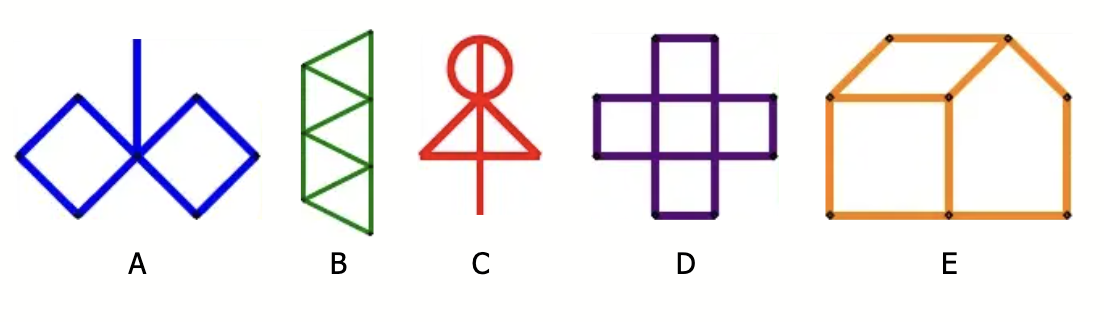
Options A–E are the figures in the image.
Answer: E
A figure can be drawn in one stroke only if it has zero or two vertices where an odd number of lines meet. Figures A–D each have at most two such odd vertices, so they can be drawn. The house (E) has four odd vertices (the top ridge corner, the two mid-level junctions and the bottom-middle), so it cannot be drawn without lifting the pen or retracing a line.
14
patterns
hard
In the table below, the word 'SASMO2021' appears in the first row. The rows follow a certain pattern. In which row will the word 'SASMO2021' appear for the third time?
1: SASMO2021
2: ASMOS0212
3: SMOSA2120
4: MOSAS1202
5: OSASM2021
…
Answer: D
The letters 'SASMO' rotate with a period of 5 rows and the digits '2021' rotate with a period of 4 rows. Both return to the original at the same time every LCM(5,4) = 20 rows. So the full word reappears in rows 1, 21, 41, … The third appearance is in row 41.
15
logic-arithmetic
hard
Melissa, Noah, Olivia, Pierre, Qiqi, Rain and Susan answered 2, 4, 6, 8, 10, 12 or 14 questions correctly in SASMO 2020, not necessarily in that order. Noah correctly answered 6 more questions than Susan. Rain's number of correct answers is 4 times as many as Olivia's. Melissa and Qiqi altogether correctly answered 6 times as many questions as Pierre. How many questions did Noah answer correctly?
Answer: C
Rain = 4 × Olivia forces Olivia = 2 and Rain = 8. Then Melissa + Qiqi = 6 × Pierre works only with Pierre = 4 and {Melissa, Qiqi} = {10, 14} (since 10 + 14 = 24 = 6 × 4). That leaves Susan and Noah as 6 and 12, and Noah = Susan + 6 gives Noah = 12.
Section B
Integer-type — 10 Questions
(+4)
16
counting-figures
medium
How many triangles are there in the figure below?
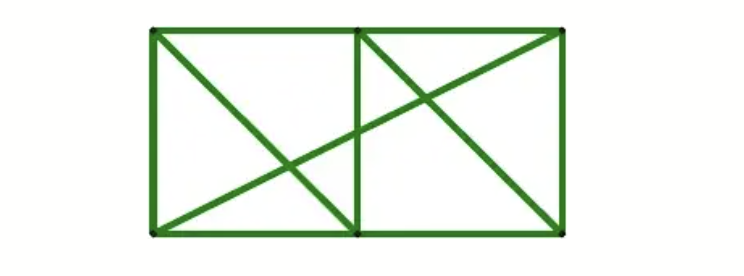
Answer: 16
The figure is a rectangle split into two squares by a middle vertical, with the diagonal from the top-left to the bottom-middle, the long diagonal from the bottom-left to the top-right, and the diagonal from the top-middle to the bottom-right. Counting every triangle formed by these lines (small and combined) gives 16.
17
word-problem
medium
There are 3 different types of fruits in a basket. The total number of fruits in the basket is 23. The number of oranges in the basket is 6 times the number of apples. If there are more apples than bananas in the basket, how many oranges are there?
Answer: 18
Let apples = a, so oranges = 6a and bananas = 23 − 7a. We need bananas ≥ 1 and apples > bananas. a = 3 gives oranges = 18, bananas = 2, and 3 > 2 works. So there are 18 oranges (3 apples, 18 oranges, 2 bananas).
18
number-theory
medium
Find a two-digit multiple of 6 which is four less than a multiple of 13.
Answer: 48
We need N a multiple of 6 with N + 4 a multiple of 13. Checking multiples of 13 minus 4: 22, 35, 48, 61, … only 48 is a two-digit multiple of 6 (48 = 6×8 and 48 + 4 = 52 = 13×4).
19
word-problem
medium
Jessica's age is twice as Derrick's age now. If Jessica's age 8 years ago is equal to Derrick's age 6 years from now, how old is Jessica now?
Answer: 28
Let Derrick = D, so Jessica = 2D. Then 2D − 8 = D + 6, giving D = 14 and Jessica = 28. (Check: 8 years ago Jessica was 20; Derrick in 6 years will be 20.)
20
shortest-path
medium
Tracy can travel to her house from the office via different pathways as shown in the diagram below. How many metres will she have to travel if she takes the shortest route?
Distances: House–Office = 2600 m, Office–Gym = 2222 m, Office–Mall = 1234 m, House–Gym = 444 m, Gym–Mall = 333 m.
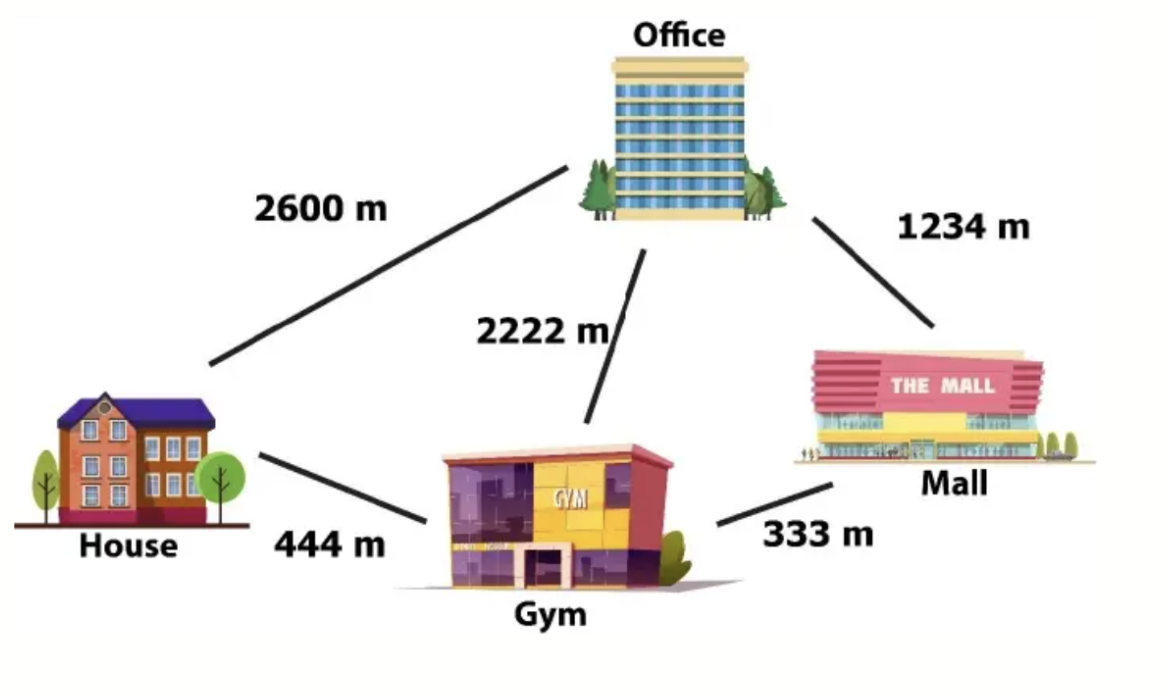
Answer: 2011
Compare routes from Office to House: direct = 2600 m; Office–Gym–House = 2222 + 444 = 2666 m; Office–Mall–Gym–House = 1234 + 333 + 444 = 2011 m. The shortest is 2011 m.
21
combinatorics
medium
How many ways are there to buy a $75 toy using $5, $10 or $50 notes?
Answer: 11
Solve 5a + 10b + 50c = 75, i.e. a + 2b + 10c = 15. With c = 0: a + 2b = 15 gives b = 0..7 → 8 ways. With c = 1: a + 2b = 5 gives b = 0..2 → 3 ways. Total 8 + 3 = 11 ways.
22
geometry-area
hard
Two squares are placed next to each other as shown below. The total shaded area is 50 cm² and the side length of the small square is 6 cm. Find the side length (in cm) of the large square.
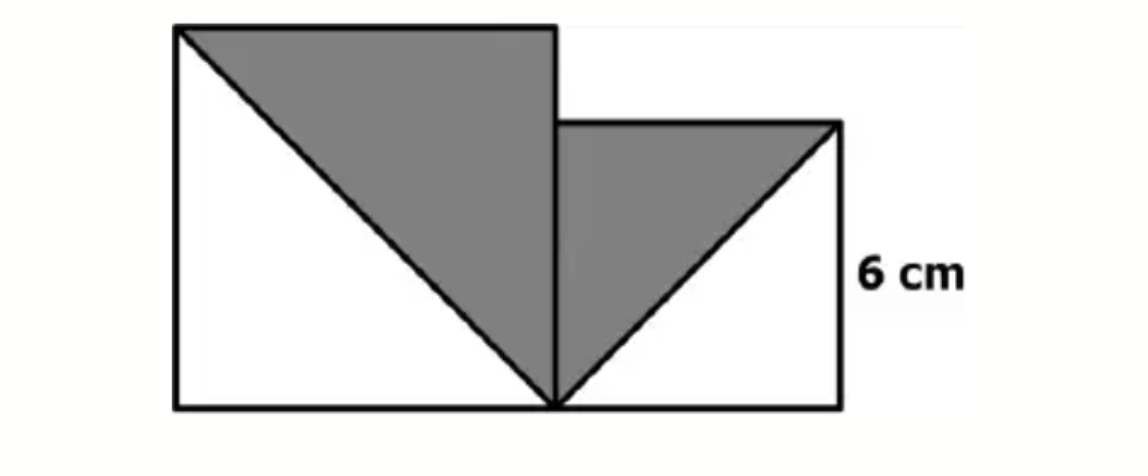
Answer: 8
The shaded region is a triangle in the large square (area = ½ × a², where a is the large side) plus a triangle in the small square (area = ½ × 6 × 6 = 18). So ½a² + 18 = 50, giving ½a² = 32, a² = 64, a = 8 cm.
23
scheduling
hard
Herman is a busy baker. He needs to bake 2 different types of bread. He has only 1 oven and 1 mixing bowl, so he can prepare and bake only 1 type of dough at a time; but once bread is in the oven he can prepare the other dough. Times: Raisin bread — prepare 20 min, bake 27 min. Pandan bread — prepare 29 min, bake 23 min. What is the least amount of time (in minutes) to finish baking both breads?
Answer: 72
Prepare Raisin first (20 min). While it bakes (ends at 20 + 27 = 47), prepare Pandan (20 → 49). Pandan can then bake from 49 to 49 + 23 = 72. Total = 72 minutes. (Preparing Pandan first gives 79 minutes, which is worse.)
24
cryptarithm
hard
In the following, all the different letters stand for different digits. What is the value of the 4-digit number UNDO?
O D D
+ O D D
-------
U N D O
Answer: 1798
ODD + ODD = 2 × ODD = UNDO. Column by column: the units give 2D ending in O; the tens force D = 9 (with carries); then O = 8 and the hundreds give N = 7, with U = 1. So ODD = 899 and UNDO = 899 + 899 = 1798.
25
spatial-reasoning
hard
In the picture below, the standard dice rotates around the squares until it rests on top of the square with '?'. If the sum of the numbers on opposite sides of the dice is 7, which number will face the square '?'?
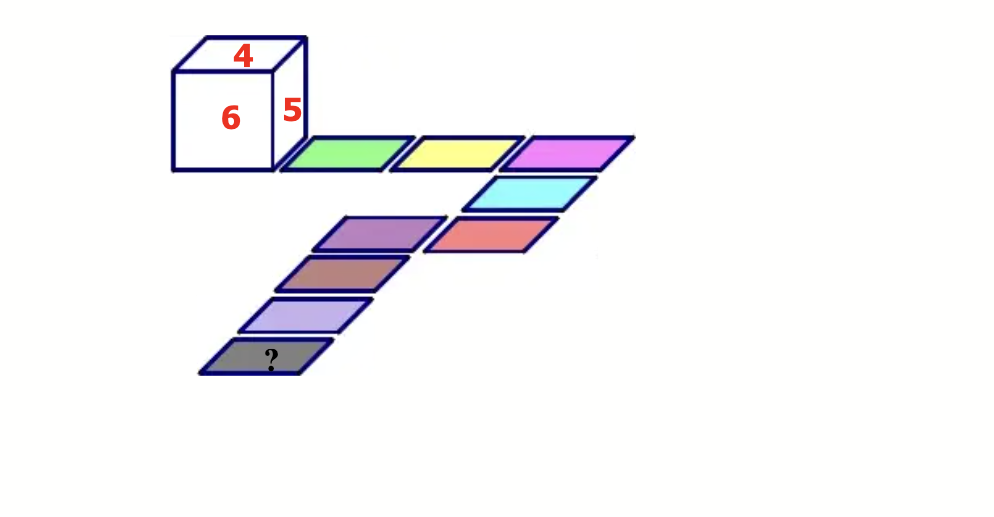
Answer: ?
Starting from top = 4, front = 6, right = 5 (opposite faces summing to 7), tip the die one square at a time along the path; the face touching the '?' square is the bottom face on arrival. A tentative trace (3 rolls along the top row, then straight down the diagonal) gives 5, but the exact tile sequence and turn could not be read reliably from the image, so this is left unresolved — verify against the official key.