Section A
MCQs — 15 Questions
(+2 / -1)
1
arithmetic
easy
What is the value of the following sum?
99 + 97 + 95 + 96 + 98
Answer: B
Rewrite the numbers as (100−1) + (100−3) + (100−5) + (100−4) + (100−2) = 500 − 1 − 2 − 3 − 4 − 5 = 485.
2
spatial-reasoning
medium
Find the correct shadow of the picture below.
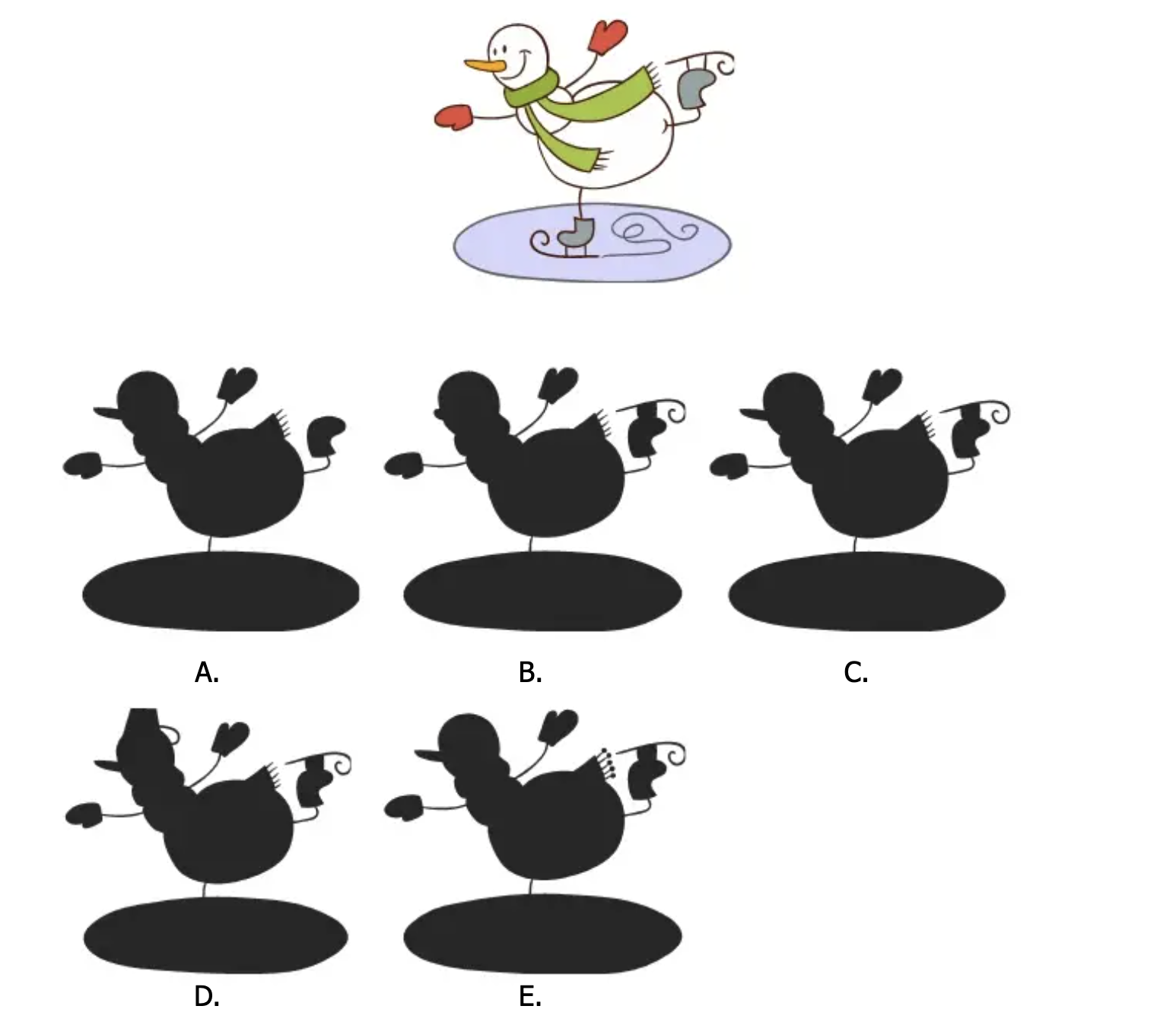
Options A–E are shown top-to-bottom, then left-to-right, in the image above.
Answer: C
The difference between the original picture and each of the non-matching options (A, B, D, E) can be circled; only option C matches the original exactly.
3
measurement
medium
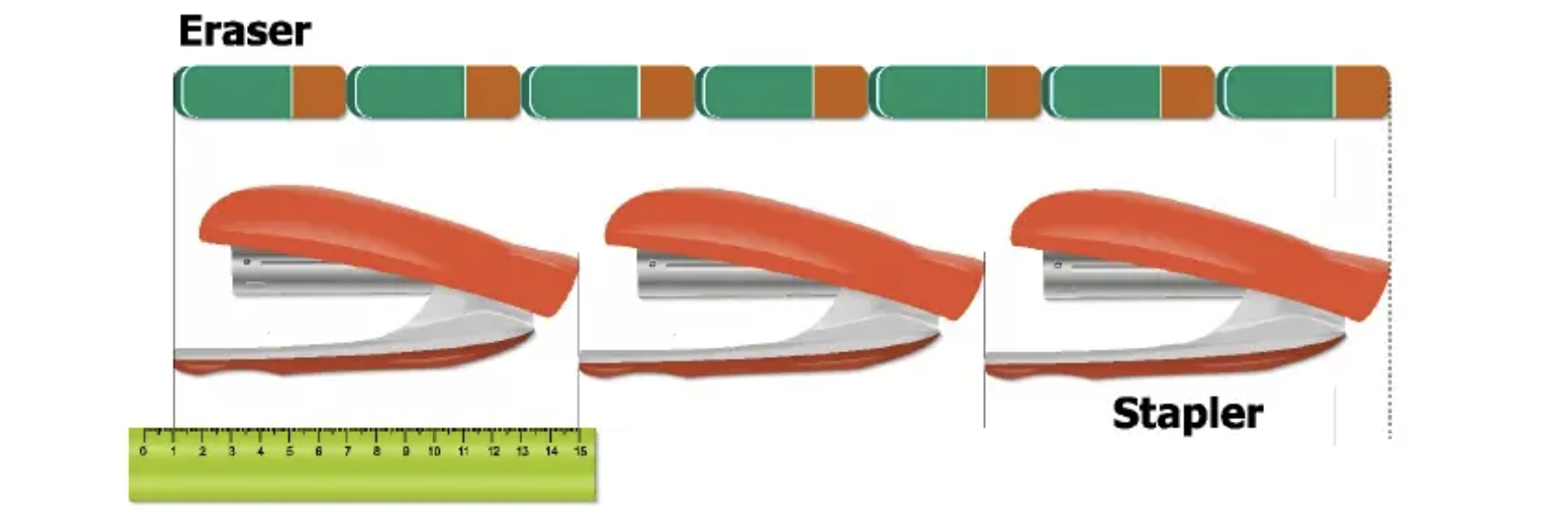
Study the picture below. Find the difference in length (in cm) between the stapler and the eraser.
Answer: B
The stapler is 15 − 1 = 14 cm long. 7 erasers are 3 staplers long, or 14 × 3 = 42 cm. So 1 eraser is 42 ÷ 7 = 6 cm long. The difference is 14 − 6 = 8 cm.
4
patterns
medium
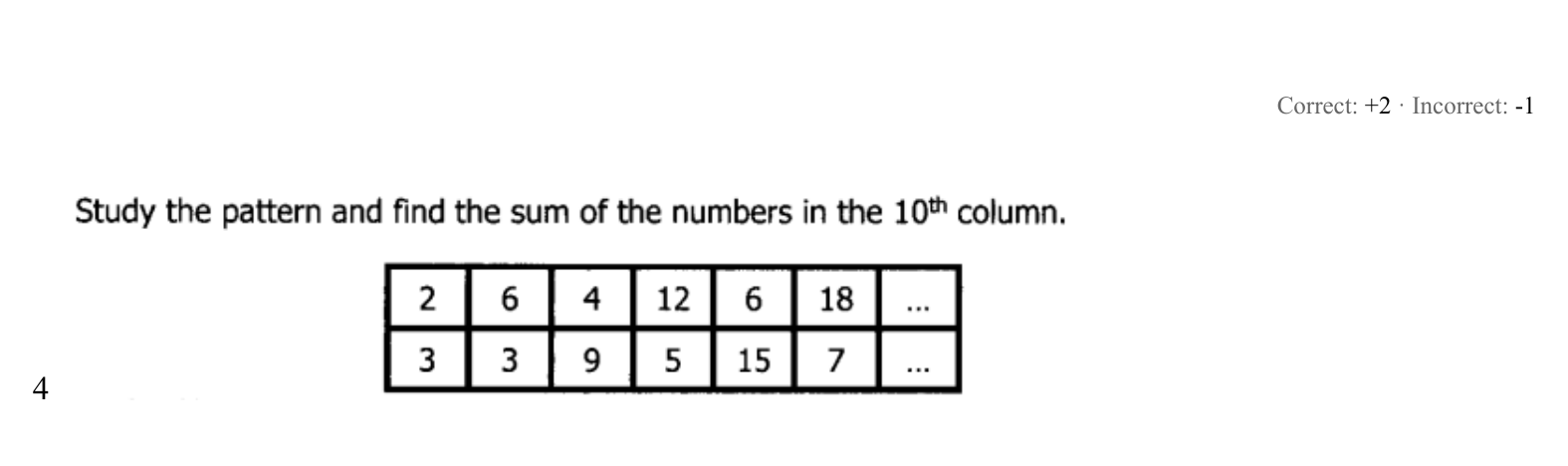
Study the pattern and find the sum of the numbers in the 10th column.
Answer: A
The column sums are 5, 9, 13, 17, 21, 25, … with a common difference of 4. So the first 10 sums are 5, 9, 13, 17, 21, 25, 29, 33, 37, 41. The 10th column sum is 41.
5
spatial-reasoning
medium
Which one of the following options is a missing piece of the dog's kennel?
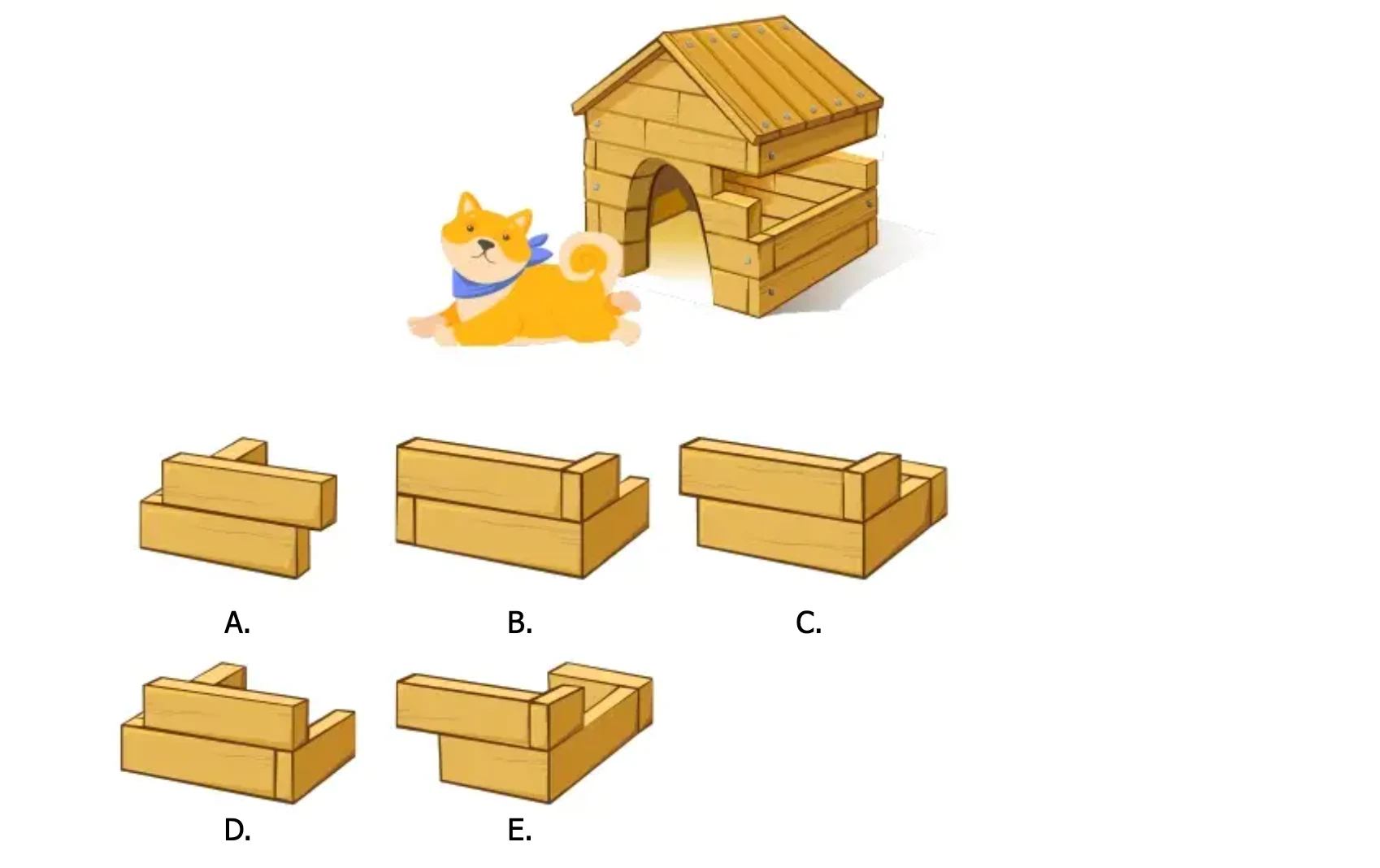
Options A–D are shown top-to-bottom in the image above.
Answer: D
Option D fits as the missing piece of the dog's kennel.
6
number-theory
medium
The sum of 5 consecutive whole numbers is 110. What is the largest odd number among the 5 numbers?
Answer: C
Let the numbers be n, n+1, n+2, n+3, n+4. Their total is 5n + 10 = 110, so 5n = 100 and n = 20. The 5 numbers are 20, 21, 22, 23, 24. The largest odd number is 23.
7
geometry-area
medium
In the square below, points E and F are the midpoints of AB and AD, respectively. If the length of the square is 4 cm, find the area (in cm²) of the shaded region.
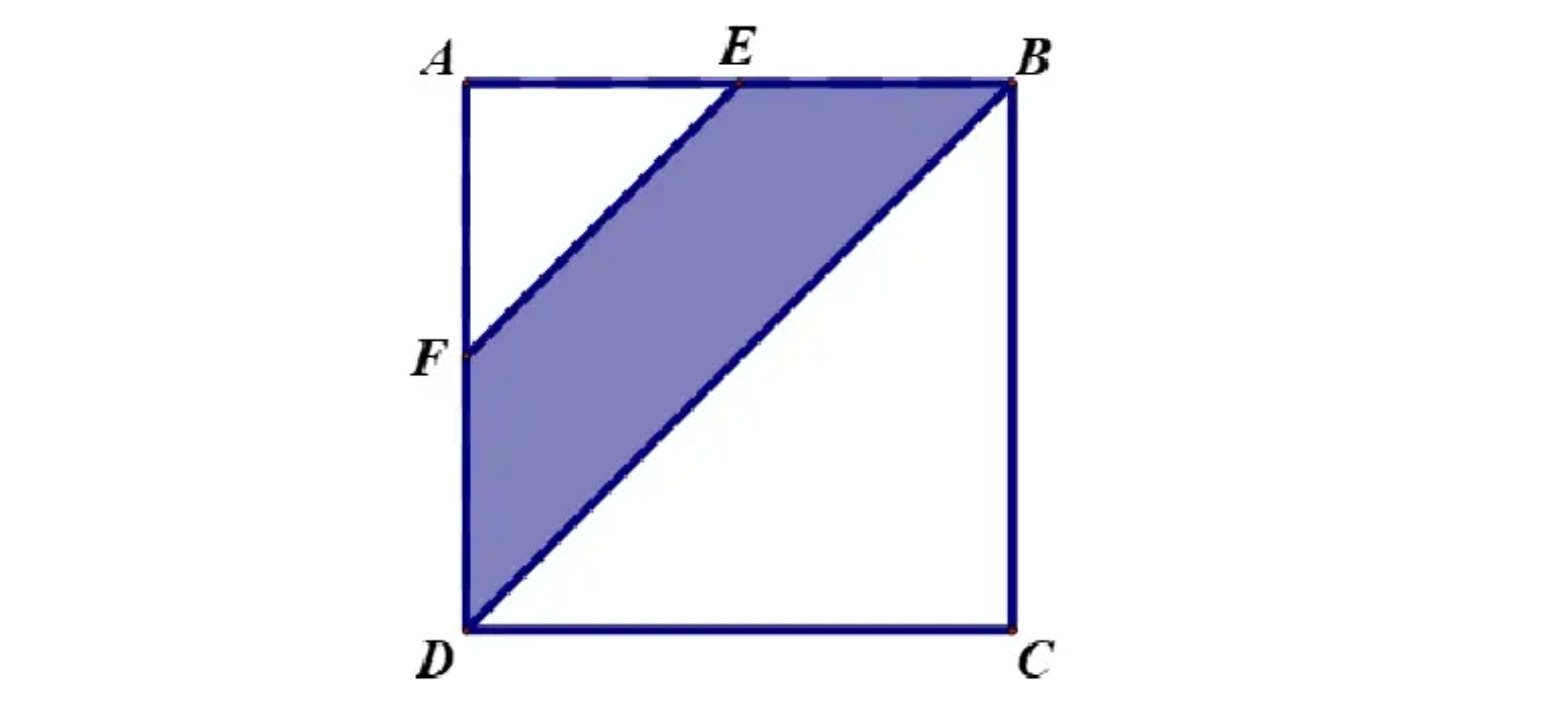
Answer: C
The area of the square is 4 × 4 = 16 cm². Dividing the square into 8 identical triangles, each has area 16 ÷ 8 = 2 cm². The shaded region equals 3 such triangles, so 3 × 2 = 6 cm².
8
geometry-graph
hard
An ant is at one vertex of a cube and can only walk along the edges of the cube. It cannot walk along any edge more than once. If the length of the cube is 4 cm, what is the greatest distance (in cm) that the ant can walk before it cannot continue?
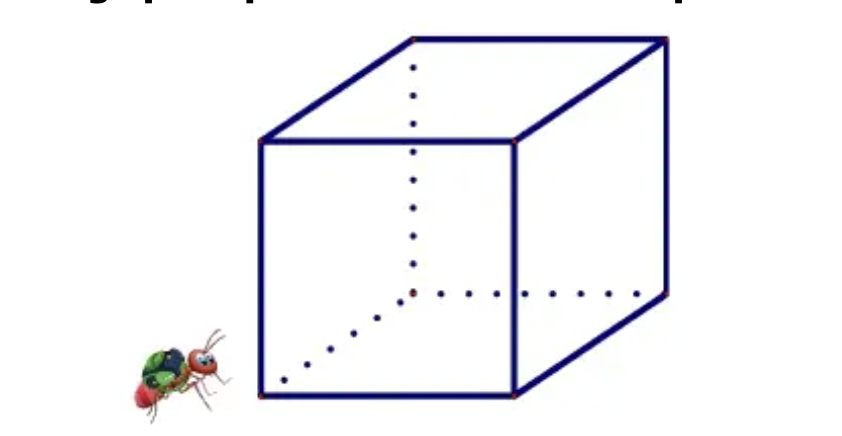
Answer: A
The greatest number of edges the ant can walk is 9. So the greatest distance is 9 × 4 = 36 cm.
9
logic-comparison
medium
Study the picture below. Which of the following relationships is correct?
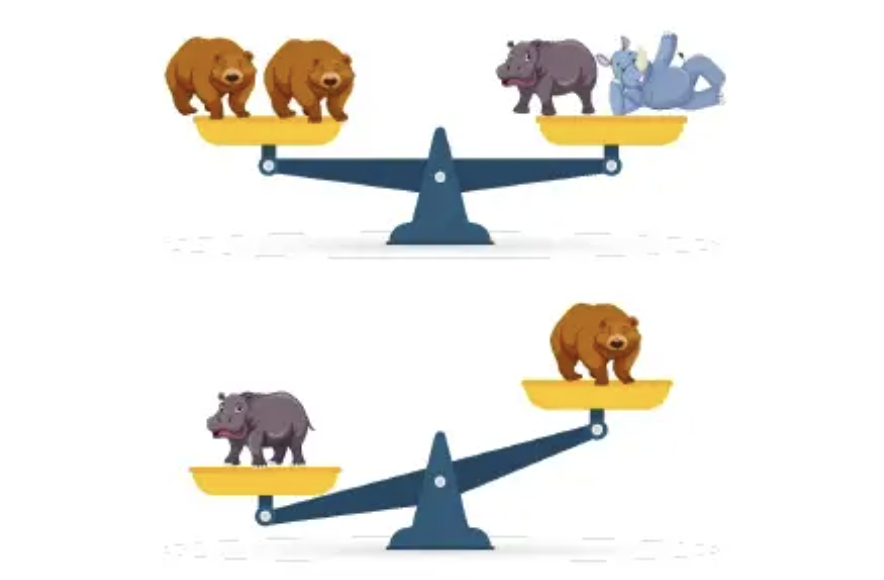
Options A–E are shown top-to-bottom in the image above.
Answer: D
From the second scale, the bear is lighter than the hippo. From the first scale, the group of small animals is lighter than the bear. So the bear is heavier than the group of small animals — option D is correct.
10
divisibility
medium
If the four-digit number 147B is divisible by 3, how many possible values are there for the digit B?
Answer: D
A number is divisible by 3 when its digit sum is divisible by 3. 1 + 4 + 7 + B = 12 + B must be divisible by 3, so B can be 0, 3, 6, or 9 — that is 4 possible values.
11
logic
hard
Mother came home and found that one of her children had eaten the whole cake she put in the fridge. She asked each of her children who did it, and their responses are shown below.
Austin: Carlos ate the cake.
Benny: Austin ate the cake.
Carlos: Benny is lying.
Daniela: It was not Carlos who ate the cake.
Ella: I did not eat the cake.
If only two of the children were telling the truth, who ate the cake?
Answer: E
Austin's and Daniela's statements are opposite, so exactly one of them is true. Benny's and Carlos's statements are also opposite, so exactly one of them is true. That already accounts for the two truth-tellers, which means Ella must be lying — so Ella ate the cake.
12
word-problem
medium
The desks in a Primary 3 classroom are arranged in straight rows. Each row has the same number of desks. Greggory sits at the desk that is in the fourth row from the front and back. He sits at the centre of his row and there are 5 desks to his left. How many desks are in the classroom?
Answer: C
Greggory is in the 4th row from both front and back, so there are 3 + 1 + 3 = 7 rows. He is at the centre with 5 desks to his left, so each row has 5 + 1 + 5 = 11 desks. Total = 7 × 11 = 77 desks.
13
patterns
medium
Observe the following pattern. What is the missing number?
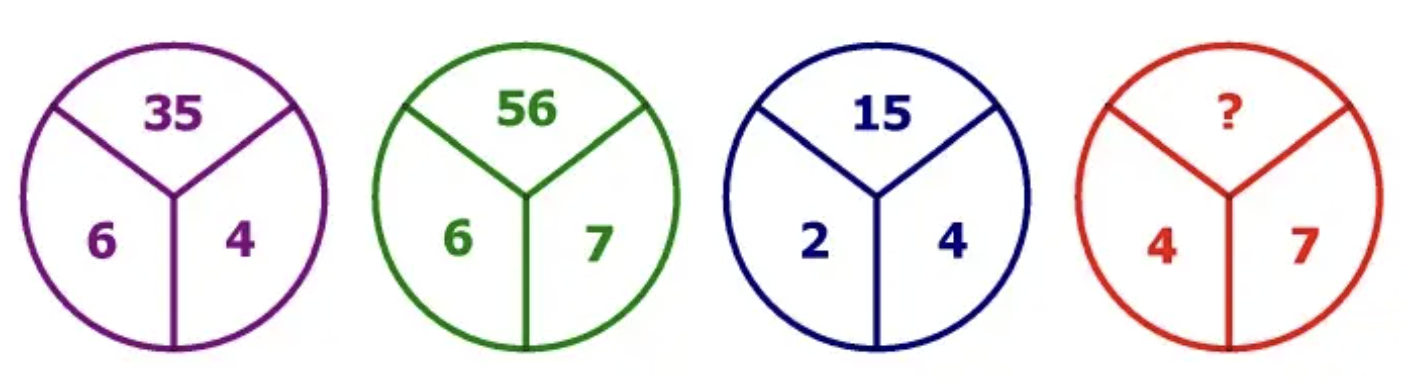
Answer: C
The top number is (bottom-left + 1) × (bottom-right + 1): (6+1)×(4+1)=35, (6+1)×(7+1)=56, (2+1)×(4+1)=15. So the missing number is (4+1)×(7+1) = 5 × 8 = 40.
14
number-sense
medium
The year 2022 is an interesting year because it contains only digits 2 and 0. How many years later will be the next interesting year?
Answer: D
2022 is the largest such 4-digit number with hundreds digit 0, so the next interesting year has hundreds digit 2: the candidates are 2200, 2202, 2220, 2222. The smallest is 2200, and 2200 − 2022 = 178 years later.
15
combinatorics
hard
Four boys each prepared 1 gift for a party. How many ways can these 4 gifts be distributed among the 4 kids so that no one receives his own gift?
Answer: C
Let the boys be A, B, C, D and gifts 1, 2, 3, 4. Listing all arrangements where no one gets their own gift (derangements of 4 items) gives 9 possibilities.
Section B
Integers — 10 Questions
(+4)
16
data-graph
medium
The picture graph below shows the number of pencils that Amelia, Stacy, Sophia and Olivia have. Altogether, they have 85 pencils. How many more pencils does Sophia have than Stacy?
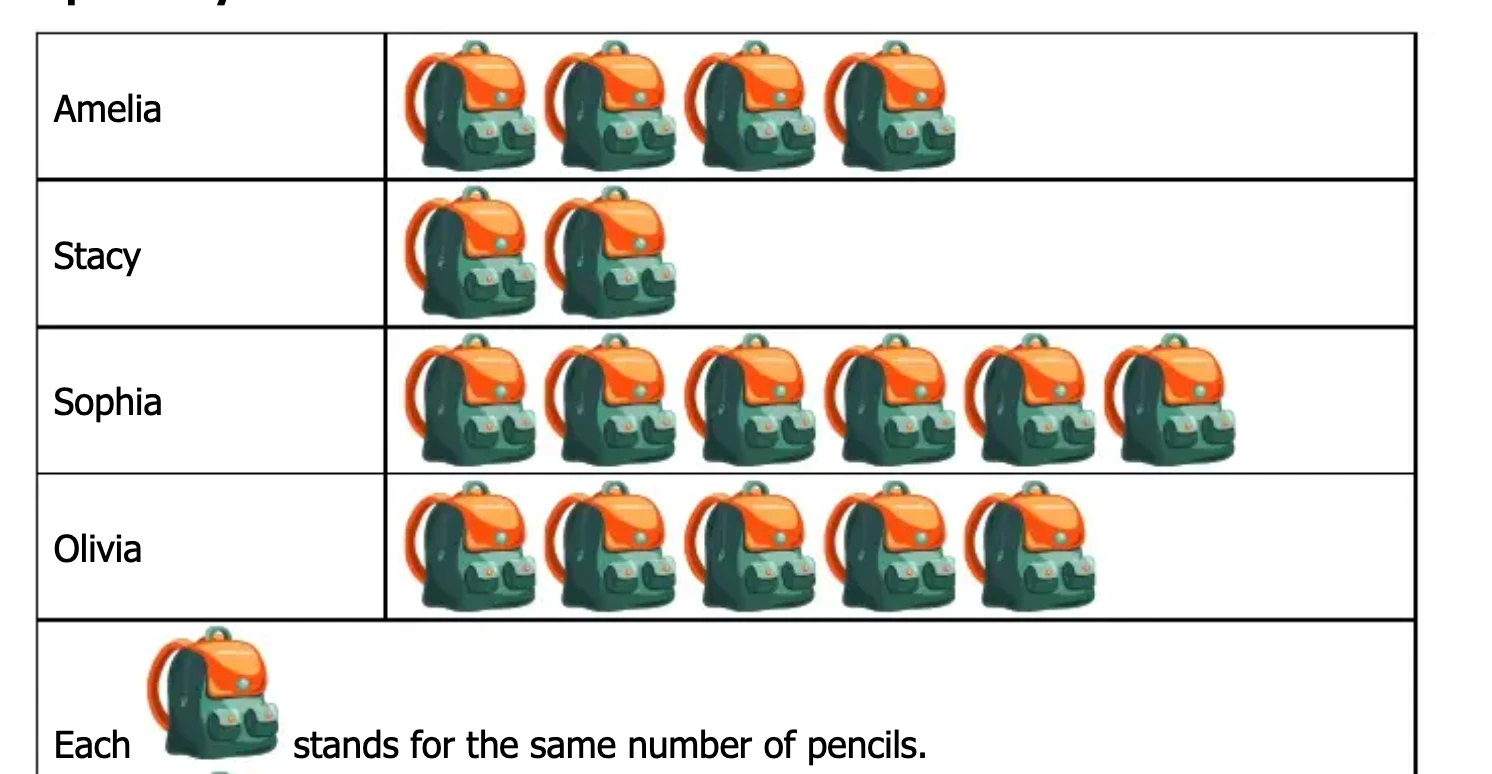
Answer: 20
Count the symbols: Amelia 4, Stacy 2, Sophia 6, Olivia 5 — a total of 17 symbols for 85 pencils, so each symbol = 5 pencils. Sophia has 6 × 5 = 30 and Stacy has 2 × 5 = 10, a difference of 20 pencils.
17
counting-figures
medium
How many triangles are there in the figure below?
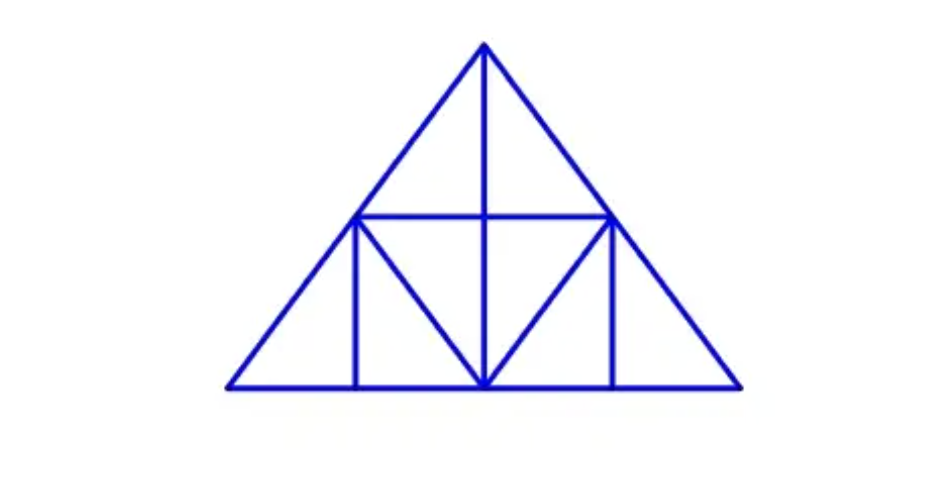
Answer: 17
Count in two groups. Smallest triangles: 2 at the top, 2 at the far left and right, and 4 in the middle block = 8. Larger triangles built by combining pieces: the top half, the central downward-pointing triangle, a 2-piece triangle on the left and one on the right, two triangles running from the top vertex down to the base centre, the left half and the right half of the whole figure, and the whole big triangle = 9. Total 8 + 9 = 17.
18
number-theory
easy
How many even multiples of 5 are there between 1 and 201?
Answer: 20
Even multiples of 5 are multiples of 10: 10, 20, 30, …, 200. There are 20 of them.
19
patterns
medium
What is the next number in the pattern below?
1, 5, 13, 25, 41, …
Answer: 61
The differences are 4, 8, 12, 16, … increasing by 4 each time. The next difference is 20, so the next number is 41 + 20 = 61.
20
arithmetic-optimization
hard
From the numbers 1 to 9, select 6 different numbers and place them in the squares. What is the largest result you can get?
(□ + □) × (□ − □) × (□ ÷ □) =
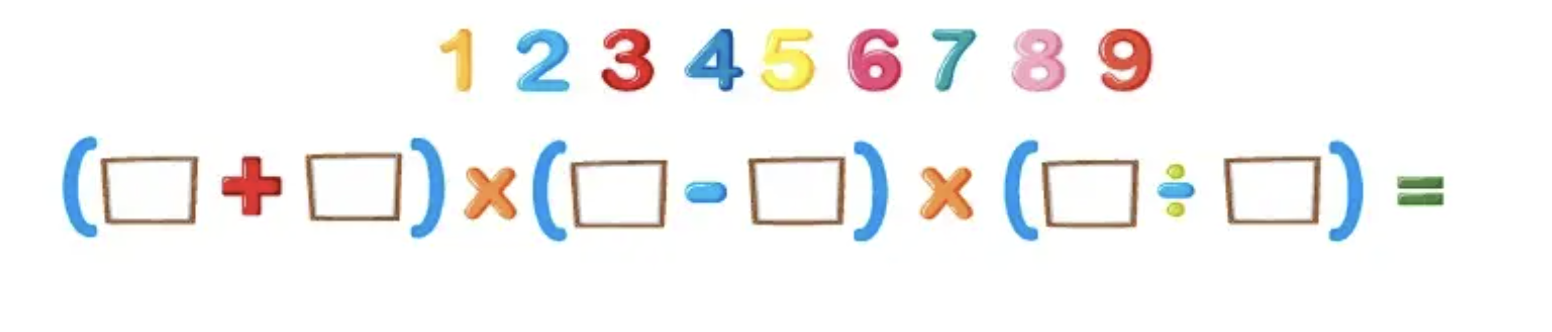
Answer: 728
The key idea: a big digit is worth more in the division (as a large multiplier) than inside the sum. Best placement is (7 + 6) × (9 − 2) × (8 ÷ 1) = 13 × 7 × 8 = 728. If instead you used 7 + 8 = 15, the 8 is 'spent', so the division can be at most 9 ÷ 1 = 9 and the middle bracket falls to 6 − 2 = 4, giving only 15 × 4 × 9 = 540. So the maximum is 728.
21
algebra-logic
hard
It is given that:
chicken × chicken + duck = 100
chicken + duck + sheep = 33
sheep + chicken = 14
What does sheep stand for?
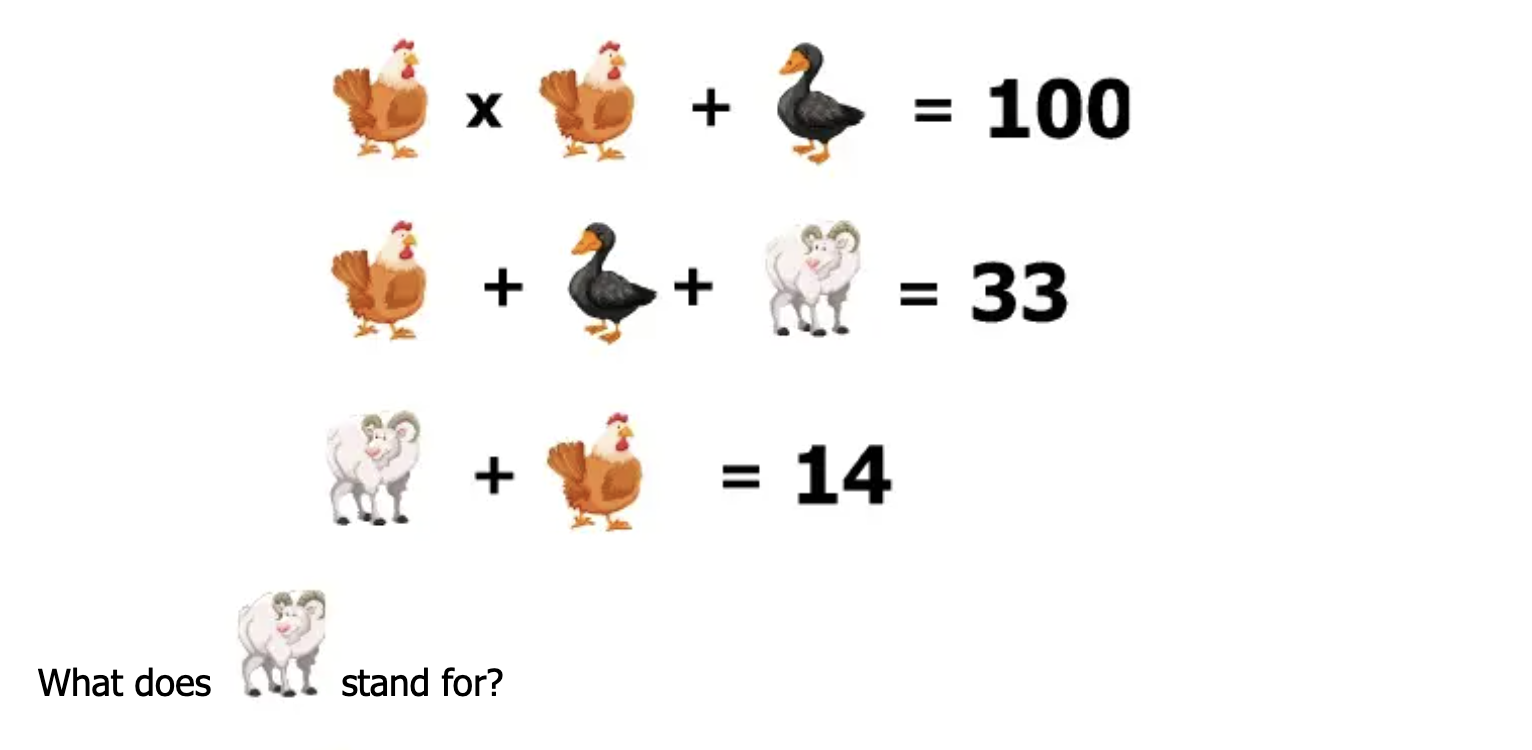
Answer: 5
Let chicken = c, duck = d, sheep = s. From sheep + chicken = 14 we get s = 14 − c. Put this into chicken + duck + sheep = 33: c + d + (14 − c) = 33, so d = 19. Then chicken × chicken + duck = 100 gives c² + 19 = 100, so c² = 81 and c = 9. Therefore s = 14 − 9 = 5. The sheep stands for 5.
22
word-problem
medium
A toy cost twice as much as 1 notebook. Betty bought 3 such toys and 3 such notebooks for $72. What was the cost (in $) of 1 toy?
Answer: 16
Let a notebook cost n. A toy costs 2n. Then 3(2n) + 3n = 9n = 72, so n = 8 and a toy costs 2 × 8 = 16.
23
logic
hard
Fifty students numbered from 1 to 50 were asked to line up in a straight line. The first student in the line was asked to leave, the second student remained. The third student was asked to leave, the fourth student remained and so forth. This process was then repeated until there was only one student left in the line. What was the number of the only student left in the line?
Answer: 32
After the first pass every student in an odd position has left, so only 2, 4, 6, …, 50 remain. Each repeat again removes the first survivor and keeps every second one, so the survivors are the multiples of 2, then of 4, then 8, then 16, then 32. The last student standing is the largest power of 2 that is ≤ 50, which is 32.
24
combinatorics
medium
How many whole numbers smaller than 300 can be formed with the digits 2, 5, 1 or 3 if each of the digits can only be used at most once in any number?
Answer: 28
Use digits from {1, 2, 3, 5}, none repeated within a number. 1-digit: 1, 2, 3, 5 → 4 numbers. 2-digit: 4 choices for the first digit × 3 for the second = 12 numbers. 3-digit under 300: the hundreds digit must be 1 or 2 (2 choices), then 3 × 2 = 6 ways for the last two digits → 12 numbers. Total = 4 + 12 + 12 = 28.
25
cryptarithm
hard
In the following, all the different letters stand for different digits. What is the value of the 4-digit number CDEC?
C D E C
− B A B
---------
A C A
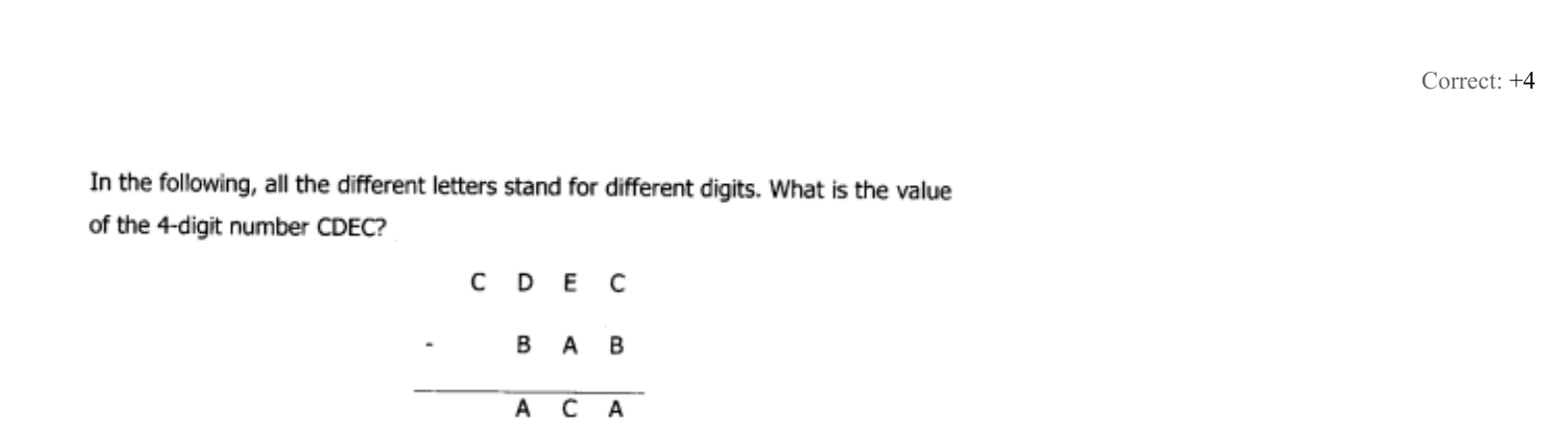
Answer: 1201
Solve CDEC − BAB = ACA with every letter a different digit. The solution is CDEC = 1201 (so C = 1, D = 2, E = 0), with A = 8 and B = 3: 1201 − 383 = 818, and 818 is exactly ACA (8-1-8). So CDEC = 1201.