Section A
MCQs — 15 Questions
(+2 / -1)
1
arithmetic
easy
What is the value of the following sum?
13 × 2023 + 0 × 2023 + 7 × 2023
Answer: B
13 × 2023 + 0 × 2023 + 7 × 2023 = (13 + 0 + 7) × 2023
= 20 × 2023
= 40460
2
spatial-reasoning
medium
Find the correct shadow of the animal shown below.
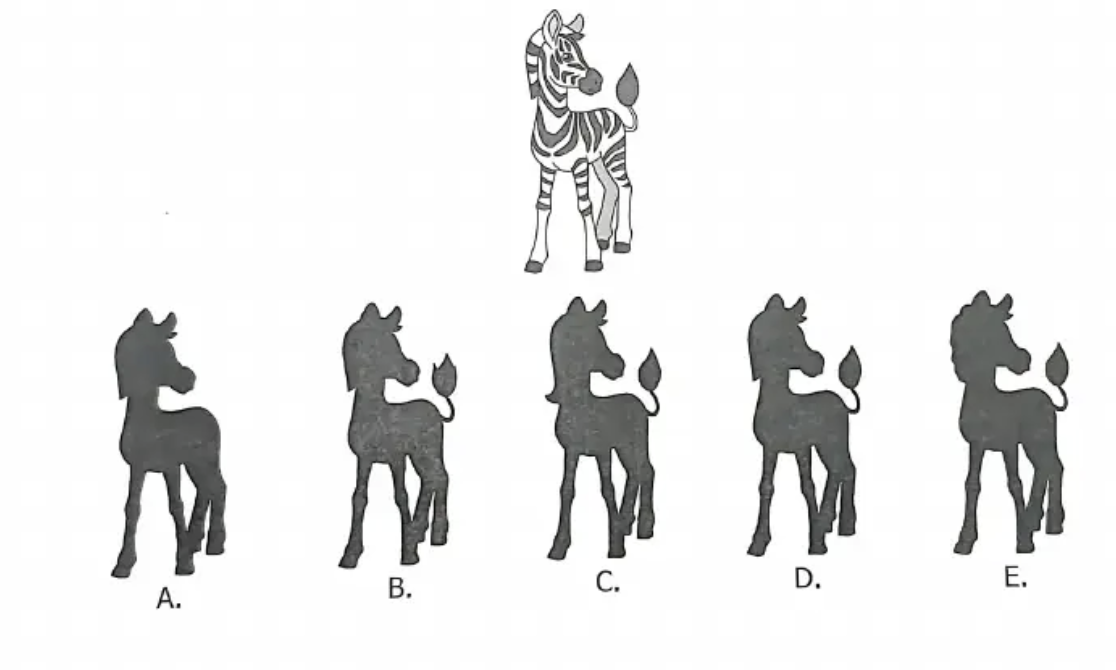
Options A–E are shown left-to-right in the image above.
Answer: D
Compare the outline of the zebra (tail shape and attachment point, ear/mane shape, leg stance) against each silhouette.
Only option D matches the original exactly.
3
number-patterns
easy
What is the missing number in the sequence below?
13, 15, 18, 22, ?, 33
Answer: C
Look at the differences between consecutive terms: 15−13=2, 18−15=3, 22−18=4.
The differences increase by 1 each time, so the next difference is 5.
22 + 5 = 27
Check: 33 − 27 = 6, which continues the pattern (2,3,4,5,6).
4
spatial-reasoning
medium
Which option below is exactly the same as the picture below?
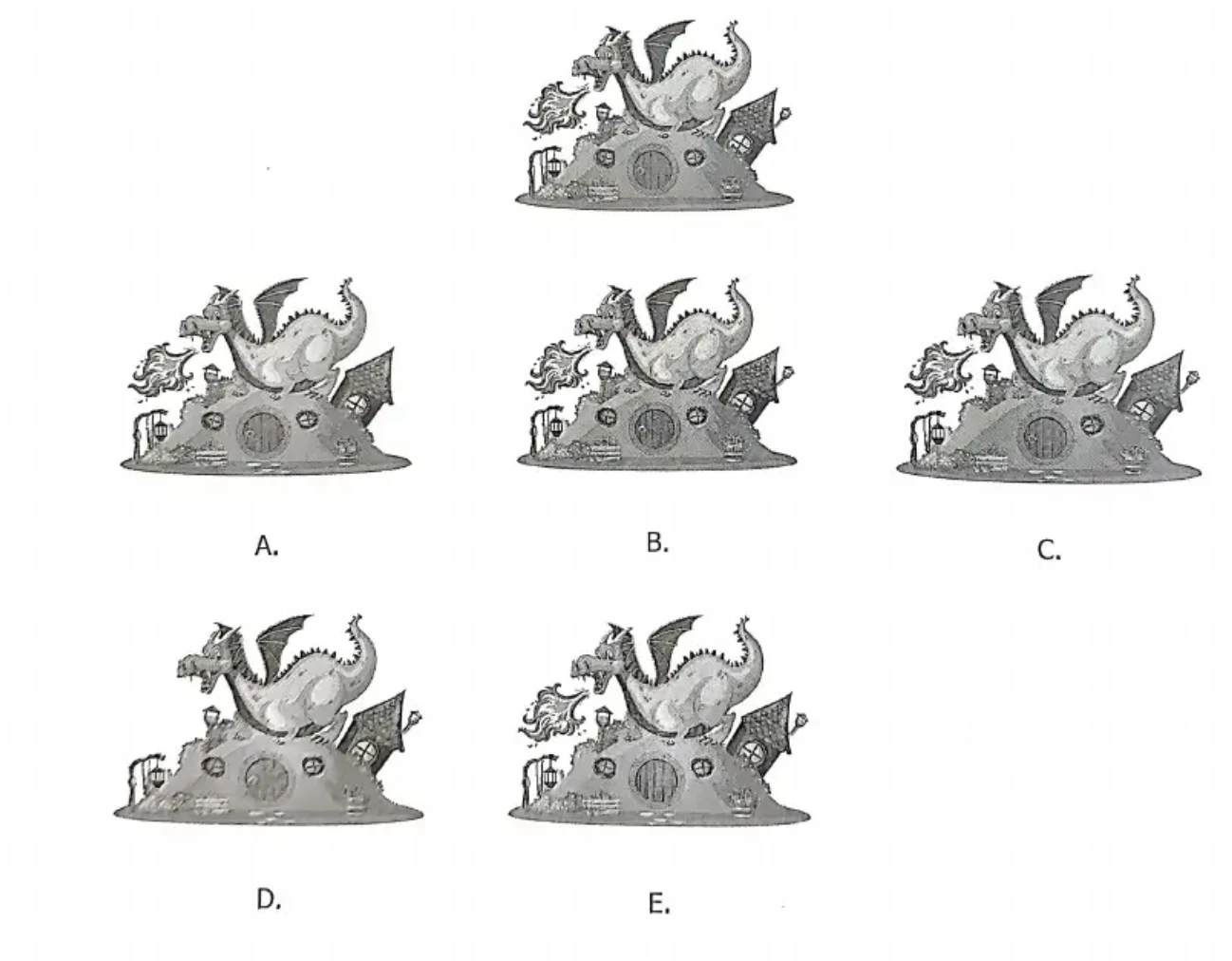
Options A–E are shown below the original picture.
Answer: B
Compare each option against the original picture feature by feature — the round door's pattern, the round window shapes, the flag, and the roof.
Options A, C, D and E each change one small detail (e.g. the door or window pattern).
Only option B matches the original exactly.
5
arithmetic
medium
Tom has a ribbon which is shorter than 80 cm and longer than 70 cm. He can cut it into 9 equal pieces. The length of each of these 9 pieces is a whole number of cm. How long is Tom's ribbon when he cuts it 32 cm shorter?
Answer: C
The ribbon's length must be a multiple of 9, and strictly between 70 and 80.
The only multiple of 9 in that range is 72 (9 × 8 = 72).
Cut 32 cm shorter: 72 − 32 = 40 cm.
6
spatial-reasoning
medium
The diagram shows some cubes of the same size stacked at a corner of a room. How many cubes are there altogether?
(Note: The floor is horizontal and the two walls are vertical. There are no gaps or holes behind the visible cubes.)
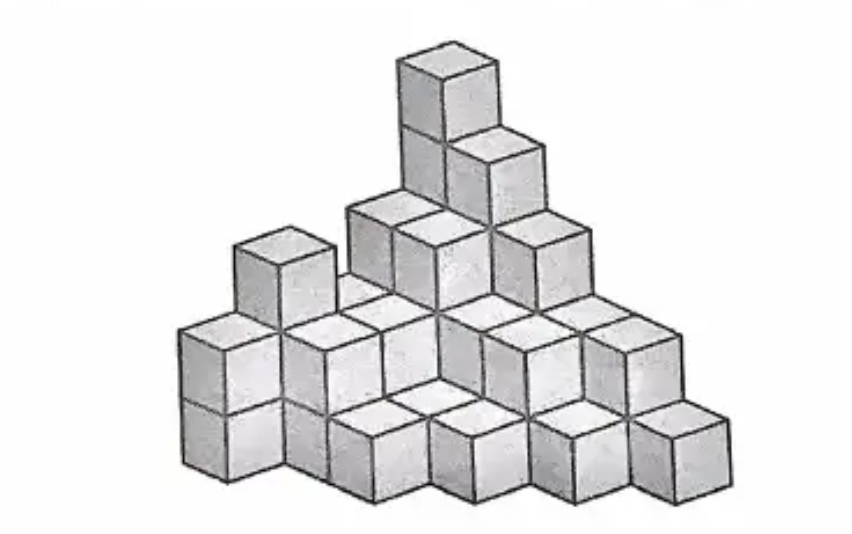
Answer: A
Count the cubes column by column, including the hidden cubes stacked behind each visible face (the note confirms there are no gaps behind visible cubes).
Summing every column's height across the whole staircase-shaped stack gives 42 cubes.
7
combinatorics
hard
Lisa walked home and picked up all the apples that she saw along the road. She chose one of the paths to walk home. Which of the following numbers could not be the total number of apples that she picked up?
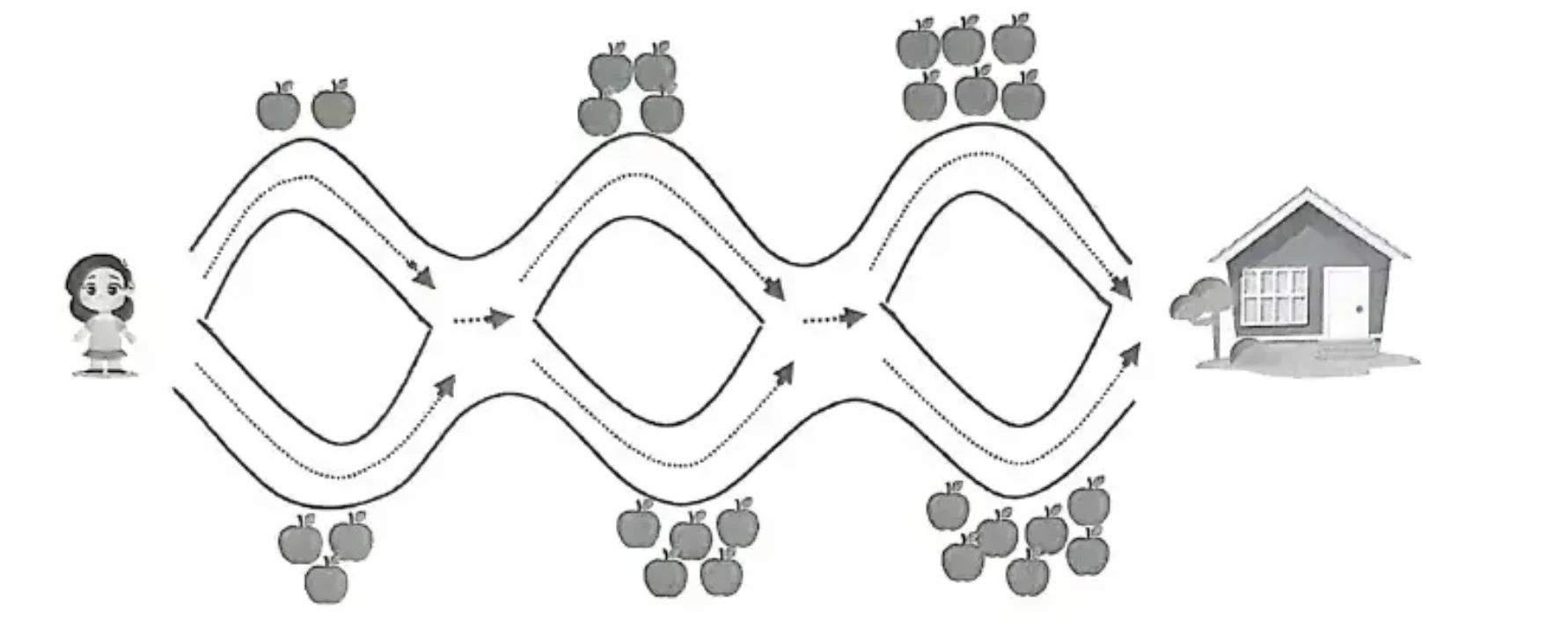
Answer: D
At each of the 3 loops, Lisa takes either the upper path (collecting the apples above) or the lower path (collecting the apples below), and the loops are independent choices.
Apple counts: loop 1 = 2 (upper) or 3 (lower); loop 2 = 4 (upper) or 5 (lower); loop 3 = 6 (upper) or 7 (lower).
Checking all 8 combinations gives possible totals of 12, 13, 14 or 15 — the maximum possible is 3 + 5 + 7 = 15.
16 is too high to reach, so it could not be the total.
8
arithmetic
easy
How many multiples of 9 are between 30 and 200?
Answer: B
The smallest multiple of 9 above 30 is 36 (9 × 4).
The largest multiple of 9 below 200 is 198 (9 × 22).
Count from the 4th to the 22nd multiple of 9: 22 − 4 + 1 = 19.
9
spatial-reasoning
medium
Which option is the top view of the objects in the picture below?
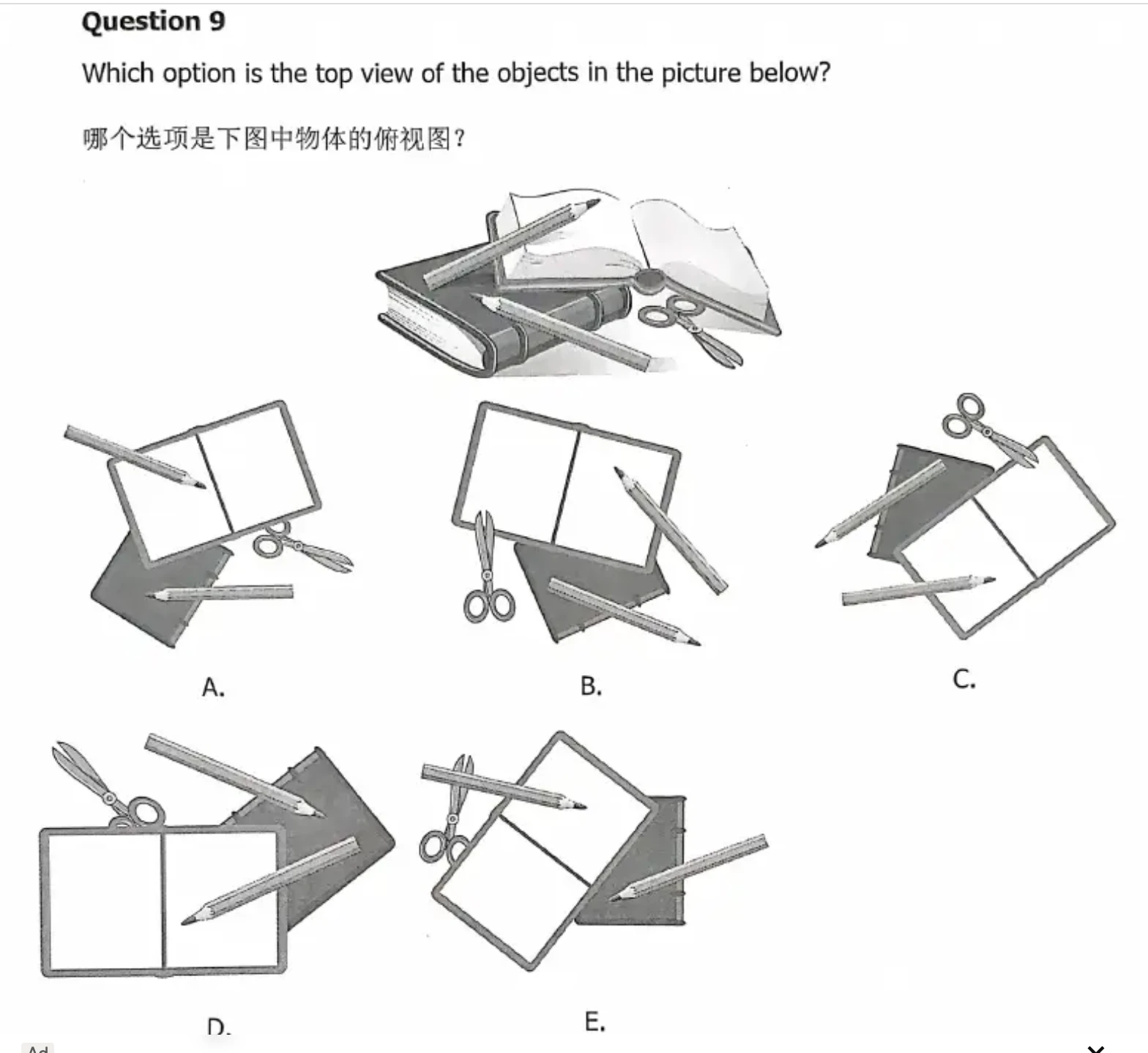
Options A–E are shown below the original picture.
Answer: D
Looking straight down at the book, scissors and pencils, match the outline and relative positions of each object to the options.
Only option D correctly shows the top view.
10
arithmetic
easy
The four-digit even number 245A is divisible by 3. Find the value of the digit A.
Answer: C
For 245A to be divisible by 3, the digit sum 2+4+5+A = 11+A must be a multiple of 3, so A must be 1, 4, or 7.
For 245A to be even, A must also be even.
Only A = 4 satisfies both conditions.
11
number-patterns
medium
Picture 1 can seat 8 people. Picture 2 can seat 14 people. Picture 3 can seat 20 people. Which picture can seat 50 people?
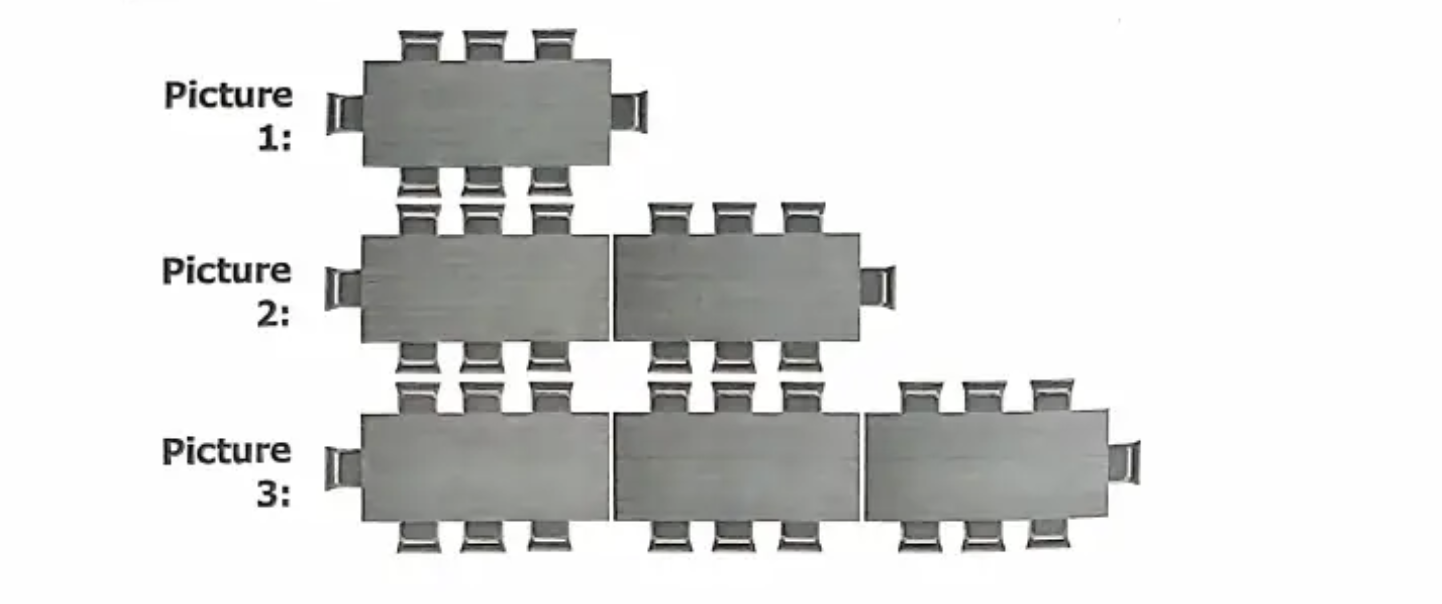
Answer: D
Each extra table in the row adds 6 more seats: 8, 14, 20, 26, ...
So the number of seats for picture n is 6n + 2.
Set 6n + 2 = 50 → 6n = 48 → n = 8.
Picture 8 seats 50 people.
12
logic
medium
In the flower below, Amelia plucked off two petals with the largest and the smallest numbers. Then she plucked off one petal with an even number and one petal with a multiple of 9. What is the sum of the numbers on the remaining two petals?
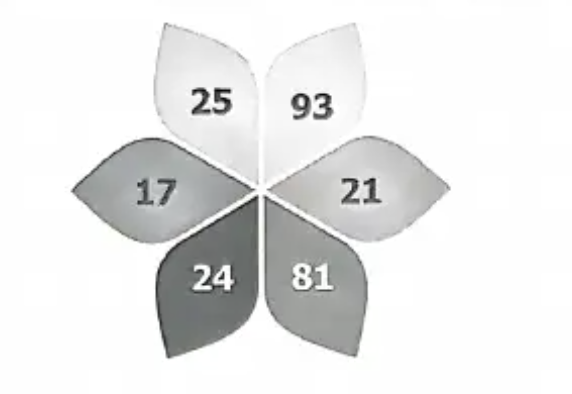
Answer: A
Petals: 25, 93, 17, 21, 24, 81.
Remove the largest (93) and smallest (17).
Remaining: 25, 21, 24, 81.
Remove the even one (24) and the multiple of 9 (81, since 81 = 9 × 9).
Remaining two petals: 25 and 21.
25 + 21 = 46.
13
logic
medium
In the morning, Tom ate one cupcake while Jerry had none. During lunch, they ate 3 cupcakes in total and they did not share any cupcakes. Which of the following sentences cannot be true?
Answer: C
Let Tom and Jerry eat t and (3−t) cupcakes respectively at lunch, where t = 0, 1, 2 or 3.
Totals: Tom = 1+t, Jerry = 3−t.
Difference (Tom − Jerry) = 1+t−(3−t) = 2t−2, which is always even: −2, 0, 2 or 4.
A difference of 1 (option C) is odd, so it can never happen.
14
logic
medium
Timothy put his 5 school textbooks on a single shelf. There are only these 5 textbooks on the shelf and his textbooks are English, Maths, Science, Social Studies and Art. He put Maths and Science next to each other whereas English and Art textbooks are separated by at least one textbook. Which textbook cannot be in the middle of the shelf?
Answer: D
Maths and Science must sit together as a block; English and Art must have at least one book between them.
Trying every position for the Maths–Science block, Social Studies only ever ends up in the 2nd or 4th spot — never the middle (3rd) spot — while every other book can reach the middle in some valid arrangement.
So Social Studies cannot be in the middle.
15
arithmetic
easy
On Monday, Derrick bought 99 stickers. On Tuesday, he bought 96 stickers. Every following day, he bought 3 stickers less than the previous day. On which day of the week did Derrick buy 12 stickers?
Answer: A
Stickers bought on day n (Monday = day 1) = 99 − 3(n−1).
Set 99 − 3(n−1) = 12 → 3(n−1) = 87 → n−1 = 29 → n = 30.
Day 30 is (30−1) mod 7 = 1 day after Monday, i.e. Tuesday.
Section B
Open-ended numeric answers — 10 Questions
(+4)
16
spatial-reasoning
hard
How many squares are there in the SASMO figure below?

Answer: 81
Count squares of every size (1×1, 2×2, 3×3, …) using the grid lines actually drawn in each letter.
First S: 14 unit squares only.
A: 14 unit squares + 2 (2×2) + 2 (3×3) = 18.
Second S: 14 unit squares only.
M: 13 unit squares only (the zigzag shape has no larger squares).
O: 16 unit squares (the frame) + 1 (3×3, the inner boundary) + 4 (4×4) + 1 (5×5, the outer outline) = 22.
Total = 14+18+14+13+22 = 81.
17
arithmetic
medium
Benjamin formed the smallest 3-digit even number with the number cards shown below (6, 8, 2, 9). George formed the largest 3-digit odd number with the number cards. None of them used any digit more than once. What is the difference between George's and Benjamin's numbers?
Answer: 601
Smallest 3-digit even number from {2,6,8,9}: use the 3 smallest digits {2,6,8} (bringing in 9 would only make the number bigger). The hundreds digit must be the smallest (2); to keep the number even, put 8 in the units place and 6 in the tens place → 268.
Largest 3-digit odd number: the only odd digit available is 9, so it must be the units digit. Use the 2 largest remaining digits (8 and 6) for the hundreds and tens places → 869.
Difference: 869 − 268 = 601.
18
logic
hard
Study the picture below. What number should be placed instead of the question mark?
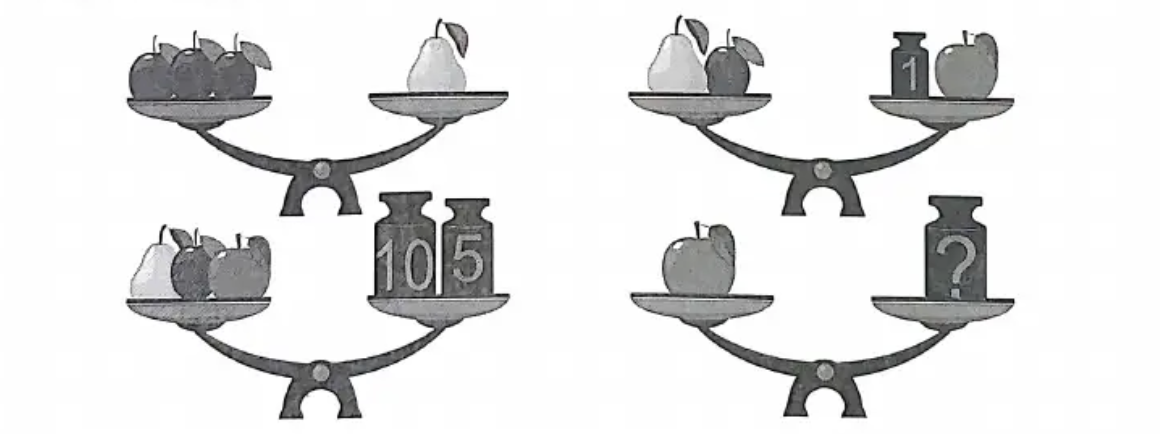
Answer: 7
Let P = pear, D = dark apple, G = grey apple (the one on the last scale).
Balance 1: 3D = P.
Balance 2: P + D = 1 + G → substituting P = 3D gives 4D = 1 + G.
Balance 3: P + D + G = 15 → substituting P = 3D gives 4D + G = 15.
From 4D = 1+G, G = 4D−1; substituting into 4D+G=15 gives 4D+(4D−1)=15 → 8D=16 → D=2.
Then G = 4(2)−1 = 7 (and P = 3×2 = 6, checking P+D+G = 6+2+7 = 15 ✓).
So the grey apple weighs 7.
19
combinatorics
hard
Towns A, B, C, D and E are connected by roads as shown below. Each town can be visited at most once. In how many different ways can you go from Town A to Town E?
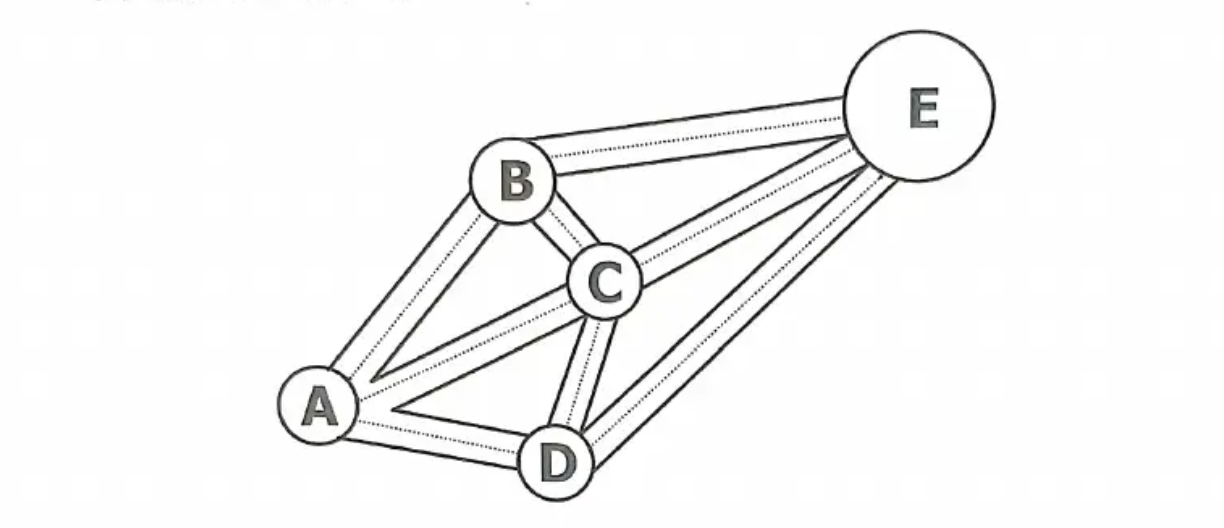
Answer: 76
The roads shown are A–B, A–C, A–D, B–C, B–E, C–D, C–E and D–E — and every road is drawn twice (a solid line plus a dotted line), meaning each connection is actually 2 separate routes.
Listing every simple route (no town repeated) from A to E, grouped by how many towns are visited in between:
via 1 town: A-B-E, A-C-E, A-D-E → 3 routes, each using 2 roads → 3 × 2² = 12 ways.
via 2 towns: A-B-C-E, A-C-B-E, A-C-D-E, A-D-C-E → 4 routes, each using 3 roads → 4 × 2³ = 32 ways.
via 3 towns: A-B-C-D-E, A-D-C-B-E → 2 routes, each using 4 roads → 2 × 2⁴ = 32 ways.
Total = 12 + 32 + 32 = 76.
20
logic
medium
In the square below, each row and column contain each of the digits 1, 2, 3, 4 and 5. What is the value of the star?
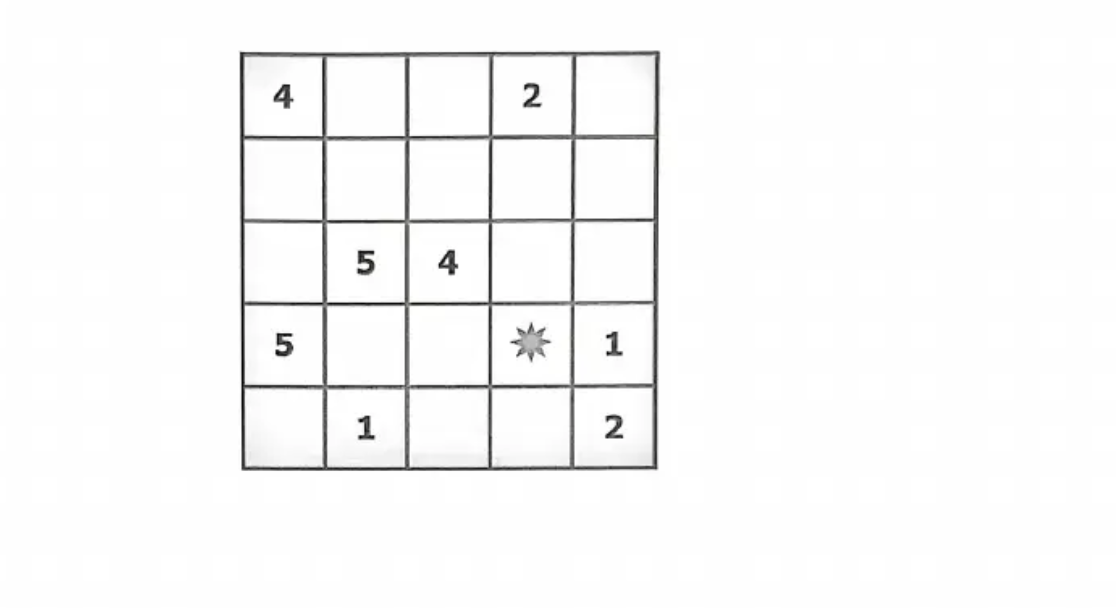
Answer: 3
Row 5 already has 1 and 2, so its remaining 3 cells must be {3,4,5}.
Column 1 already has 4 and 5, so its remaining 3 cells must be {1,2,3} — combined with the row 5 fact, row5-col1 can only be 3 (the only value common to both).
So row 5's remaining two cells (col3, col4) are left with {4,5}.
Column 3 already has 4, so row5-col3 can't be 4 — it must be 5, which makes row5-col4 = 4.
Column 4 already has 2 (row1) and now 4 (row5), so row2, row3 and row4 (the star) must be {1,3,5}.
Row 4 already has 5 and 1, so its remaining cells (col2, col3, star) must be {2,3,4} — the only value common to both {1,3,5} and {2,3,4} is 3.
So the star = 3.
21
logic
easy
Amir, Balaji and Chris ate 13, 16 and 24 cookies, not necessarily in the given order. Balaji ate an even number of cookies. Amir ate more cookies than Balaji. How many cookies did Chris eat?
Answer: 13
Balaji ate an even number, so Balaji ate 16 or 24.
If Balaji ate 24, Amir would need to eat more than 24 — impossible, since 24 is the largest value.
So Balaji ate 16, and Amir (who ate more) must have eaten 24.
Chris ate the remaining amount: 13.
22
geometry
hard
If the area of the square below is 256 cm², what is the area (in cm²) of the shaded rectangle?
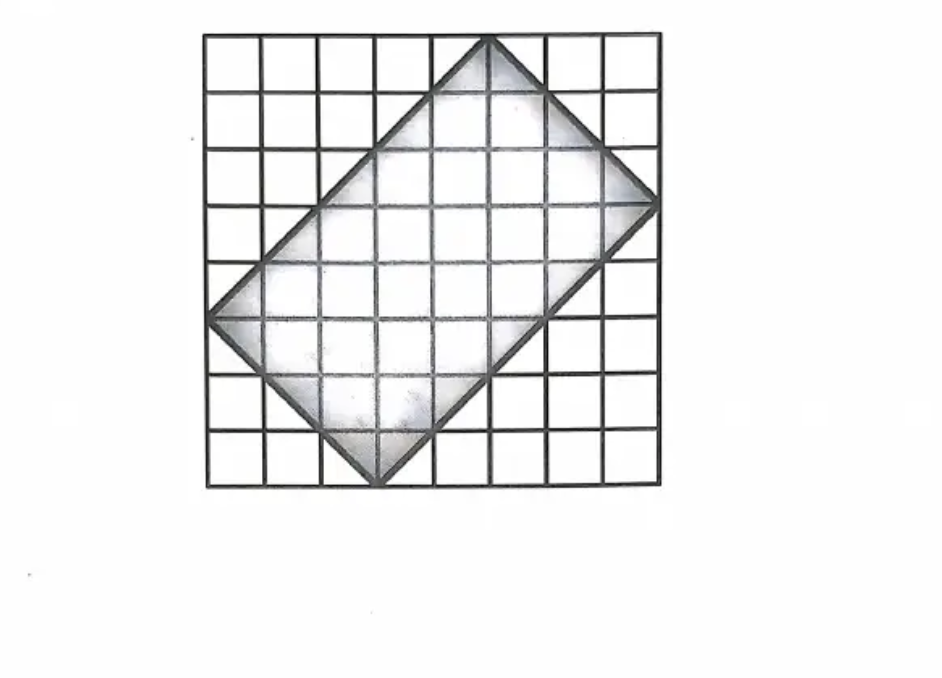
Answer: 120
The square's area is 256 cm², so its side is 16 cm; the grid shown is 8×8, so each small grid square is 2 cm × 2 cm.
Reading the rectangle's 4 corners on the grid: it touches the top edge 5 units from the left, the right edge 3 units down, the bottom edge 3 units from the left, and the left edge 5 units down.
Its two sides are the grid-vectors (3,3) and (5,−5), i.e. lengths 3√2 and 5√2 grid units — and since (3,3)·(5,−5) = 0, the corner is a right angle, confirming it is a rectangle.
Area = 3√2 × 5√2 = 30 grid-squares = 30 × (2 cm × 2 cm) = 120 cm².
23
arithmetic
easy
What is the sum of all the numbers in the sequence below?
11, 13, 15, ..., 57, 59
Answer: 875
This is an arithmetic sequence of odd numbers from 11 to 59, with common difference 2.
Number of terms = (59−11)/2 + 1 = 25.
Sum = (first + last)/2 × number of terms = (11+59)/2 × 25 = 35 × 25 = 875.
24
combinatorics
medium
How many whole numbers from 100 to 300 consist of only odd digits?
Answer: 25
For a number in [100,300] to have only odd digits, its hundreds digit must itself be odd — the only odd hundreds digit possible in this range is 1 (2 is even, and 300 has even digits anyway).
So the number looks like 1__, where the tens and units digits can each independently be any of the 5 odd digits {1,3,5,7,9}.
Total = 5 × 5 = 25.
25
logic
hard
In the following, all the different letters stand for different digits. If O = 4, then what is the value of the 3-digit number OSM?
S A S
+ M O
---------
O S M
Answer: 437
Writing SAS + MO = OSM in place value: (101S + 10A) + (10M + O) = 100O + 10S + M.
Rearranging gives 91S + 10A + 9M = 99O. With O = 4, this is 91S + 10A + 9M = 396.
Since 10A + 9M can be at most 90+81 = 171, S can only be 1, 2 or 3 — testing shows only S=3 works: 10A + 9M = 396 − 273 = 123, solved by M=7, A=6 (10×6 + 9×7 = 123).
Check: SAS = 363, MO = 74, and 363 + 74 = 437 = OSM. ✓
So OSM = 437.