Section A
Open-ended and multiple-choice — Questions 1 to 40
(+2)
1
number-sense
easy
2 tens more than ☐ is 5860.
What is the missing number in the box?
Answer: 5840
2 tens = 20.
The box + 20 = 5860.
Box = 5860 − 20 = 5840.
2
number-sense
easy
18 + 6 + 6 = ☐ × 6.
What is the missing number in the box?
Answer: 5
18 + 6 + 6 = 30.
So ☐ × 6 = 30.
☐ = 30 ÷ 6 = 5.
3
volume
medium
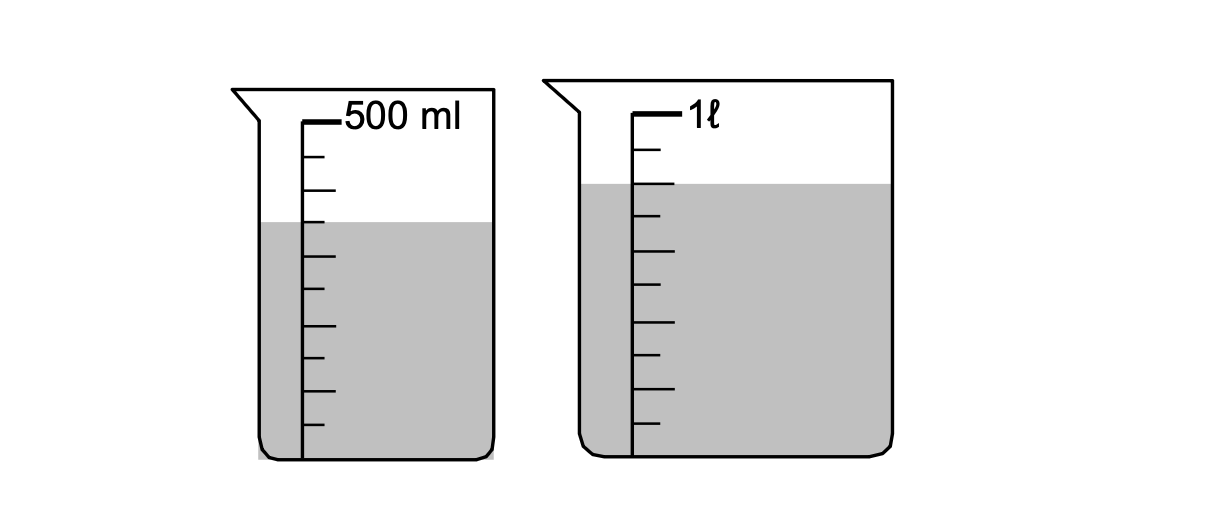
What is the total volume of water in the 2 beakers below?
Give your answer in ml.
Answer: 1250
Left beaker (500 ml scale, a mark every 50 ml): the water is at 350 ml.
Right beaker (1 ℓ scale, a mark every 50 ml): the water is at 900 ml.
Total = 350 + 900 = 1250 ml.
4
time
easy
Express 3 h 25 min in minutes.
Answer: 205
3 h = 3 × 60 = 180 min.
180 + 25 = 205 min.
5
bar-graph
medium
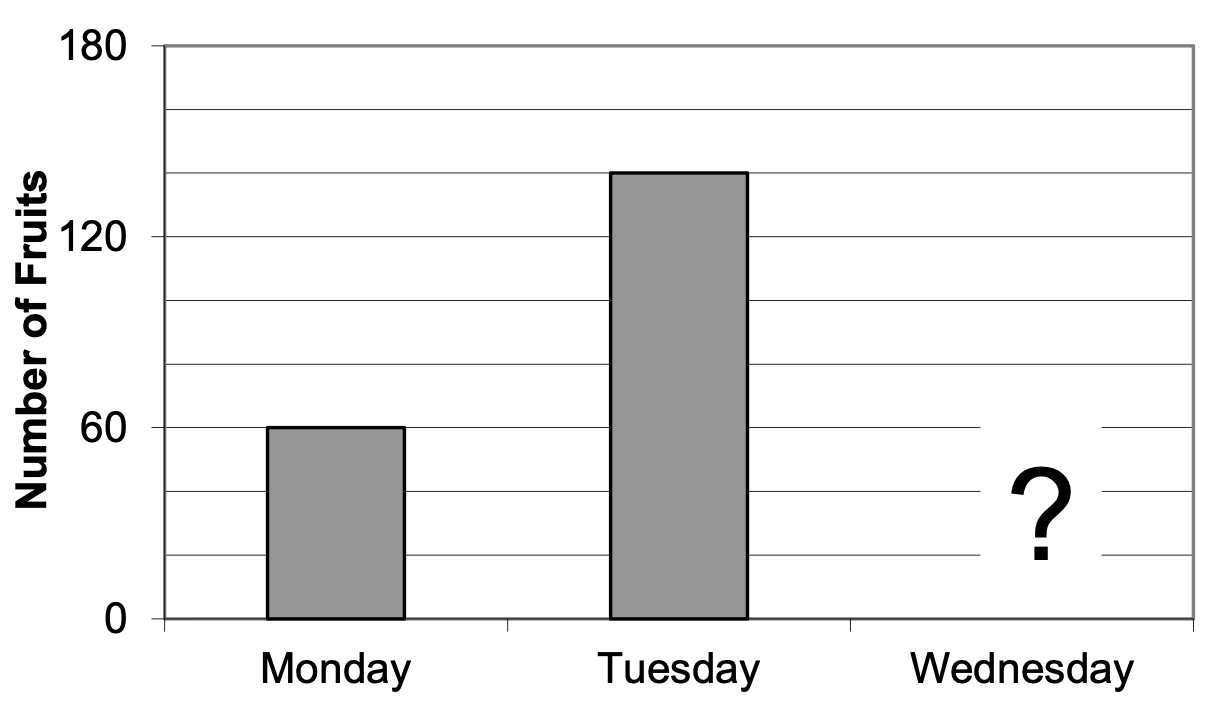
The graph below shows the number of fruits James sold.
How many fruits must he sell on Wednesday so that he sells a total of 280 fruits for the 3 days?
Answer: 80
Monday = 60 fruits.
Tuesday = 140 fruits.
Monday + Tuesday = 60 + 140 = 200.
Wednesday = 280 − 200 = 80.
6
fractions
easy
21/49 = 3/☐
What is the missing number in the box?
Answer: 7
21/49 = 3/7 (divide the top and bottom by 7).
So the box is 7.
7
mass
medium
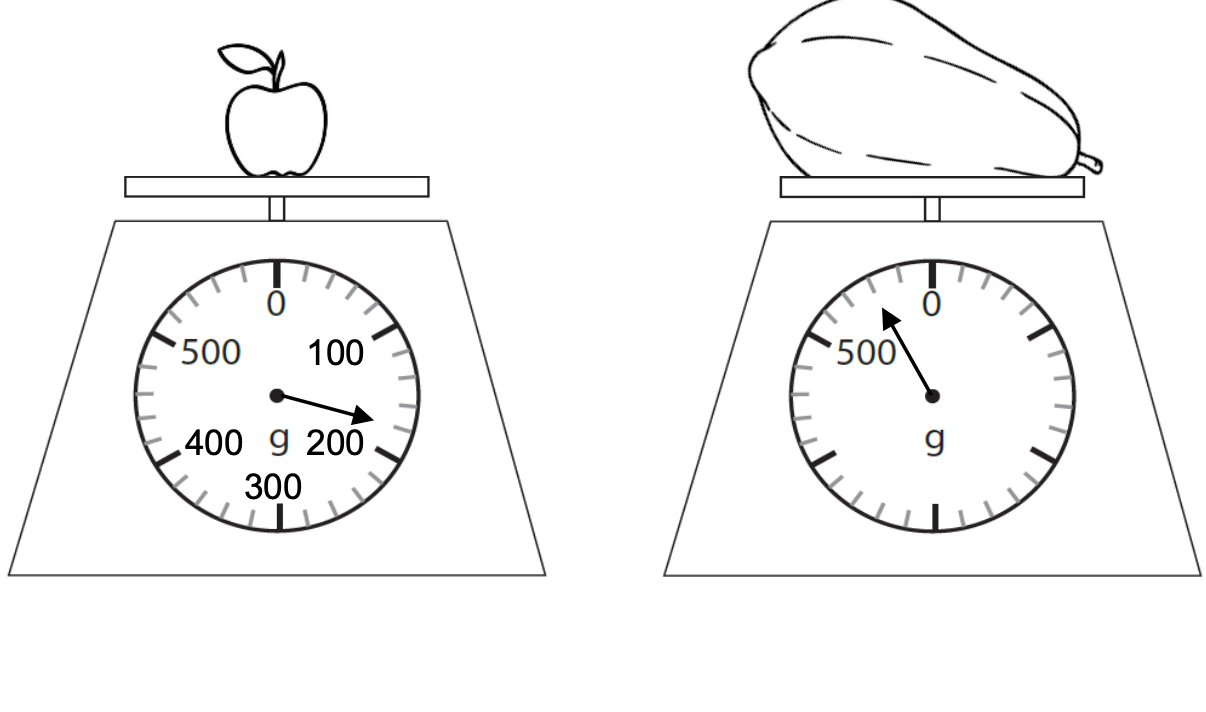
Study the diagram below.
How much heavier is the papaya than the apple?
Give your answer in grams.
Answer: 380
Each small mark on the scale is 20 g.
Apple = 180 g.
Papaya = 560 g.
Difference = 560 − 180 = 380 g.
8
fractions
easy
Which one of the following fractions is greater than 1/2?
Answer: 3
1/2 is the same as 3.5/7.
3/6 = 1/2 (equal, not greater).
3/7 < 1/2 and 4/9 < 1/2.
4/7 is more than 3.5/7, so 4/7 > 1/2.
9
fractions
medium
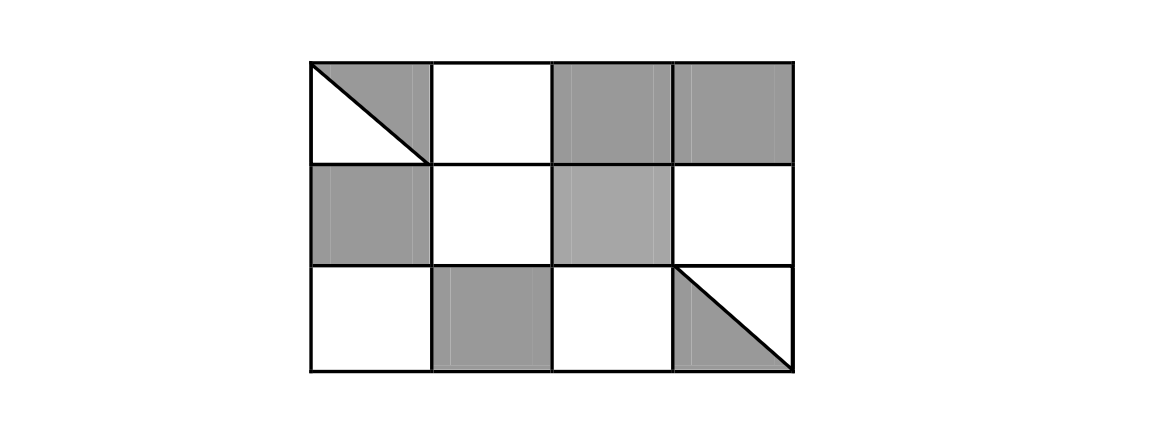
What fraction of the figure below is shaded?
Answer: 2
The figure is made of 12 equal squares.
Fully shaded squares = 5.
Two half-shaded (triangle) squares = 2 halves = 1 whole.
Shaded = 5 + 1 = 6 squares = 6/12.
10
time
medium
The clock below is 20 min fast.
Which of the following options shows the actual time?
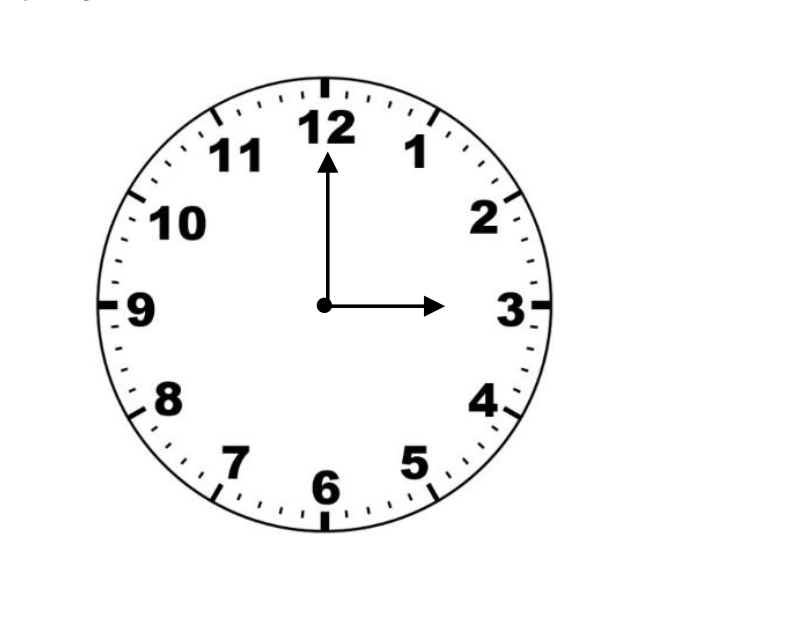
Answer: 1
The clock shows 3:00.
It is 20 min fast, so the real time is 20 min earlier.
3:00 − 20 min = 2:40.
2:40 is 20 minutes to 3.
11
geometry
medium
Look at the diagram below.
Which of the following options shows a pair of perpendicular lines?
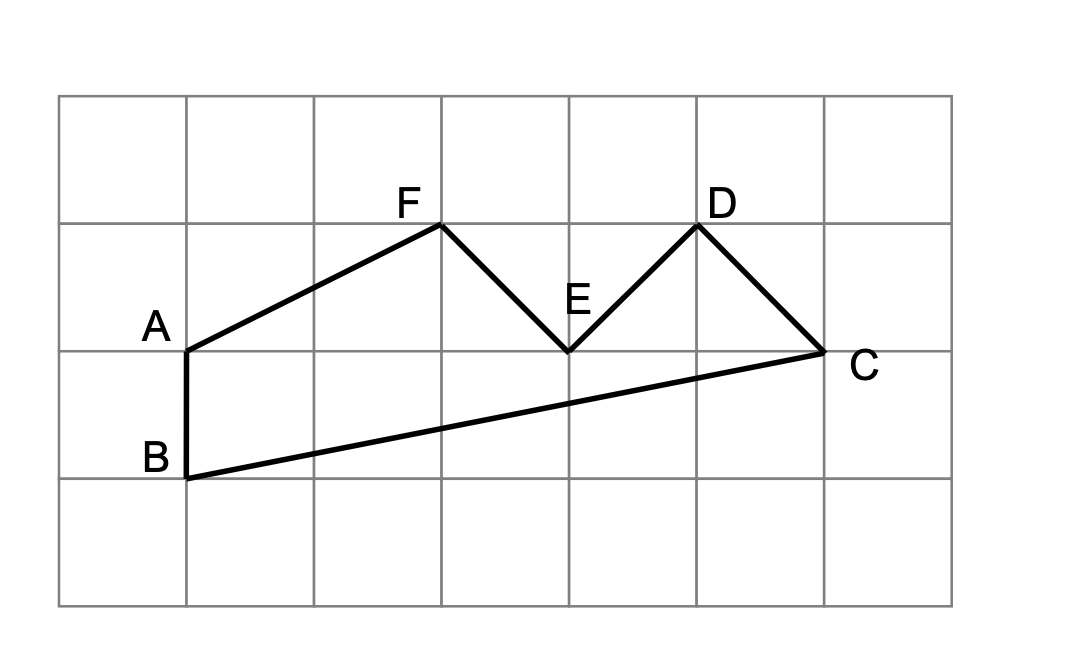
Answer: 2
On the grid, DE goes up 1 and right 1 (a downhill-to-uphill turn at D).
DC goes down 1 and right 1.
One line sloping ‘up 1, right 1’ and one sloping ‘down 1, right 1’ meet at a right angle.
So CD and DE are perpendicular.
12
geometry
medium
Study the neighbourhood map below.
Which of the following options is a correct statement?
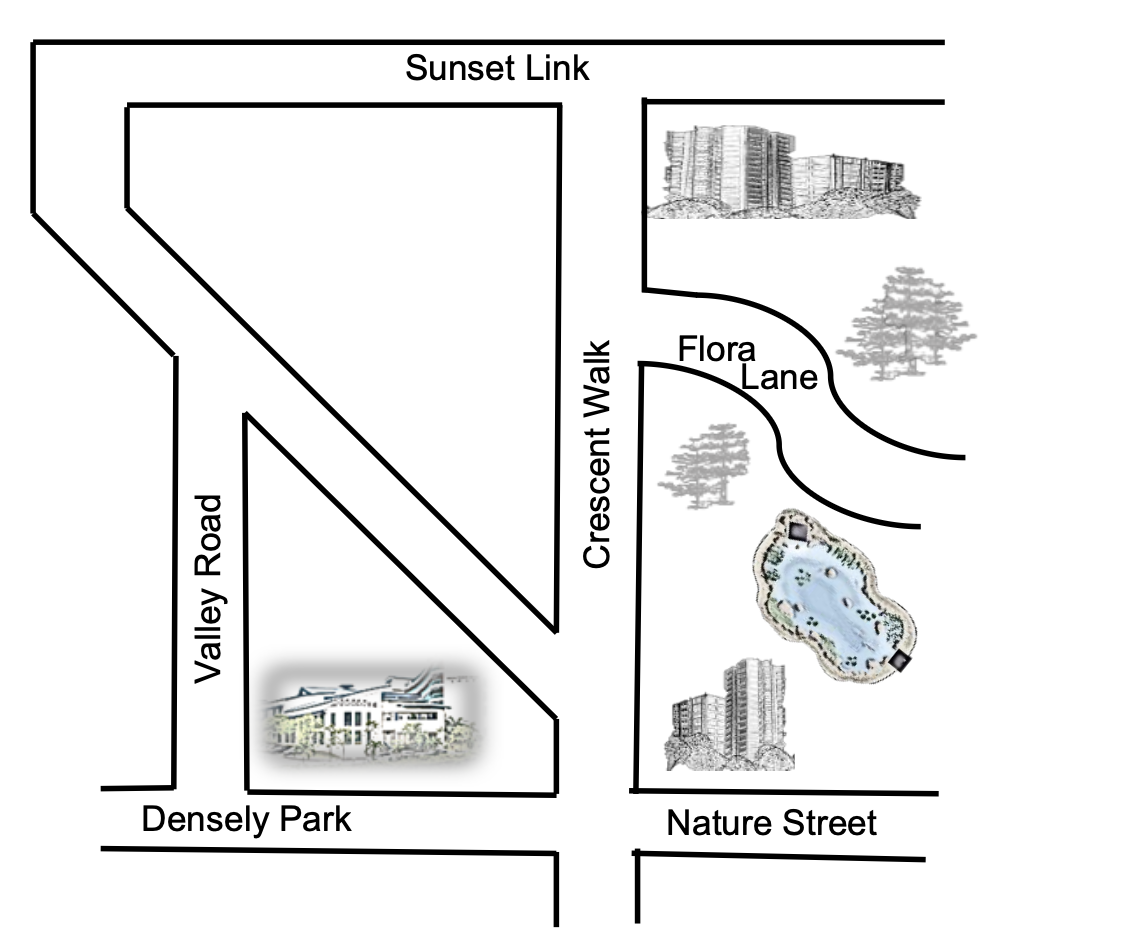
Answer: 2
Valley Road and Crescent Walk are both drawn as straight up-and-down (vertical) roads.
Roads that run the same way and never meet are parallel.
So Crescent Walk is parallel to Valley Road.
13
money
easy
Tina bought a bag.
She gave the cashier 2 fifty-dollar notes.
She received $2.75 change.
Which of the following options shows the cost of the bag?
Answer: 4
2 fifty-dollar notes = $100.
Cost = amount paid − change.
Cost = $100 − $2.75 = $97.25.
14
money
medium
Julie saves only five-cent and twenty-cent coins.
She wants to buy a present that costs $6.
She has only $4.85.
Which option shows the additional coins she needs?
Answer: 3
She still needs $6 − $4.85 = $1.15 = 115 cents.
7 five-cent coins = 35 cents.
4 twenty-cent coins = 80 cents.
35 + 80 = 115 cents = $1.15.
15
time
medium
Mr Mok is a taxi driver.
He drove 6 h on Sunday.
He drove 2 h 55 min less on Monday than on Sunday.
What is the total time he drove on Sunday and Monday?
Give your answer in minutes.
Answer: 545
Sunday = 6 h = 360 min.
Monday = 6 h − 2 h 55 min = 3 h 5 min = 185 min.
Total = 360 + 185 = 545 min.
16
area
easy
The figure below is made up of 5 identical squares of sides 3 cm.
What is the area of the figure?
Give your answer in square centimetres.
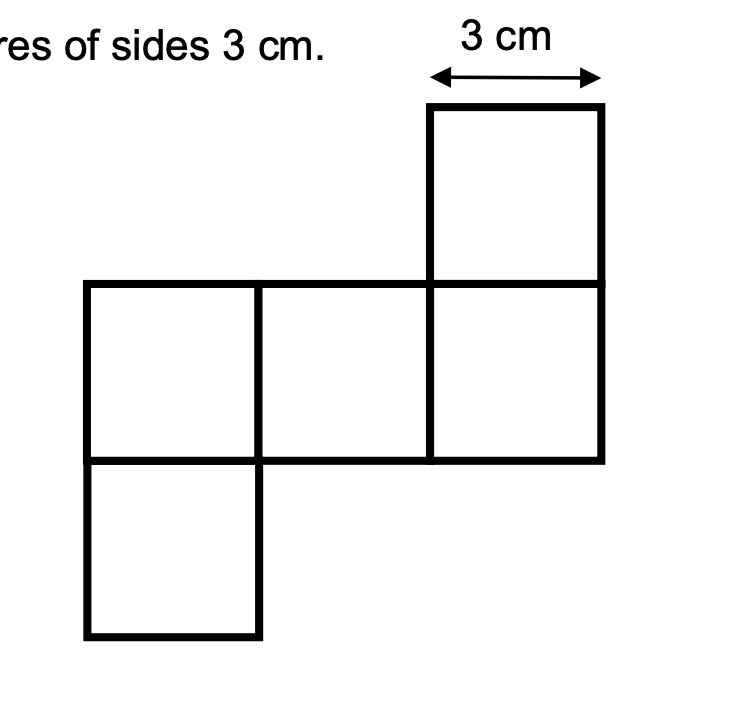
Answer: 45
Each square = 3 × 3 = 9 cm².
There are 5 squares.
Area = 5 × 9 = 45 cm².
17
length
medium
Study the picture below.
How long more must the rubber band be stretched so that it has the same length as the pencil?
Give your answer in centimetres.
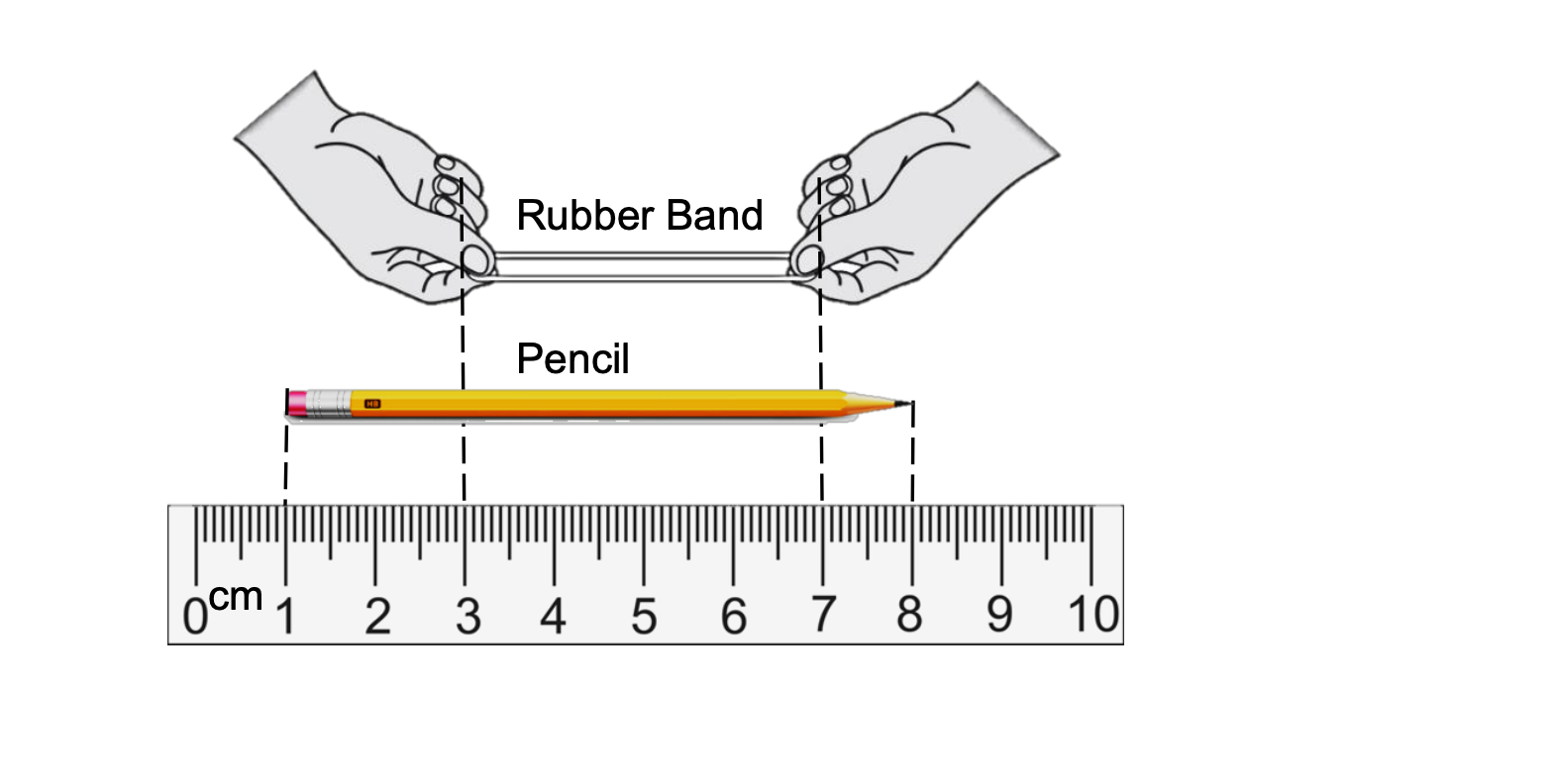
Answer: 3
Rubber band: from 3 cm to 7 cm = 4 cm long.
Pencil: from 1 cm to 8 cm = 7 cm long.
Extra needed = 7 − 4 = 3 cm.
18
volume
medium
A jug holds 1000 ml of orange juice.
After filling 3 identical glasses, 376 ml of juice is left in the jug.
What is the capacity of one such glass?
Give your answer in millilitres.
Answer: 208
Juice used by the 3 glasses = 1000 − 376 = 624 ml.
One glass = 624 ÷ 3 = 208 ml.
19
division
easy
A farmer had 450 apples.
He put them into 7 boxes equally and had 58 apples left.
How many apples were there in each box?
Answer: 56
Apples put into boxes = 450 − 58 = 392.
Each box = 392 ÷ 7 = 56.
20
pattern
medium
Sticks are used to form triangles. Figure 1 uses 3 sticks, Figure 2 uses 5, Figure 3 uses 7, Figure 4 uses 9, and the pattern continues.
How many sticks are needed to form Figure 9?
Answer: 19
Sticks: 3, 5, 7, 9, … increasing by 2 each time.
Figure n uses 2 × n + 1 sticks.
Figure 9 = 2 × 9 + 1 = 19 sticks.
21
money
easy
Mangoes were sold at $24 for 3 kg.
Mdm Ong sold 27 kg of mangoes.
How much did she receive?
Answer: 216
27 kg = 9 lots of 3 kg.
Each 3 kg = $24.
Total = 9 × $24 = $216.
22
counting
easy
John, Sam and Tom stand in a row for a photograph and switch positions after each shot.
How many different ways can they stand in a row?
Answer: 6
First place: 3 choices.
Second place: 2 choices.
Third place: 1 choice.
3 × 2 × 1 = 6 ways.
23
mass
medium
The total mass of 3 mangoes and 1 watermelon is 2 kg 600 g.
Each mango has a mass of 350 g.
What is the mass of the watermelon?
Give your answer in grams.
Answer: 1550
Total = 2 kg 600 g = 2600 g.
3 mangoes = 3 × 350 = 1050 g.
Watermelon = 2600 − 1050 = 1550 g.
24
money
medium
A wallet and 4 pouches cost $265.
The wallet and 2 such pouches cost $189.
Find the cost of 1 wallet.
Answer: 113
Wallet + 4 pouches = $265.
Wallet + 2 pouches = $189.
2 pouches = $265 − $189 = $76, so 1 pouch = $38.
Wallet = $189 − 2 × $38 = $189 − $76 = $113.
25
ratio
medium
Polly has 72 oranges.
She has 8 times as many oranges as apples.
She has 4 times as many pears as apples.
How many pears does Polly have?
Answer: 36
Apples = 72 ÷ 8 = 9.
Pears = 4 × apples = 4 × 9 = 36.
26
bar-graph
hard
The bar graph shows the number of carnival tickets sold by four Primary Three classes.
Each ticket costs $8.
What is the difference between the class that collected the most money and the class that collected the least?
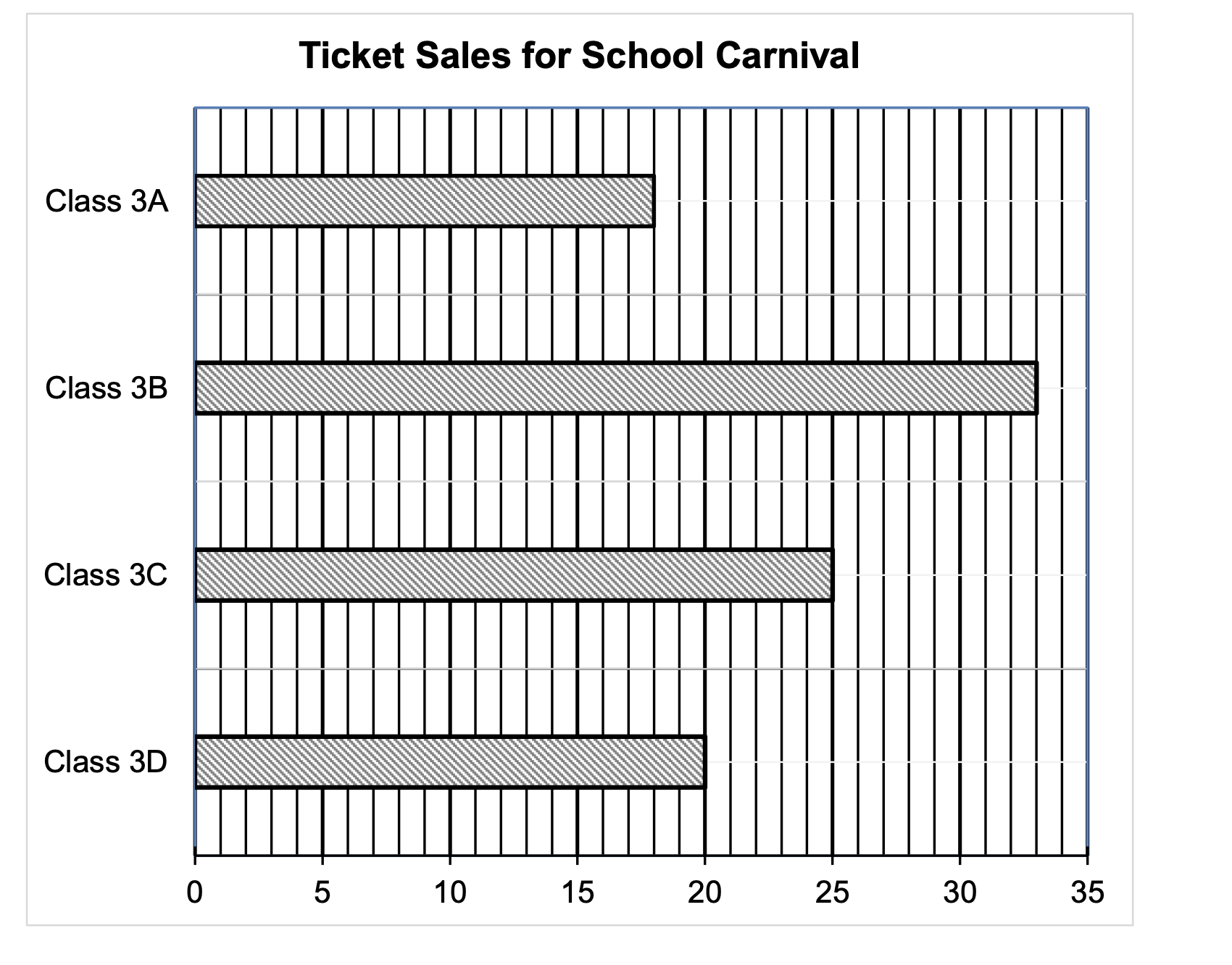
Answer: 120
Tickets sold: 3A = 18, 3B = 33, 3C = 25, 3D = 20.
Most = 3B (33 tickets); least = 3A (18 tickets).
Difference in tickets = 33 − 18 = 15.
Difference in money = 15 × $8 = $120.
27
money
hard
Jack and Tom had a total of $330.
Jack gave $87 to Tom.
In the end, Tom had twice as much money as Jack.
How much money did Tom have at first?
Answer: 133
The total $330 does not change.
At the end Tom = 2 × Jack, so 3 equal parts = $330 → 1 part = $110.
At the end: Jack = $110, Tom = $220.
Tom at first = $220 − $87 = $133.
28
geometry
medium
A wire 2 m long is cut into 2 pieces which are bent to form two squares, A and B.
Square A has sides of 13 cm.
What is the length of each side of Square B?
Give your answer in centimetres.
Answer: 37
Wire = 2 m = 200 cm.
Square A uses 4 × 13 = 52 cm.
Square B uses 200 − 52 = 148 cm.
Side of B = 148 ÷ 4 = 37 cm.
29
perimeter
hard
Find the perimeter of the shaded figure.
Give your answer in centimetres.
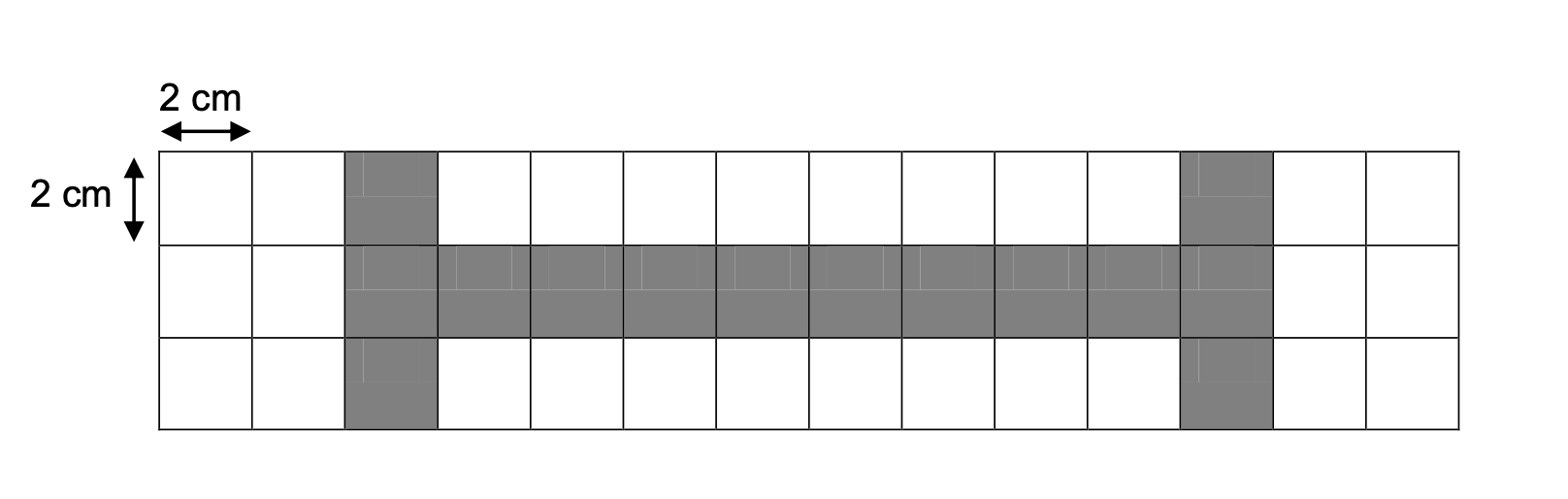
Answer: 60
Each square is 2 cm on a side.
Counting all the outside edges of the shaded I-shape gives 30 unit sides.
Perimeter = 30 × 2 cm = 60 cm.
30
money
hard
Cheese tarts are sold in boxes of 3 for $8, or singly for $2.80 each.
Mdm Sim has $55.
What is the greatest number of cheese tarts she can buy?
Answer: 20
A box of 3 tarts for $8 is cheaper than 3 singles ($8.40).
6 boxes = $48 → 18 tarts, leaving $55 − $48 = $7.
$7 buys 2 single tarts ($5.60), leaving $1.40 (not enough for more).
Greatest number = 18 + 2 = 20 tarts.
31
area
hard
Rectangle ABCD is made up of 1 big shaded rectangle and 5 identical smaller unshaded rectangles.
The area of the shaded rectangle is 35 cm² and DC = 15 cm.
What is the area of Rectangle ABCD?
Give your answer in square centimetres.
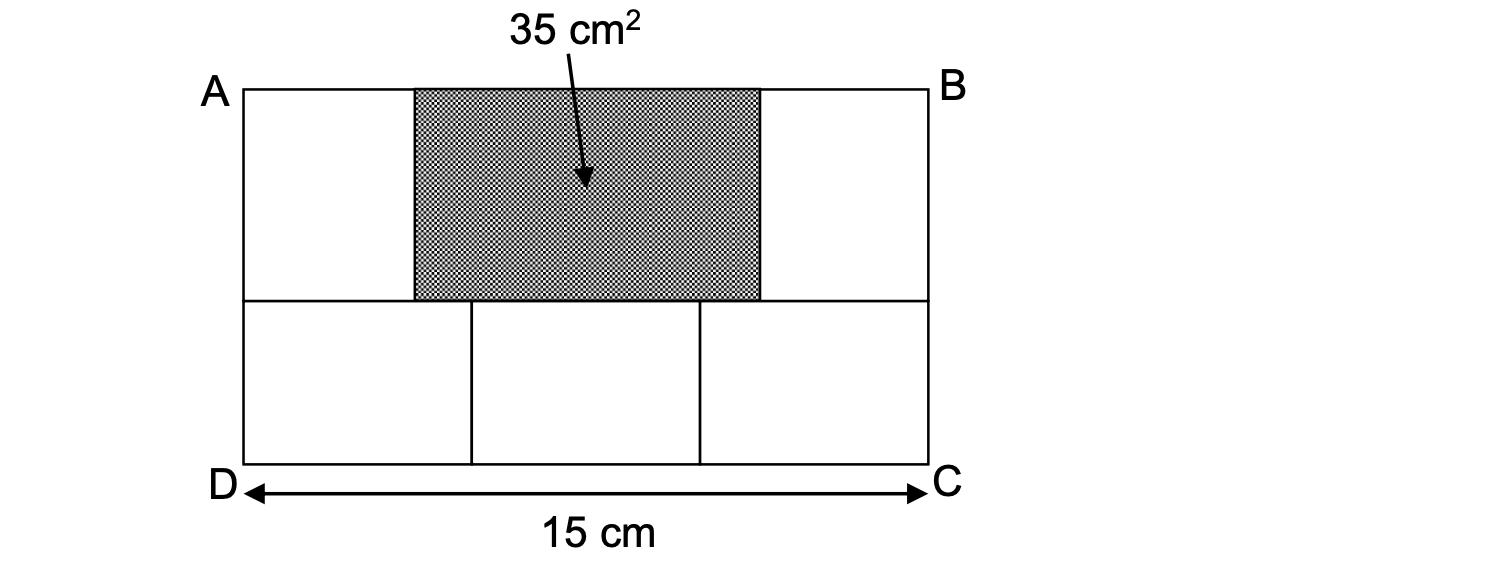
Answer: 210
The bottom row is 3 identical rectangles across DC = 15 cm, so each small rectangle is 15 ÷ 3 = 5 cm wide.
Shaded rectangle width = 5 cm and area = 35 cm², so its height = 35 ÷ 5 = 7 cm.
The small rectangles are identical, so both rows are 7 cm tall.
ABCD = 15 × (7 + 7) = 15 × 14 = 210 cm².
32
volume
medium
A jug holds 1050 ml of water.
A bottle holds 225 ml less than the jug.
A flask holds 3 times as much as the bottle.
How much water can the items hold altogether?
Give your answer in millilitres.
Answer: 4350
Jug = 1050 ml.
Bottle = 1050 − 225 = 825 ml.
Flask = 3 × 825 = 2475 ml.
Total = 1050 + 825 + 2475 = 4350 ml.
33
mass
hard
A container with 20 identical beads weighed 826 g.
After 7 beads were removed, the container with the remaining beads weighed 721 g.
What is the mass of 9 such beads?
Give your answer in grams.
Answer: 135
7 beads weigh 826 − 721 = 105 g.
1 bead = 105 ÷ 7 = 15 g.
9 beads = 9 × 15 = 135 g.
34
perimeter
easy
The length of a rectangle is 3 times its breadth.
Its breadth is 8 cm.
What is the perimeter of the rectangle?
Give your answer in centimetres.
Answer: 64
Breadth = 8 cm.
Length = 3 × 8 = 24 cm.
Perimeter = 2 × (24 + 8) = 2 × 32 = 64 cm.
35
area
hard
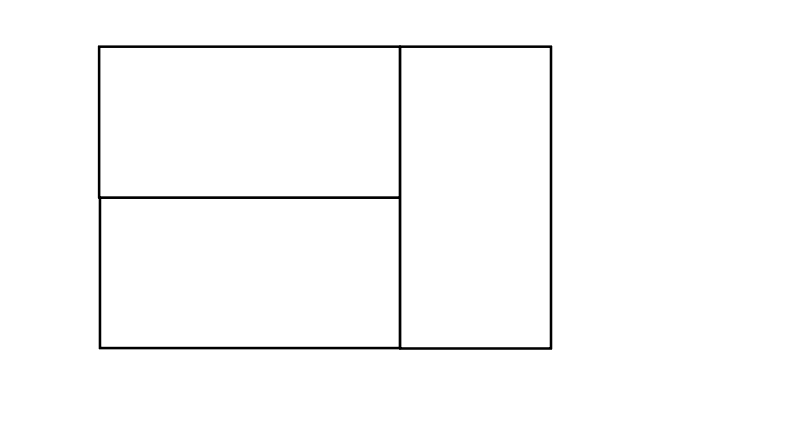
The figure below is formed using 3 identical rectangles.
The perimeter of the figure is 60 cm.
Find the total area of the figure.
Give your answer in square centimetres.
Answer: 216
Two rectangles stacked have a height equal to one rectangle's length, so length = 2 × breadth.
The whole figure is a rectangle 3 breadths wide and 2 breadths tall.
Perimeter = 2 × (3b + 2b) = 10b = 60 → b = 6 cm, length = 12 cm.
Each rectangle = 12 × 6 = 72 cm².
Total = 3 × 72 = 216 cm².
36
money
hard
Jay and Kenny had an equal amount of money.
Jay bought 5 cookies and had $3.60 left.
Kenny wanted 8 cookies but was short of $4.80.
Find the cost of 1 cookie.
Give your answer in cents.
Answer: 280
They started with the same amount.
8 cookies − 5 cookies = 3 cookies cost the extra $3.60 + $4.80 = $8.40.
1 cookie = $8.40 ÷ 3 = $2.80 = 280 cents.
37
fractions
medium
The figure is made up of 9 identical squares. 5 of the squares are shaded.
How many more squares should be shaded so that 2/3 of the figure is shaded?
Answer: 1
2/3 of 9 squares = 6 squares must be shaded.
Already shaded = 5.
More to shade = 6 − 5 = 1.
38
bar-graph
hard
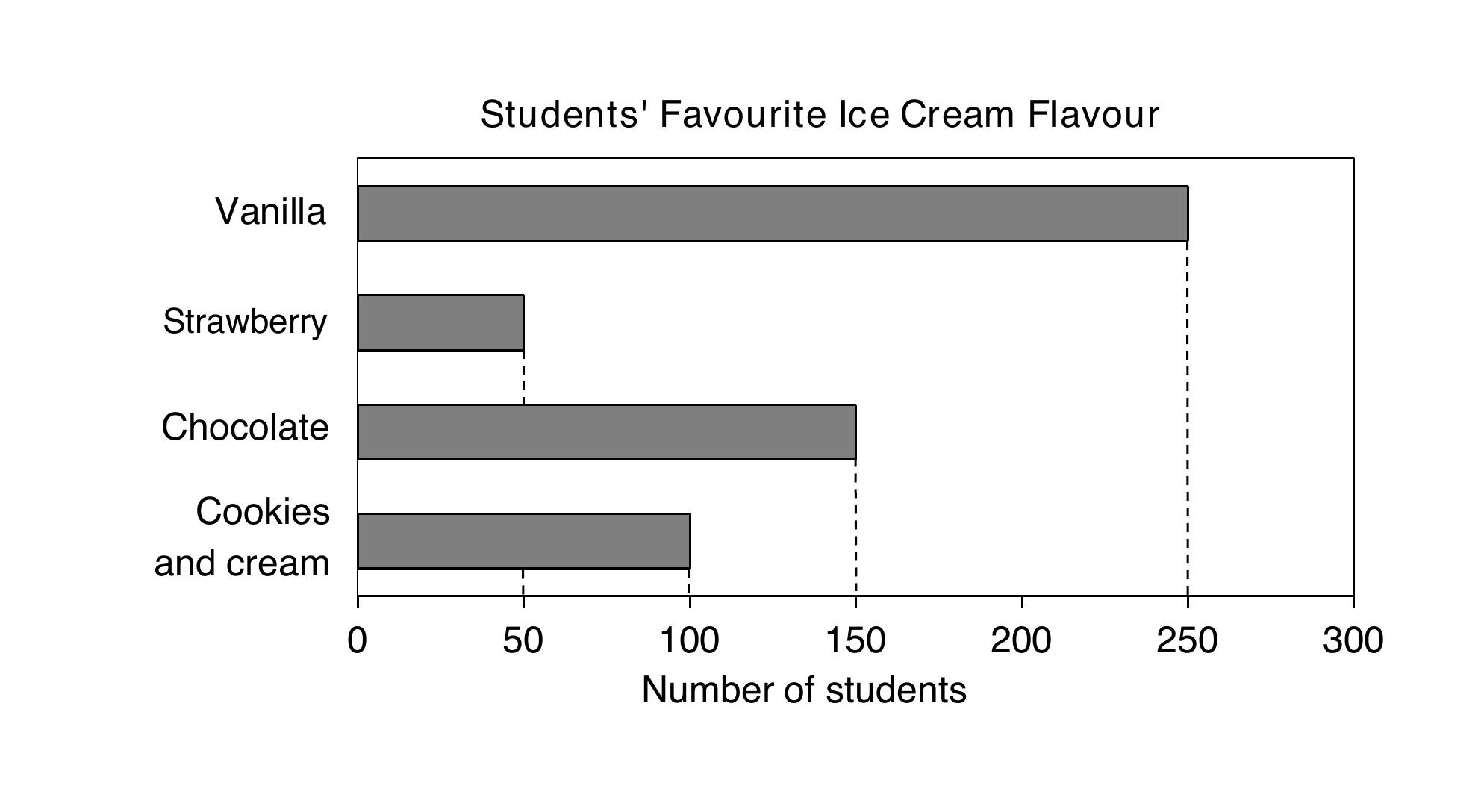
A total of 480 students chose their favourite ice cream flavour.
The bar graph shows the numbers for each of the 4 flavours.
How many students chose more than one flavour?
Answer: 70
Bar values: Vanilla 250, Strawberry 50, Chocolate 150, Cookies and cream 100.
Sum of choices = 250 + 50 + 150 + 100 = 550.
Students = 480.
Chose more than one = 550 − 480 = 70.
39
model
hard
Rita and Sarah had the same number of beads.
Rita gave away 35 beads and Sarah received 40 beads.
In the end, Sarah had 4 times as many beads as Rita.
How many beads did Sarah have at first?
Answer: 60
Let each start with n beads.
Rita ends with n − 35; Sarah ends with n + 40.
Sarah = 4 × Rita: n + 40 = 4(n − 35).
n + 40 = 4n − 140 → 180 = 3n → n = 60.
Sarah had 60 beads at first.
40
model
hard
A farmer had 98 oranges and pears.
He packed all of them into similar boxes.
Each box holds 6 oranges or 5 pears.
There are 2 more boxes of pears than of oranges.
How many oranges did he have?
Answer: 48
Let orange boxes = b, then pear boxes = b + 2.
Oranges = 6b; pears = 5(b + 2) = 5b + 10.
6b + 5b + 10 = 98 → 11b = 88 → b = 8.
Oranges = 6 × 8 = 48.