Section A
Open-ended and multiple-choice — Questions 1 to 40
(+2)
1
place-value
easy
What is the value of the digit '6' in the numeral 36 574?
Answer: 6000
The digit 6 is in the thousands place.
Its value = 6 × 1000 = 6000.
2
rounding
easy
A number when rounded to the nearest 100 is 8000.
What is the greatest possible number?
Answer: 8049
Numbers from 7950 to 8049 round to 8000 (nearest 100).
8050 would round up to 8100.
So the greatest possible number is 8049.
3
multiplication
easy
A van can transport 8 passengers.
How many passengers can 240 vans transport?
Answer: 1920
240 × 8 = 1920 passengers.
4
geometry
medium
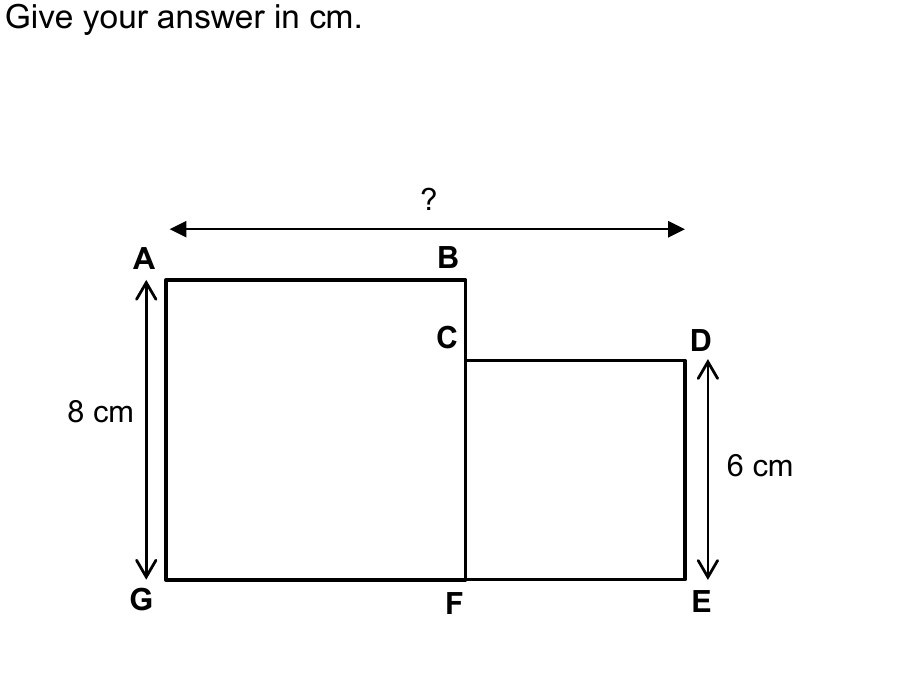
The figure below is made up of 2 squares of different sizes.
AG is 8 cm and DE is 6 cm. What is the length of AD?
Give your answer in cm.
Answer: 14
AG = 8 cm is the side of the big square, so AB = 8 cm.
DE = 6 cm is the side of the small square, so BD (the horizontal part above the small square) = 6 cm.
AD = AB + BD = 8 + 6 = 14 cm.
5
symmetry
hard
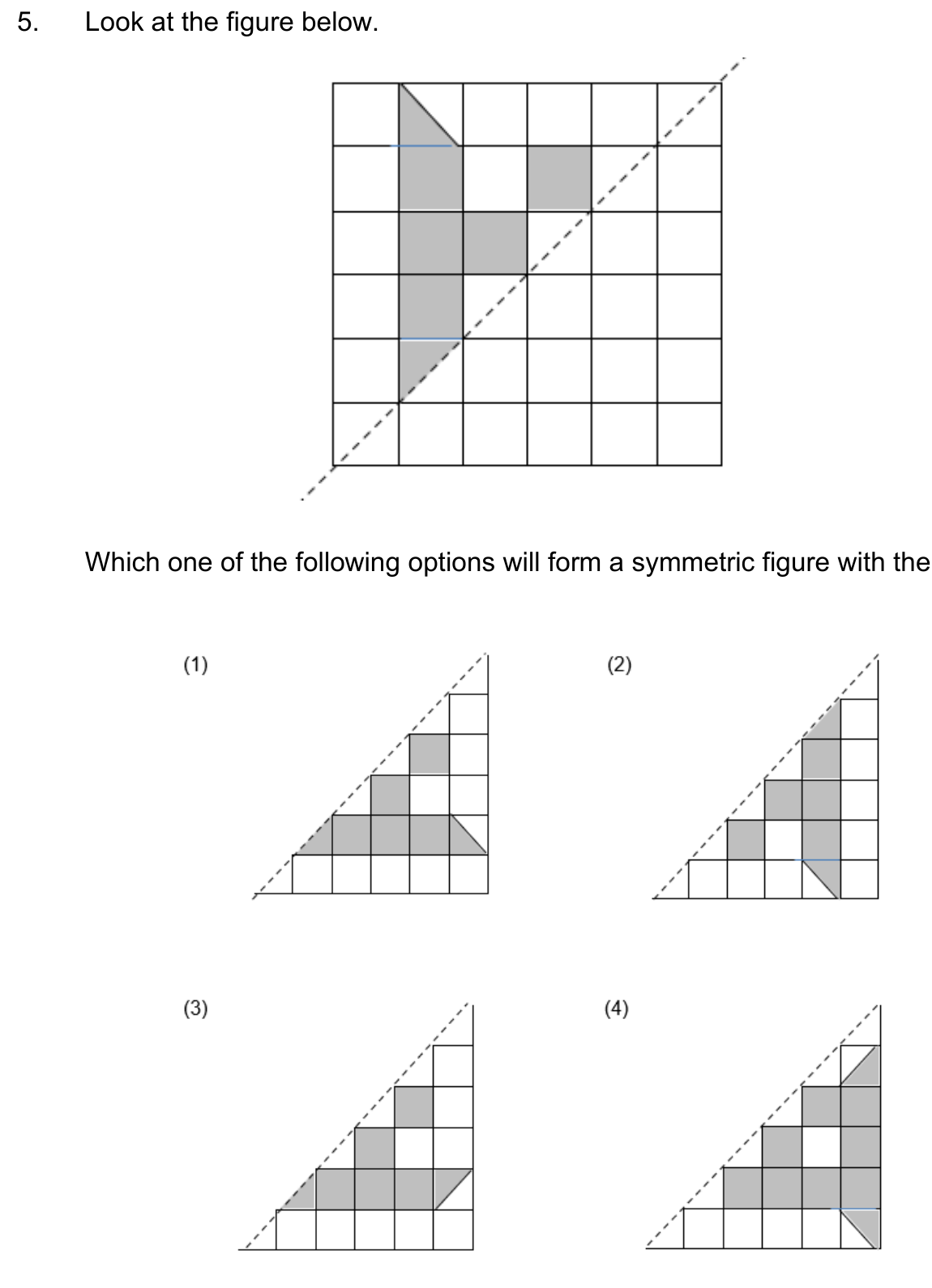
Look at the figure below (a grid with a dashed diagonal line of symmetry and some shaded squares/triangles above it).
Which one of the following options will form a symmetric figure with the above?
Answer: 1
Reflecting the shaded shape across the dashed diagonal, the small corner triangle must end up shaded on the side that includes the bottom-right corner of its cell (mirroring the original corner triangle, which excludes only its bottom-right corner).
Only Option 1 reproduces this exact mirrored pattern together with the correct staircase of full squares; the other options either shade an extra square, leave a gap in the run of full squares, or shade the small triangle on the wrong side.
6
direction
hard
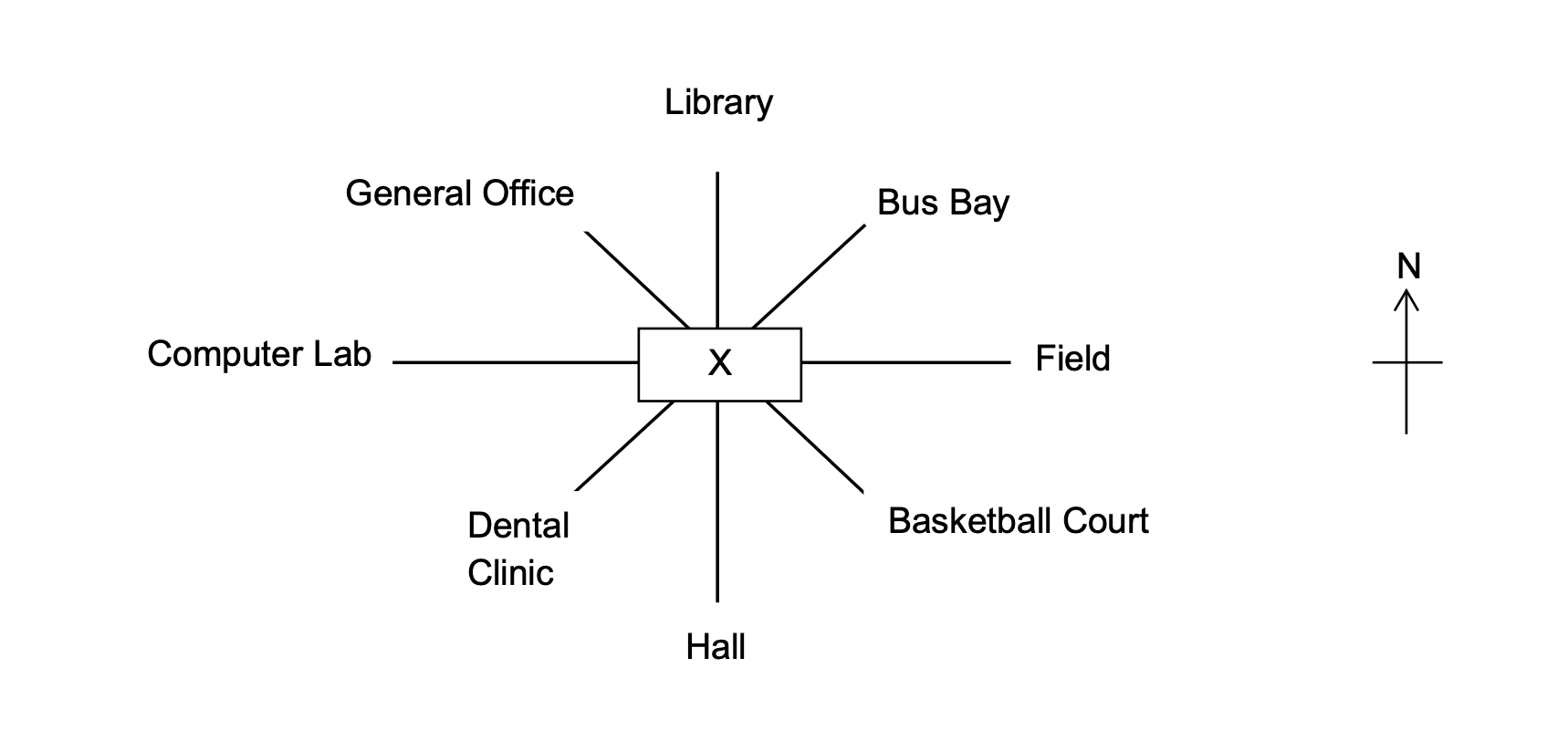
Ben was standing at Point X.
He turned 225° anti-clockwise and then made another 1/4 turn in the clockwise direction.
He ended up facing the Bus Bay.
Which location was Ben facing at first?
(Layout around X: Library=N, Bus Bay=NE, General Office=NW, Field=E, Computer Lab=W, Basketball Court=SE, Dental Clinic=SW, Hall=S.)
Answer: 1
Let the initial bearing (clockwise from North) be θ.
Turning 225° anti-clockwise: bearing becomes θ − 225.
Turning a further 1/4 turn (90°) clockwise: bearing becomes θ − 225 + 90 = θ − 135.
This final bearing faces Bus Bay, which is NE (45°): θ − 135 = 45, so θ = 180°.
180° is South, which is Hall.
7
fractions
easy
Which of the following is an equivalent fraction of 3/4?
Answer: 4
3/4 = 6/8 (multiply top and bottom by 2).
12/24 = 1/2, 9/16 ≠ 3/4, 5/6 ≠ 3/4.
8
measurement
medium
Zainal had 5 m of ribbon at first. He used 1.4 m of it to wrap a present and some ribbon to decorate 2 cards. He had 2.6 m of ribbon left. Which of the following is the length of ribbon for each card?
Answer: 4
Total used = 5 − 2.6 = 2.4 m.
Used for the 2 cards = 2.4 − 1.4 = 1.0 m.
Each card = 1.0 ÷ 2 = 0.5 m.
9
logic
medium
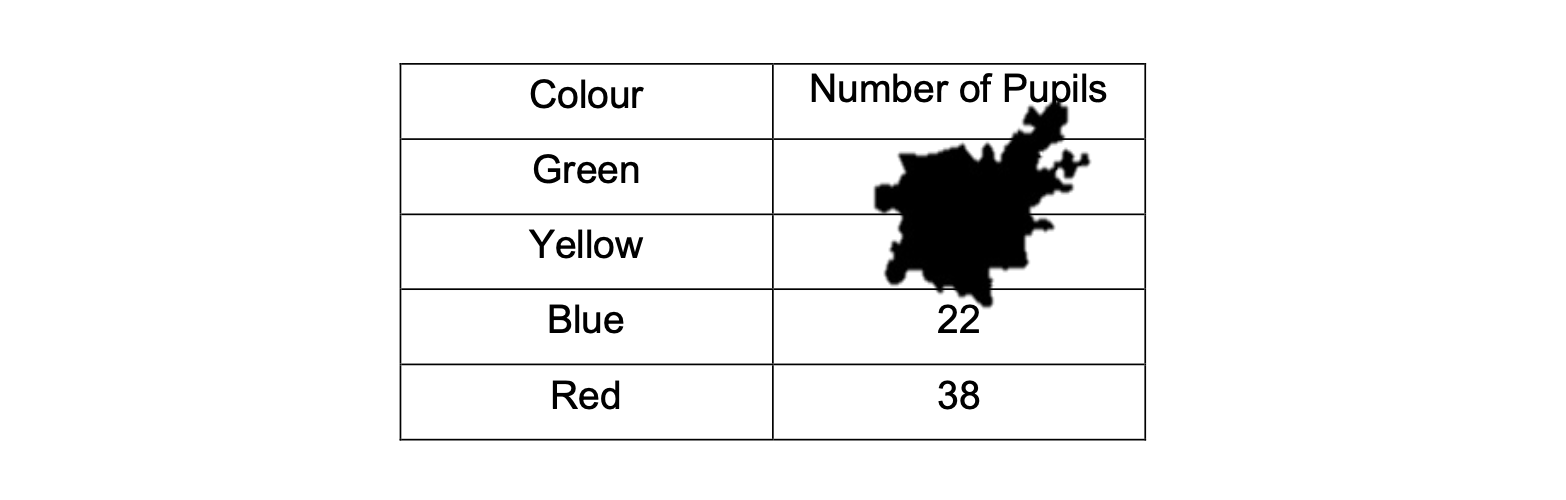
The table below shows the favourite colours of 108 pupils in Primary Four.
Green: ?, Yellow: ?, Blue: 22, Red: 38.
There were twice as many pupils who chose green than yellow.
There is a total of 38 pupils who like 2 of the colours.
Which of the following options shows the two colours?
Answer: 2
Green + Yellow = 108 − 22 − 38 = 48.
Green = 2 × Yellow, so 3 × Yellow = 48 → Yellow = 16, Green = 32.
Check pairs: Yellow + Blue = 16 + 22 = 38. This matches, so the answer is Yellow and Blue.
10
symmetry
easy
Which of the following figures has only one line of symmetry?
Option 1: a slanted parallelogram. Option 2: a regular pentagon. Option 3: an isosceles trapezium. Option 4: a rectangle.
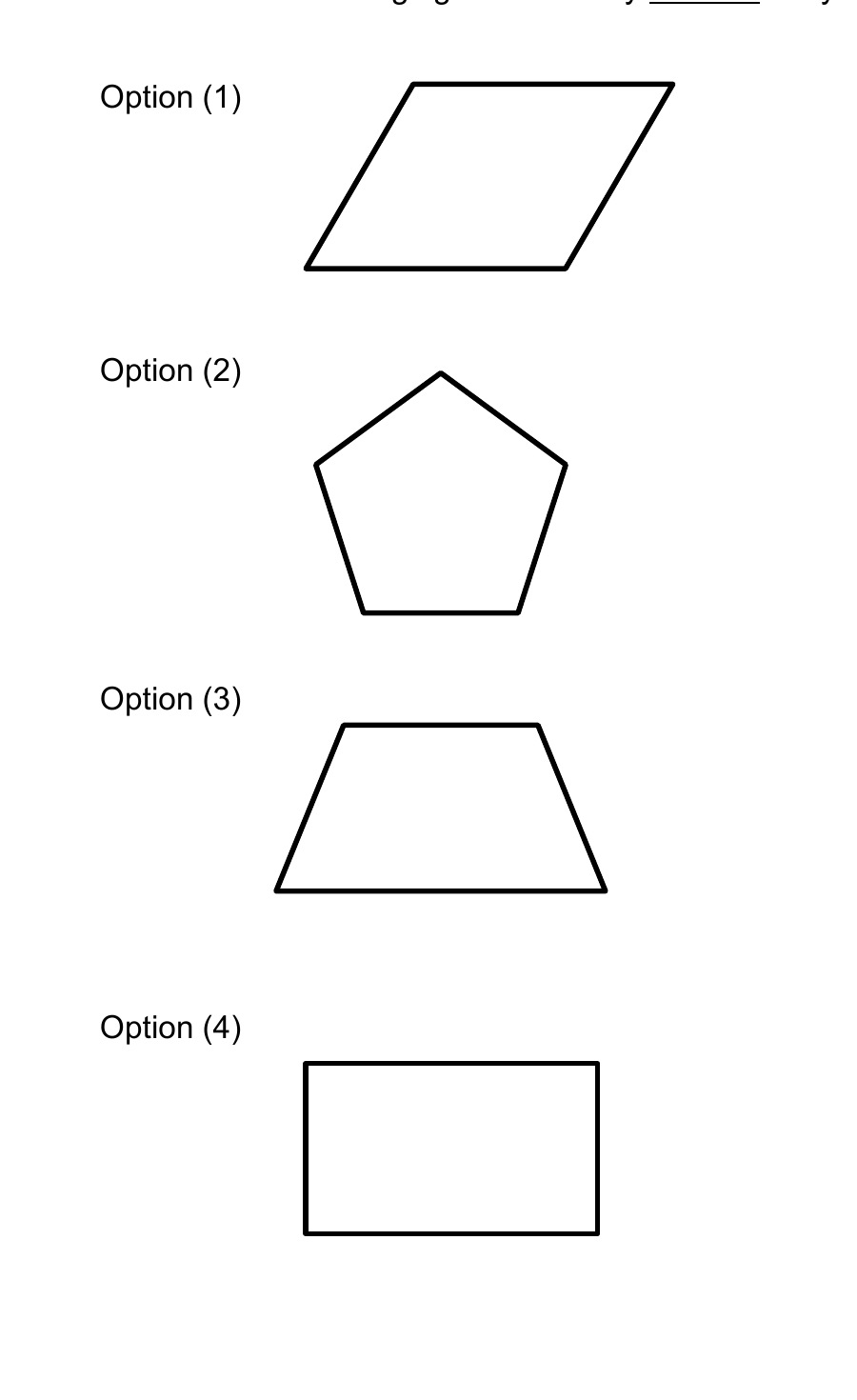
Answer: 3
A general parallelogram has 0 lines of symmetry.
A regular pentagon has 5 lines of symmetry.
An isosceles trapezium has exactly 1 line of symmetry (vertical).
A rectangle has 2 lines of symmetry.
Only the trapezium has exactly one.
11
geometry
hard
Rectangle PQRS is folded to form the figure below (a corner is folded so that R lands on side SR itself, creating angles y and x at Q, with y = angle between the original QR position and the crease, and x = angle between the crease and the folded edge to R).
∠y is three times of ∠x.
Find ∠x.
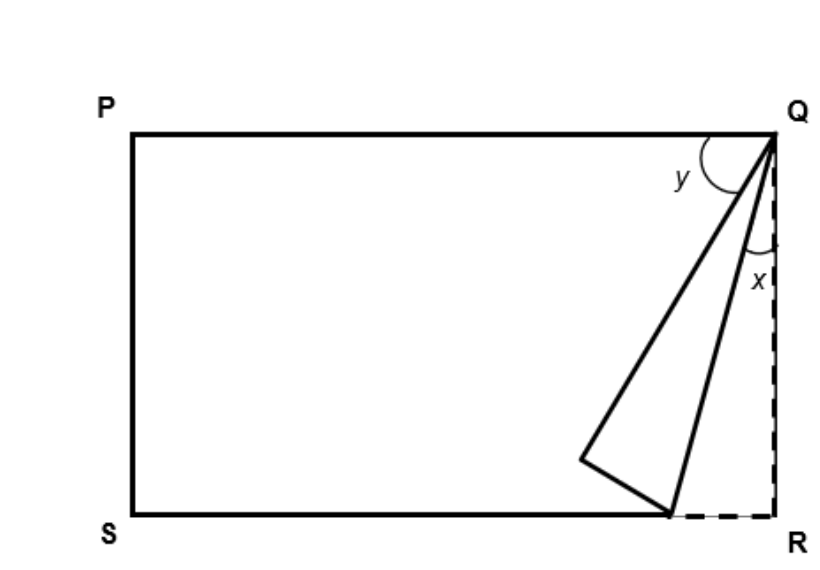
Answer: 18
The fold reflects part of the right angle at Q, so the crease splits angle PQR (90°) into three parts: x (from the fold reflection), x (the middle angle, equal to the first by fold symmetry), and y = 3x.
x + x + 3x = 90° → 5x = 90° → x = 18°.
12
place-value
medium
A 4-digit number is made up of three different odd digits and a zero.
What is the smallest possible value of the number?
Answer: 1035
To make the smallest number, use the smallest odd digits: 1, 3, 5, plus 0.
The leading digit cannot be 0, so use the smallest nonzero digit (1) first.
Arrange the rest in ascending order: 0, 3, 5.
Smallest number = 1035.
13
algebra
medium
Study the pattern (★ = star, 🌙 = moon):
★ × ★ = 49
🌙 + 🌙 + 🌙 + 🌙 = 100
★ × 🌙 = ?
What is the missing number in the box?
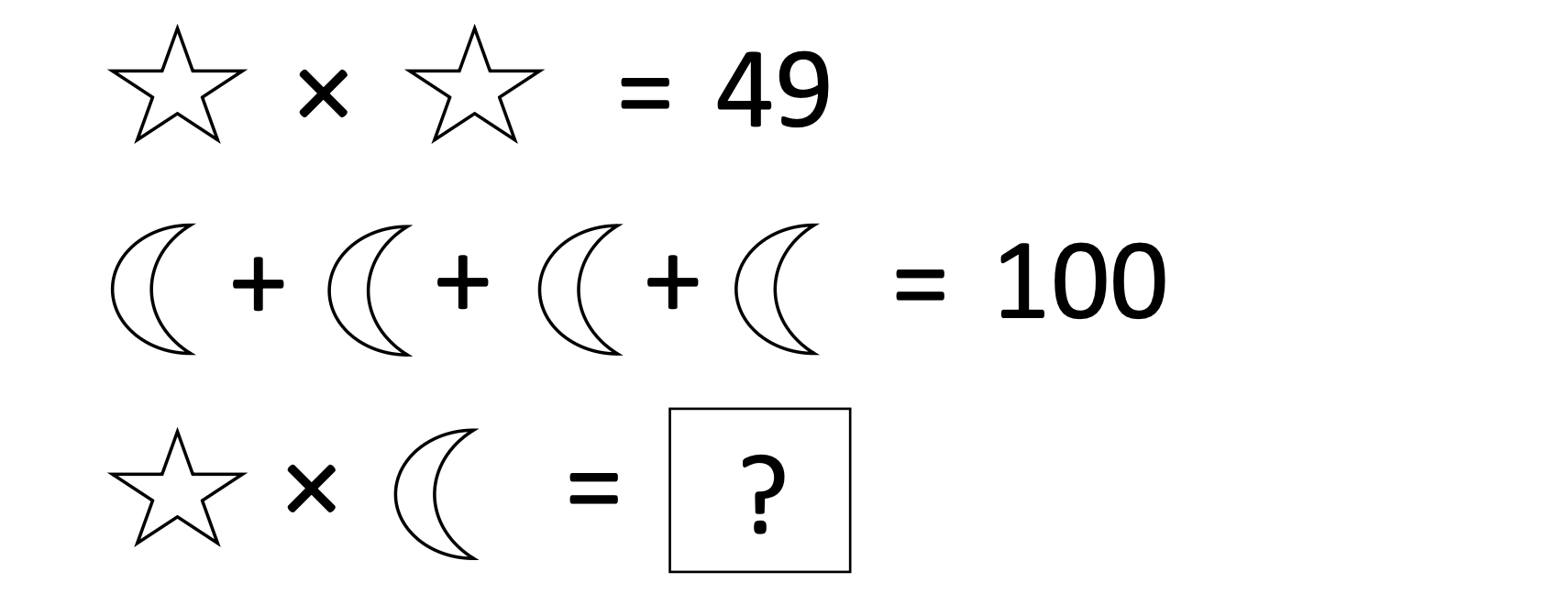
Answer: 175
★ × ★ = 49 → ★ = 7.
🌙 + 🌙 + 🌙 + 🌙 = 100 → 🌙 = 25.
★ × 🌙 = 7 × 25 = 175.
14
number-sense
medium
Alice's present age is a 2-digit number which is also a multiple of 4.
5 years ago, her age was a factor of 54.
What is Alice's age 5 years later?
Answer: 37
Factors of 54: 1, 2, 3, 6, 9, 18, 27, 54.
Adding 5 to each and checking for a 2-digit multiple of 4: 27 + 5 = 32, and 32 is a 2-digit multiple of 4. ✓
So Alice's present age is 32.
Her age 5 years later = 32 + 5 = 37.
15
fractions
medium
Colin, Dylan, and Eden shared some sweets.
Colin took 1/6 of the sweets.
Dylan took the remaining sweets and shared it equally with Eden.
Eden ate 12 of his sweets and has 18 sweets left.
How many sweets were there altogether?
Answer: 72
Eden had 12 + 18 = 30 sweets to begin with.
Dylan and Eden shared the remaining 5/6 of the total equally, so Eden's share = 5/12 of the total.
5/12 of total = 30 → total = 30 × 12/5 = 72.
16
multiplication
easy
The product of 7 and a number is 84.
What is the product of 252 and that number?
Answer: 3024
7 × number = 84 → number = 12.
252 × 12 = 3024.
17
geometry
hard
A rectangular piece of paper was folded differently on both ends as shown below (left end folded up leaving a 3 cm exposed edge and a diagonal fold to the main rectangle; right end folded down leaving a 4 cm × 1 cm flap and a diagonal fold; the main unfolded middle section is 9 cm wide).
What is the area of the rectangular piece of paper before it was folded?
Give your answer in cm².
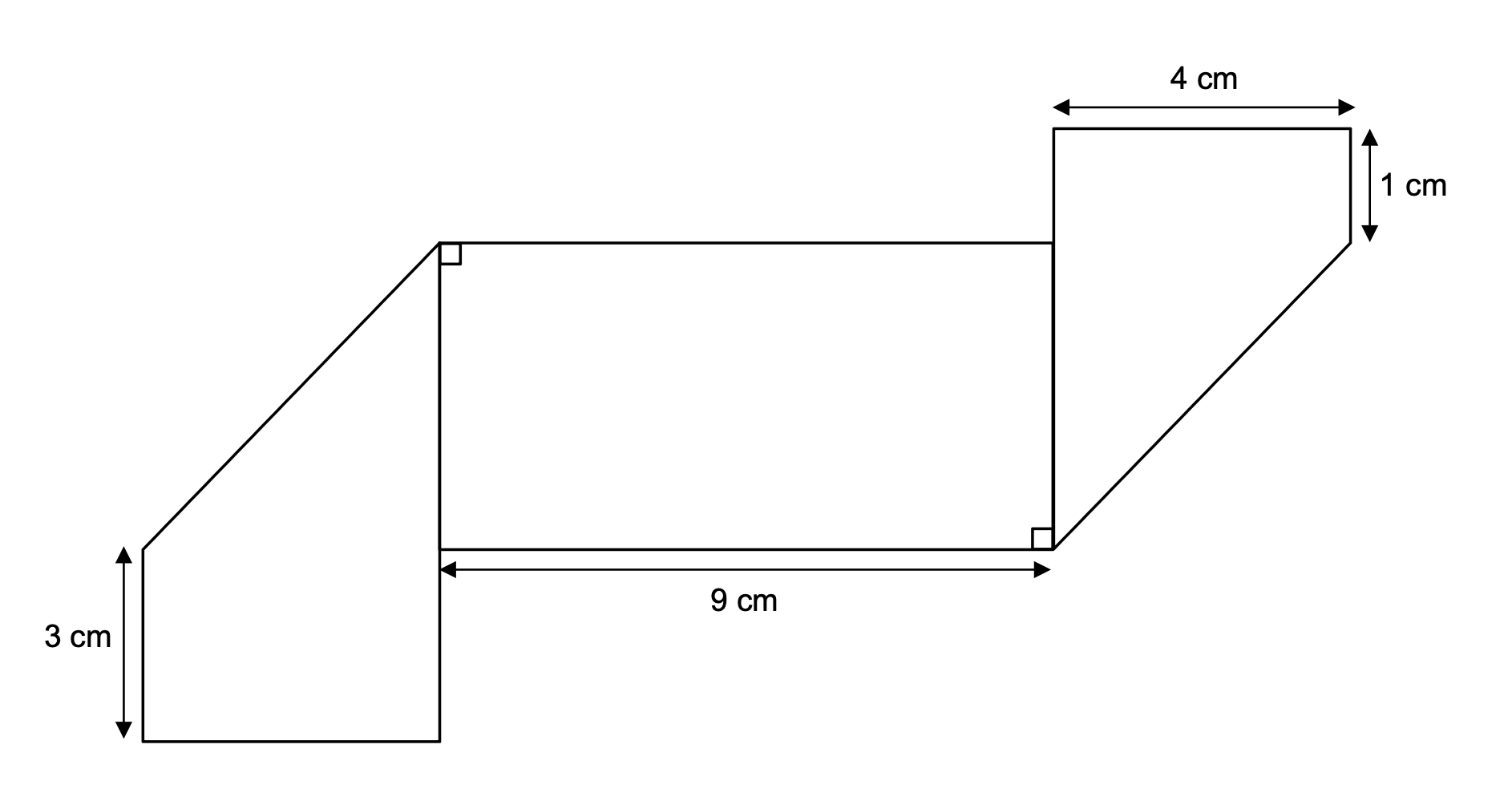
Answer: 84
The width (short side) of the original paper is 4 cm.
The length (long side) is made up of the right flap's 4 + 1, the main strip's 9, and the left flap's 3 + 4: (4 + 1) + 9 + (3 + 4) = 21 cm.
Area = 4 × 21 = 84 cm².
18
geometry
medium
A rectangular piece of paper was cut into 3 smaller rectangles with dimensions as shown: 9 cm × 12 cm, 9 cm × 2 cm, and 9 cm × 5 cm.
Find the length of the paper before it was cut.
Give your answer in cm.
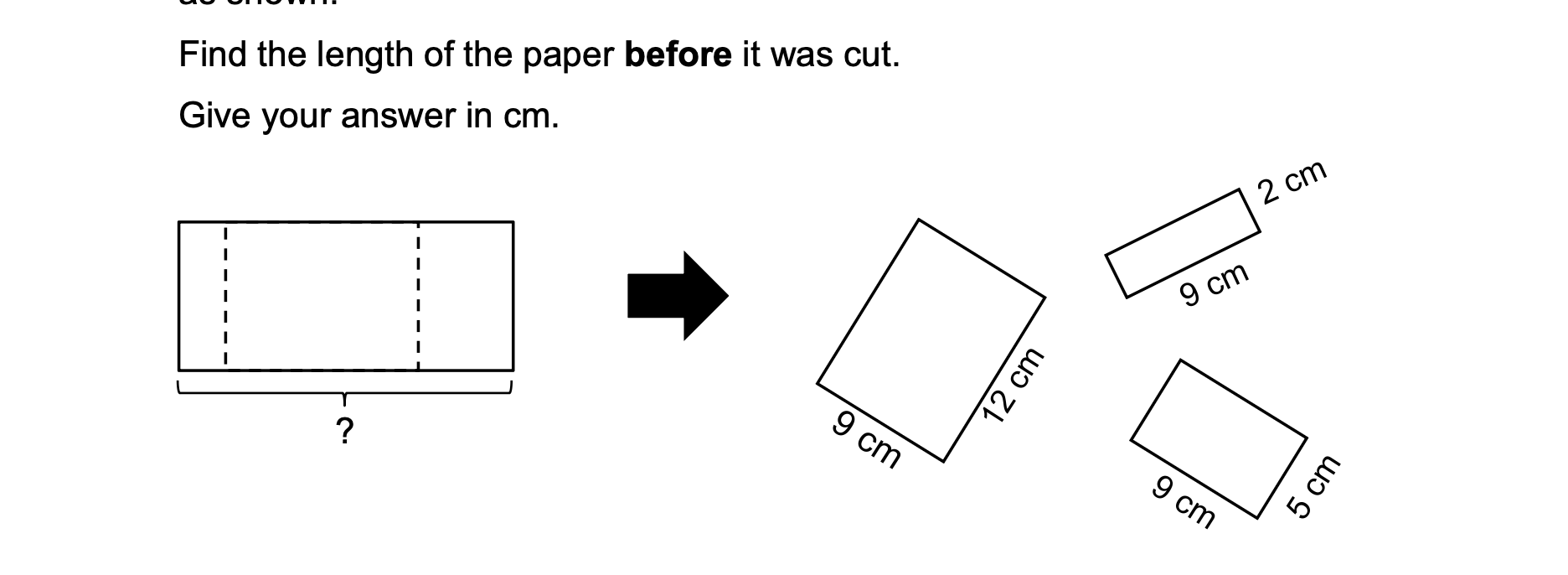
Answer: 19
All three pieces share the same 9 cm side, which is the width of the original paper.
The length of the original paper = sum of the other three dimensions = 12 + 2 + 5 = 19 cm.
19
money
easy
The table below shows the cost of pizza with different sizes: Regular $12, Large $22.
Mrs Tan ordered 6 large pizzas and 5 regular pizzas.
She gave the delivery man $200.
How much change did Mrs Tan receive?
Answer: 8
Cost = 6 × 22 + 5 × 12 = 132 + 60 = 192.
Change = 200 − 192 = $8.
20
patterns
medium
A length of sticky tape is made up of a repeated design: a diagonal-hatch pattern (5 cm), then a checkerboard pattern (3 cm), then a crosshatch/grid pattern (4 cm), repeating. The tape ends with only the diagonal-hatch and checkerboard pattern (no final grid piece).
The sticky tape is 80 cm long.
How many checkerboard patterns are there altogether?
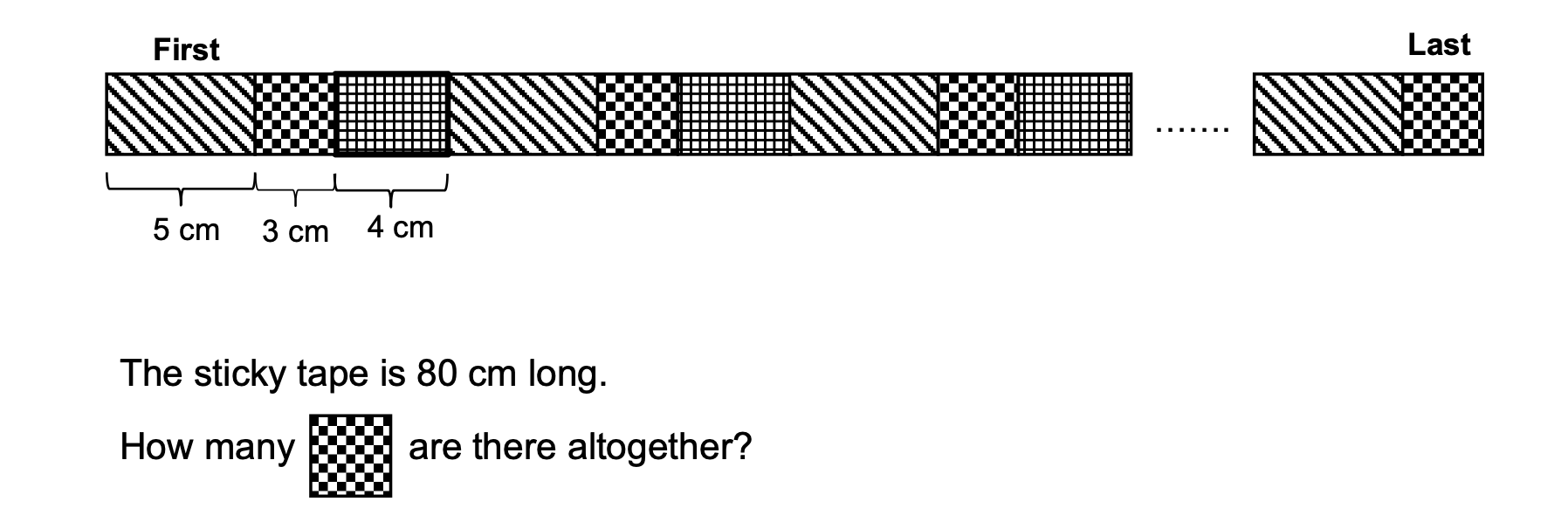
Answer: 7
One full repeat = 5 + 3 + 4 = 12 cm.
The tape ends with a partial repeat of just 5 + 3 = 8 cm (diagonal-hatch + checkerboard, no grid).
80 = 12n + 8 → 12n = 72 → n = 6 full repeats, plus 1 partial repeat.
Each full repeat has 1 checkerboard, and the partial repeat also has 1 checkerboard.
Total checkerboards = 6 + 1 = 7.
21
time
easy
Sam spent a total of 3 h 10 min revising for his English, Science and Mathematics tests over the weekend.
He spent 50 min on English and another 1 h 25 min on Science.
How long did Sam spend revising Mathematics?
Express your answer in minutes.
Answer: 55
3 h 10 min = 190 min.
English + Science = 50 + 85 = 135 min.
Mathematics = 190 − 135 = 55 min.
22
geometry
medium
The figure below is made up of 7 identical rectangles: 2 placed lengthwise (landscape) in a top row, and 5 placed widthwise (portrait) in a bottom row, together forming a bigger rectangle.
The perimeter of the whole figure is 340 cm.
Find the breadth of 1 such rectangle.
Give your answer in cm.
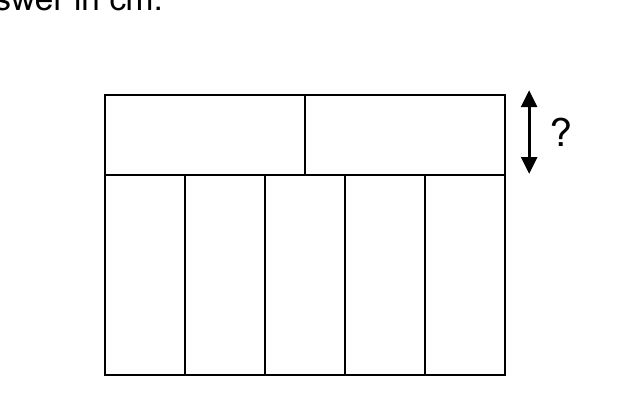
Answer: 20
Let each identical rectangle have length l and breadth b.
Top row (2 rectangles, landscape): total width = 2l.
Bottom row (5 rectangles, portrait): total width = 5b.
Since both rows span the same total width: 2l = 5b → l = 2.5b.
Overall figure: width = 5b, height = b + l = b + 2.5b = 3.5b.
Perimeter = 2 × (5b + 3.5b) = 17b = 340 → b = 20 cm.
23
ratio
easy
Yiping had 100 fewer stickers than Joanne.
Joanne had 4 times as many stickers as Wendy. Wendy had 40 stickers.
How many stickers did they have altogether?
Answer: 260
Joanne = 4 × 40 = 160.
Yiping = 160 − 100 = 60.
Total = 40 + 160 + 60 = 260.
24
money
medium
Star Bookshop is having a promotion: for every 2 notebooks bought, the third notebook is free (buy 3 for the price of 2, $5 each).
Karen bought 25 notebooks.
What is the least amount of money she has spent in total?
Answer: 85
Group into sets of 3 (pay for 2 in each set): 25 ÷ 3 = 8 sets with 1 notebook left over.
8 sets × 2 paid notebooks = 16 paid, plus 1 leftover paid in full = 17 paid notebooks.
Cost = 17 × $5 = $85.
25
time
medium
Meena left her house to watch a movie at the cinema.
Her watch showed 1630 but it was actually 5 minutes slower than the actual time.
She took 35 minutes to reach the cinema.
In the end, she was 10 minutes early for the movie.
What time did the movie begin?
Give your answer in 24-hour clock format.
Answer: 1720
Actual time when she left = 1630 + 5 = 1635 (watch is 5 min slower than actual).
She arrived at 1635 + 35 min = 1710.
She was 10 min early, so the movie began at 1710 + 10 = 1720.
26
fractions
medium
Ken had some money.
He used 1/2 of it to buy a shirt and 1/5 of it to buy a pair of pants.
He had $180 left.
How much money did he have at first?
Answer: 600
Fraction left = 1 − 1/2 − 1/5 = 10/10 − 5/10 − 2/10 = 3/10.
3/10 of total = 180 → total = 180 × 10/3 = $600.
27
geometry
hard
A rectangular piece of paper was folded as shown below (corner S is folded up along crease UR to land on point T on the top edge; the angle between RU and the original bottom edge SR, together with ∠TRU, add up to 52°).
Find ∠TRU.
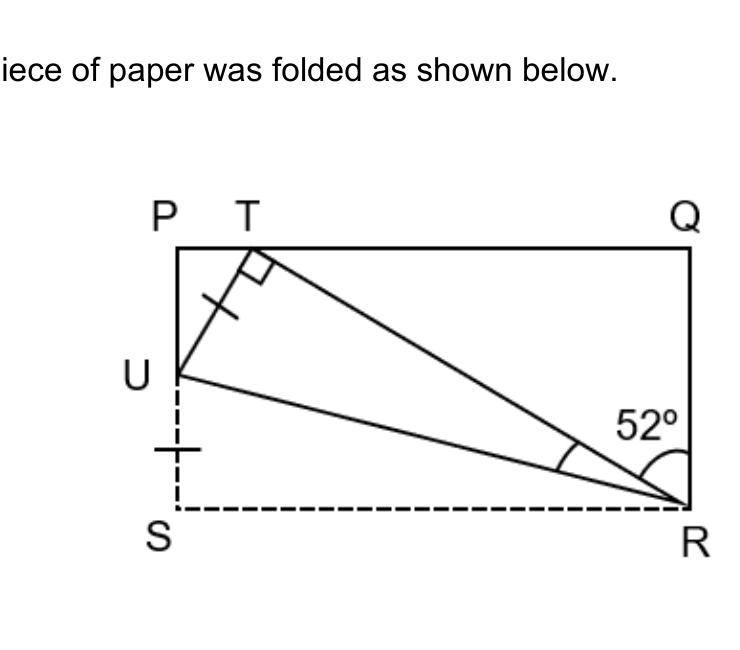
Answer: 26
Folding reflects the paper over crease UR, so S maps to T, meaning ∠SRU = ∠TRU (fold preserves this angle).
The two equal angles together make up the marked 52°: ∠SRU + ∠TRU = 52°.
So 2 × ∠TRU = 52° → ∠TRU = 26°.
28
bar-graph
medium
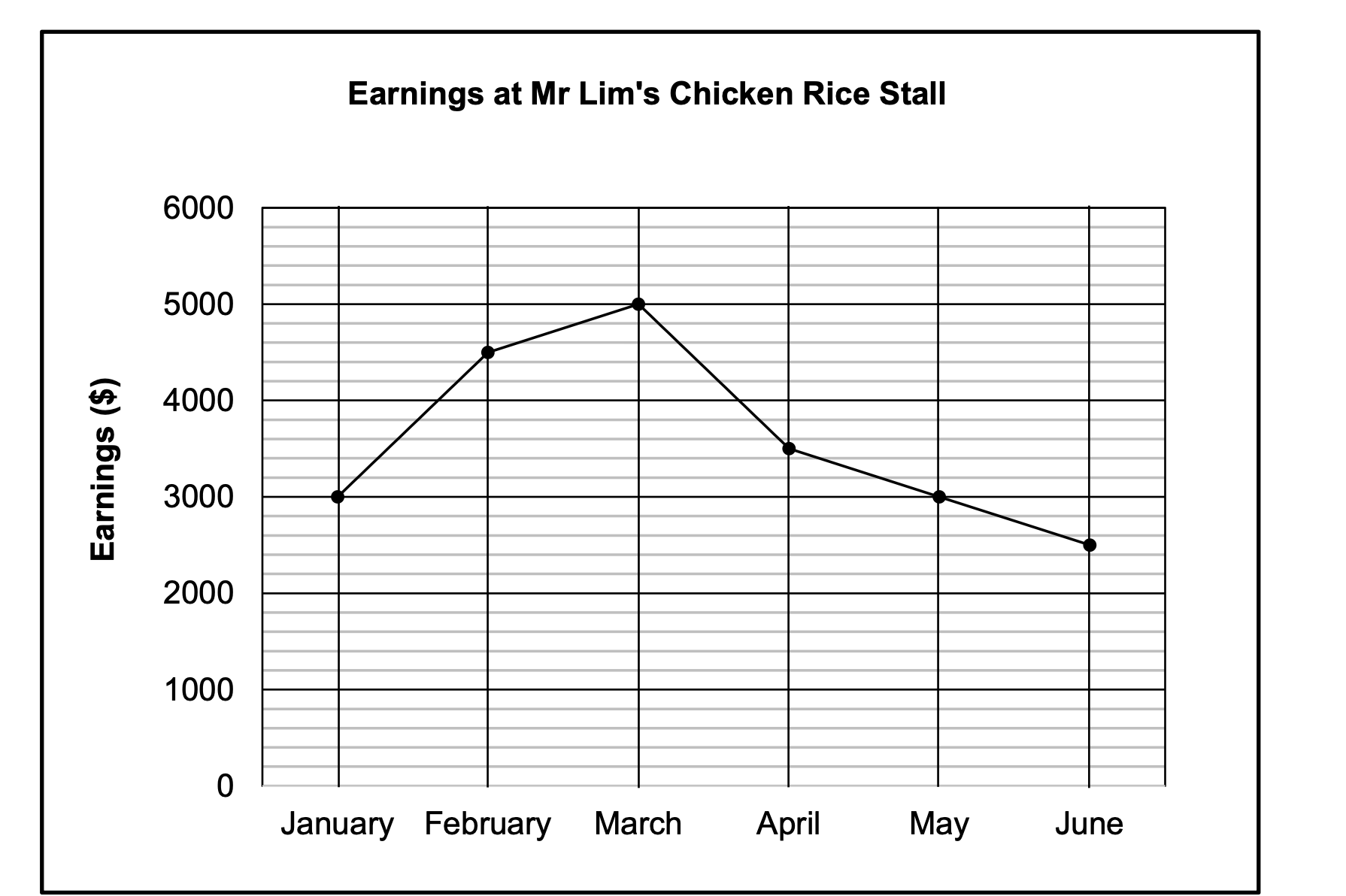
The line graph shows the earnings at Mr Lim's chicken rice stall over a 6-month period: January $3000, February $4500, March $5000, April $3500, May $3000, June $2500.
Mr Lim charged $5 for every plate of chicken rice.
What is the difference in the number of plates of chicken rice sold between the highest earnings month and the lowest earnings month?
Answer: 500
Highest earnings = March = $5000. Lowest earnings = June = $2500.
Difference in earnings = 5000 − 2500 = $2500.
Difference in plates = 2500 ÷ 5 = 500 plates.
29
geometry
medium
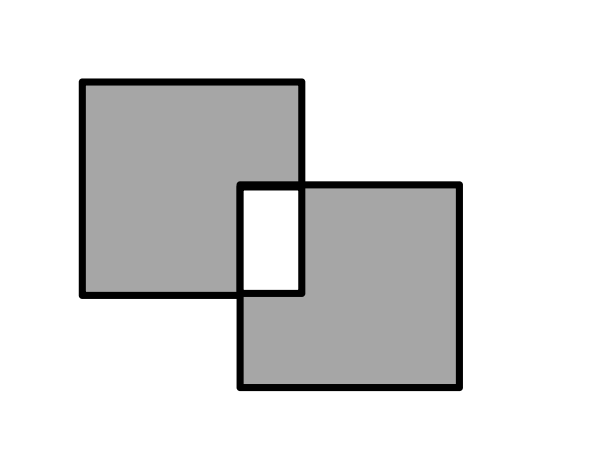
The figure is made up of 2 identical squares overlapping each other.
The unshaded rectangle (the overlap) has an area of 10 cm².
The total area of the shaded parts is 142 cm².
Find the length of the square.
Give your answer in cm.
Answer: 9
The whole drawn figure (union of the two squares) = shaded + unshaded = 142 + 10 = 152 cm².
The union of 2 overlapping squares of side s with overlap area 10 = 2s² − 10.
So 2s² − 10 = 152 → 2s² = 162 → s² = 81 → s = 9 cm.
30
geometry
easy
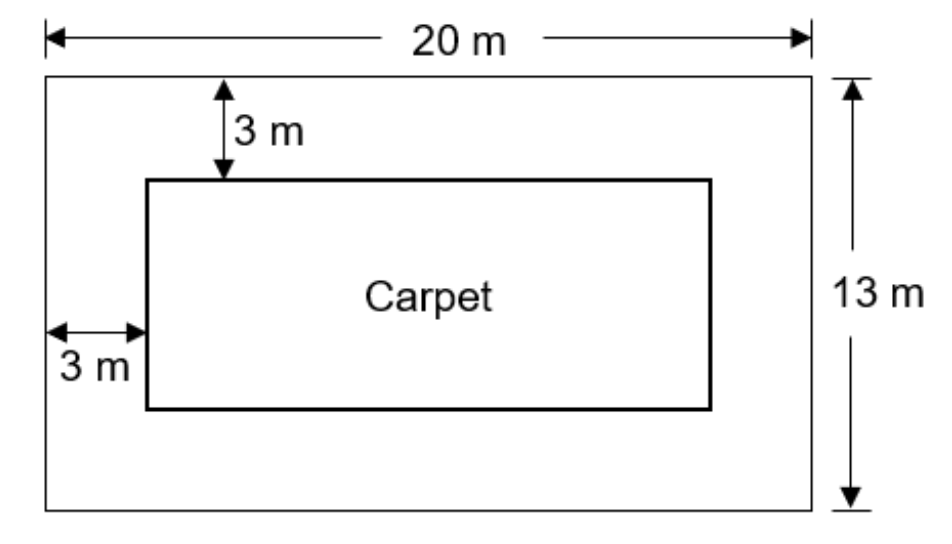
A carpet is laid on a rectangular floor measuring 20 m by 13 m, leaving a border of 3 m around it.
Find the area of the floor that is not covered by the carpet.
Give your answer in square metres.
Answer: 162
Carpet dimensions = (20 − 2×3) × (13 − 2×3) = 14 × 7 = 98 m².
Floor area = 20 × 13 = 260 m².
Uncovered area = 260 − 98 = 162 m².
31
money
easy
Max bought the same number of books and files.
Each book cost $7 and each file cost $2.
He paid $243 altogether.
How many books and files did he buy altogether?
Answer: 54
Let n = number of books = number of files.
7n + 2n = 243 → 9n = 243 → n = 27.
Total items = 2 × 27 = 54.
32
algebra
medium
John bought 2 crates of oranges.
Crate A contained 200 more oranges than Crate B.
After he transferred 50 oranges from Crate B to Crate A, there were twice as many oranges in Crate A than in Crate B.
How many oranges were there in Crate A at first?
Answer: 550
Let B = Crate B at first, A = B + 200.
After transfer: A + 50 = 2(B − 50) → B + 250 = 2B − 100 → B = 350.
A = B + 200 = 550.
33
patterns
medium
Some circles and triangles are arranged in a repeating pattern: triangle, circle, circle, circle, triangle, circle, circle, circle, triangle, ...
How many circles are there if there are 122 shapes?

Answer: 91
Each repeat unit is 4 shapes: 1 triangle + 3 circles.
122 ÷ 4 = 30 remainder 2, so there are 30 complete units (120 shapes: 30 triangles, 90 circles) plus 2 more shapes.
The next 2 shapes continue the pattern: triangle, circle.
Total circles = 90 + 1 = 91.
34
algebra
medium
Mr Tan has less than 40 sweets for a group of pupils.
If he gives his pupils 4 sweets each, he will be short of 1 sweet.
If he gives each pupil 5 sweets each, he will be short of 11 sweets.
How many pupils does he have in the group?
Answer: 10
Let n = number of pupils. Sweets = 4n − 1 = 5n − 11.
4n − 1 = 5n − 11 → n = 10.
Check: sweets = 4(10) − 1 = 39, which is less than 40. ✓
35
combinatorics
medium
There are 17 pupils in a class.
The teacher gets each pupil to give a hi-five to every classmate once.
How many hi-fives are exchanged altogether?
Answer: 136
Each pair of pupils exchanges exactly one hi-five: this is a combination of 17 pupils taken 2 at a time.
17 × 16 ÷ 2 = 136.
36
logic
medium
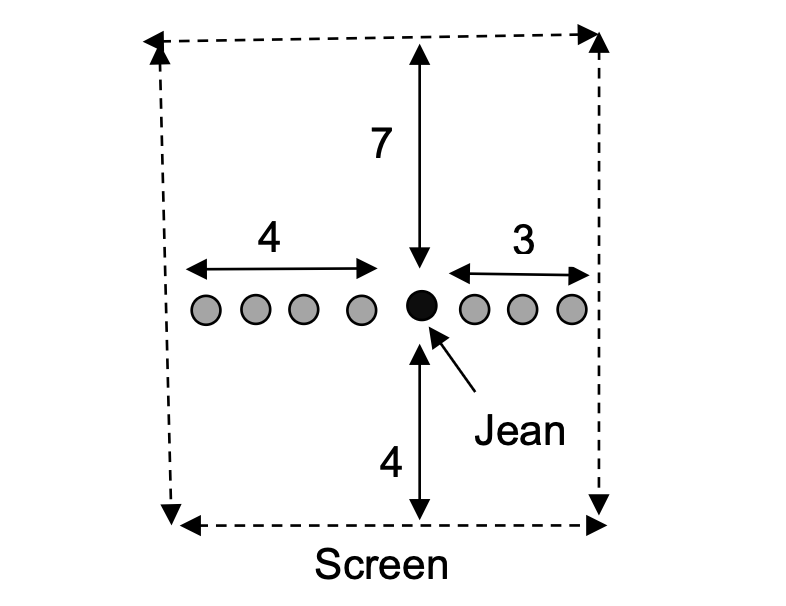
Jean is watching a movie in a hall.
The chairs in the hall are arranged in rows with the same number in each row.
All the chairs are occupied.
There are 7 people behind Jean and 4 people in front of her.
There are 3 people on her left and 4 people on her right.
How many people are watching the movie?
Answer: 96
Number of rows (front-to-back) = 7 (behind) + 1 (Jean) + 4 (front) = 12.
Number of columns (side-to-side) = 3 (left) + 1 (Jean) + 4 (right) = 8.
Total people = 12 × 8 = 96.
37
number-sense
medium
Mike had 72 oranges and 45 pears.
He packed the fruits such that each bag contained an equal number of oranges and an equal number of pears.
He packed the fruits into as many bags as possible.
How many fruits were there in each bag?
Answer: 13
The greatest number of bags = GCD(72, 45) = 9.
Each bag: 72 ÷ 9 = 8 oranges, 45 ÷ 9 = 5 pears.
Fruits per bag = 8 + 5 = 13.
38
geometry
hard
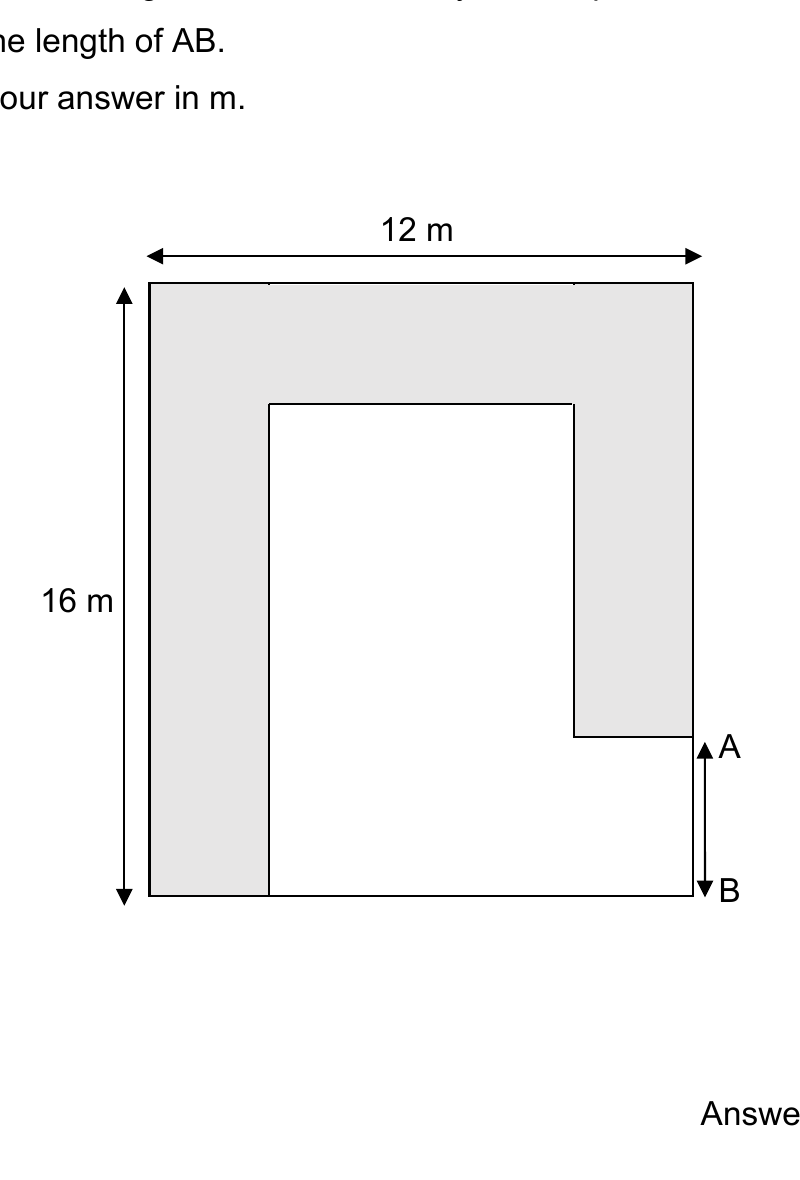
The following figure shows a rectangular garden (12 m × 16 m) with a footpath.
The width of the footpath is 2 m (running along the top and left edges, and down a 2 m-wide strip on the right side to point A).
The area of the garden not covered by the footpath is 124 m².
Find the length of AB.
Give your answer in m.
Answer: 6
Top path: 12 × 2 = 24 m². Left path (excluding the corner already counted): 2 × (16 − 2) = 28 m².
Let the right-side path strip run from the bottom of the top path (y = 2) down to point A (y = YA), with width 2 m: area = 2 × (YA − 2).
Total path area = 24 + 28 + 2(YA − 2) = 192 − 124 = 68 → 2(YA − 2) = 16 → YA = 10.
AB = 16 − YA = 16 − 10 = 6 m.
39
algebra
medium
In a General Knowledge quiz, 5 marks were awarded for a correct answer but 2 marks were deducted for an incorrect answer.
Mei Ling answered all 50 questions and was awarded a total of 166 marks.
How many questions did she answer correctly?
Answer: 38
Let c = correct answers, so 50 − c = wrong answers.
5c − 2(50 − c) = 166 → 5c − 100 + 2c = 166 → 7c = 266 → c = 38.
40
arithmetic
medium
Uncle Lee had some pears in his shop.
He sold 36 of them in the morning and threw away 5 bad ones.
He sold 10 pears in the afternoon and packed half of the remaining pears into 10 bags.
Each bag contained 7 pears.
How many pears did he have at first?
Answer: 191
10 bags × 7 pears = 70 pears = half of what remained after the morning sales, waste, and afternoon sale.
So the remaining amount = 70 × 2 = 140.
At first = 140 + 36 (morning) + 5 (thrown away) + 10 (afternoon) = 191.