1
place-value
easy
What is the value of 20 thousands and 9 tens?
Answer: 4
20 thousands = 20 000.
9 tens = 90.
20 000 + 90 = 20 090.
2
fractions
easy
How many one-thirds are there in 4 wholes?
Answer: 4
4 wholes = 4 ÷ (1/3) = 4 × 3 = 12 one-thirds.
3
fractions
easy
Which of the following is not an equivalent fraction of 1/4?
Answer: 3
2/8 = 1/4.
3/12 = 1/4.
25/100 = 1/4.
5/8 = 0.625, which is not equal to 1/4 (0.25).
So 5/8 is not an equivalent fraction of 1/4.
4
symmetry
medium
A figure folded in half along the dotted line of symmetry is shown below.
Which of the following figures is the symmetric figure when opened up?
(Options A, B, C, D are shown as figures — see image.)
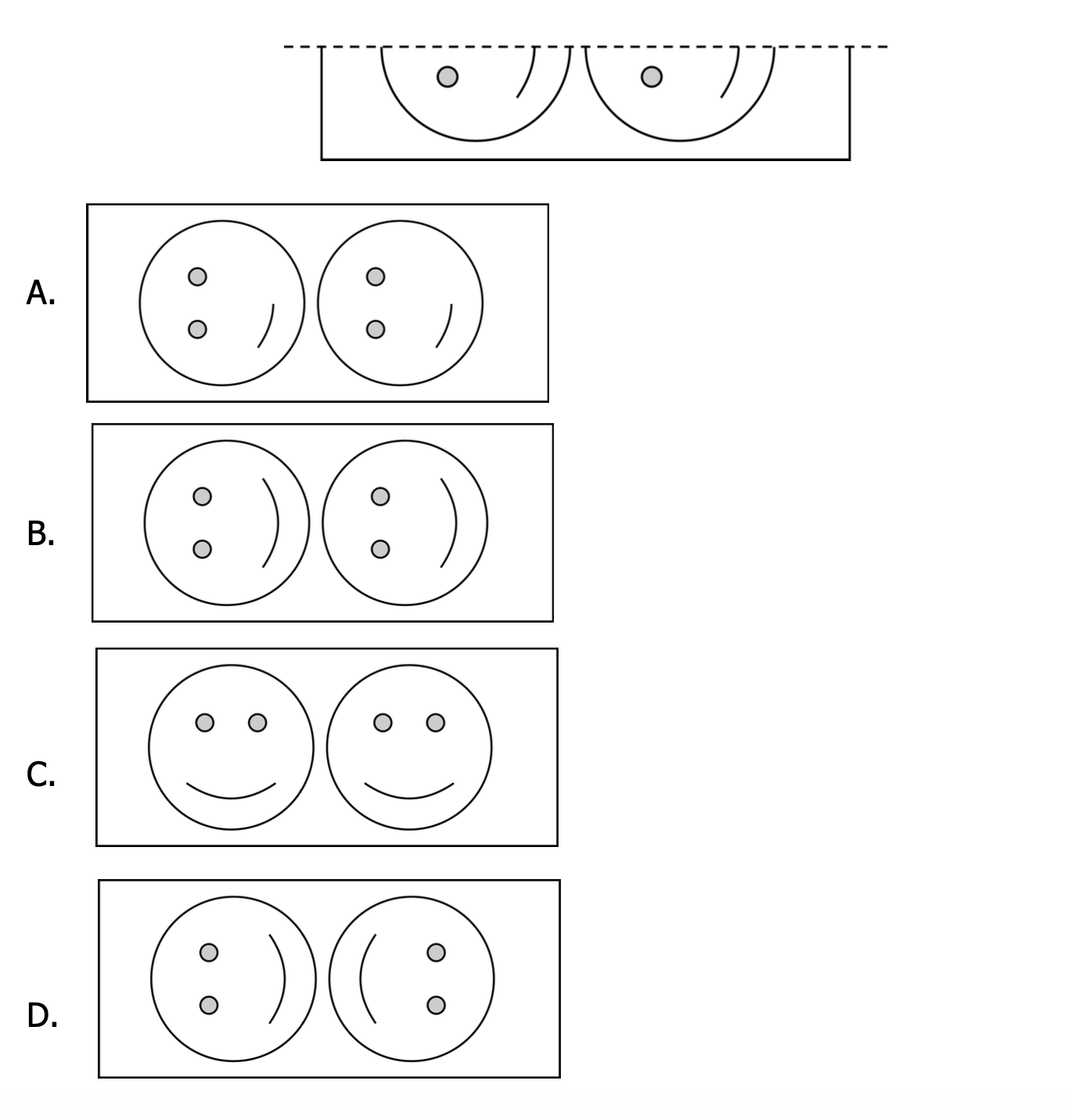
The four options are figures, not text — shown in the image.
Answer: 2
Reflecting the shown half across the horizontal fold line gives each circle a mirrored dot (so 2 dots stacked vertically per circle) and the curve keeps the same left-right orientation (since a vertical flip doesn't reverse it).
Option B matches this: 2 stacked dots and a matching curve on each circle.
5
data-tables
easy
The table shows the number of pets kept by a group of children.
Number of pets: 0, 1, 2, 3, 4
Number of children: 10, 17, 5, 8, 2
How many children have more than 1 pet?
Answer: 1
Children with more than 1 pet have 2, 3 or 4 pets.
5 + 8 + 2 = 15.
6
perimeter
medium
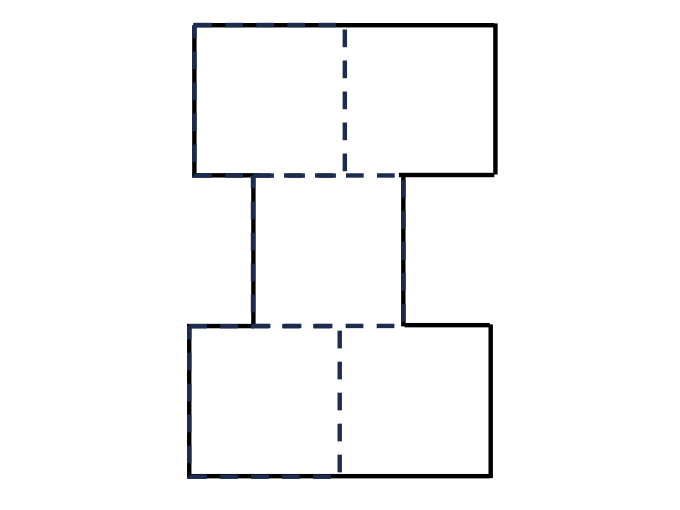
The figure below is made up of 5 identical squares.
The area of each square is 36 cm².
What is the perimeter of the figure?
Answer: 2
Each square has side √36 = 6 cm.
The 5 squares form a dumbbell/H shape: a 2-square block on top, a single connecting square in the middle, and a 2-square block on the bottom.
Tracing the outline and summing every exposed edge gives a total perimeter of 72 cm.
7
fractions-decimals
medium
Arrange the following from the greatest to the smallest: 9/20, 0.54, 4.05, 1/2
Answer: 4
9/20 = 0.45.
1/2 = 0.5.
Comparing 4.05, 0.54, 0.5, 0.45 from greatest to smallest: 4.05, 0.54, 1/2, 9/20.
8
money
easy
Jason has $20.
He bought 2 packets of chips and 6 oranges.
1 packet of chips costs $2.50.
3 oranges cost $1.20.
How much money did he have left?
Answer: 4
2 packets of chips = 2 × $2.50 = $5.
6 oranges = 2 × 3 oranges = 2 × $1.20 = $2.40.
Total spent = $5 + $2.40 = $7.40.
Money left = $20 − $7.40 = $12.60.
9
direction
hard
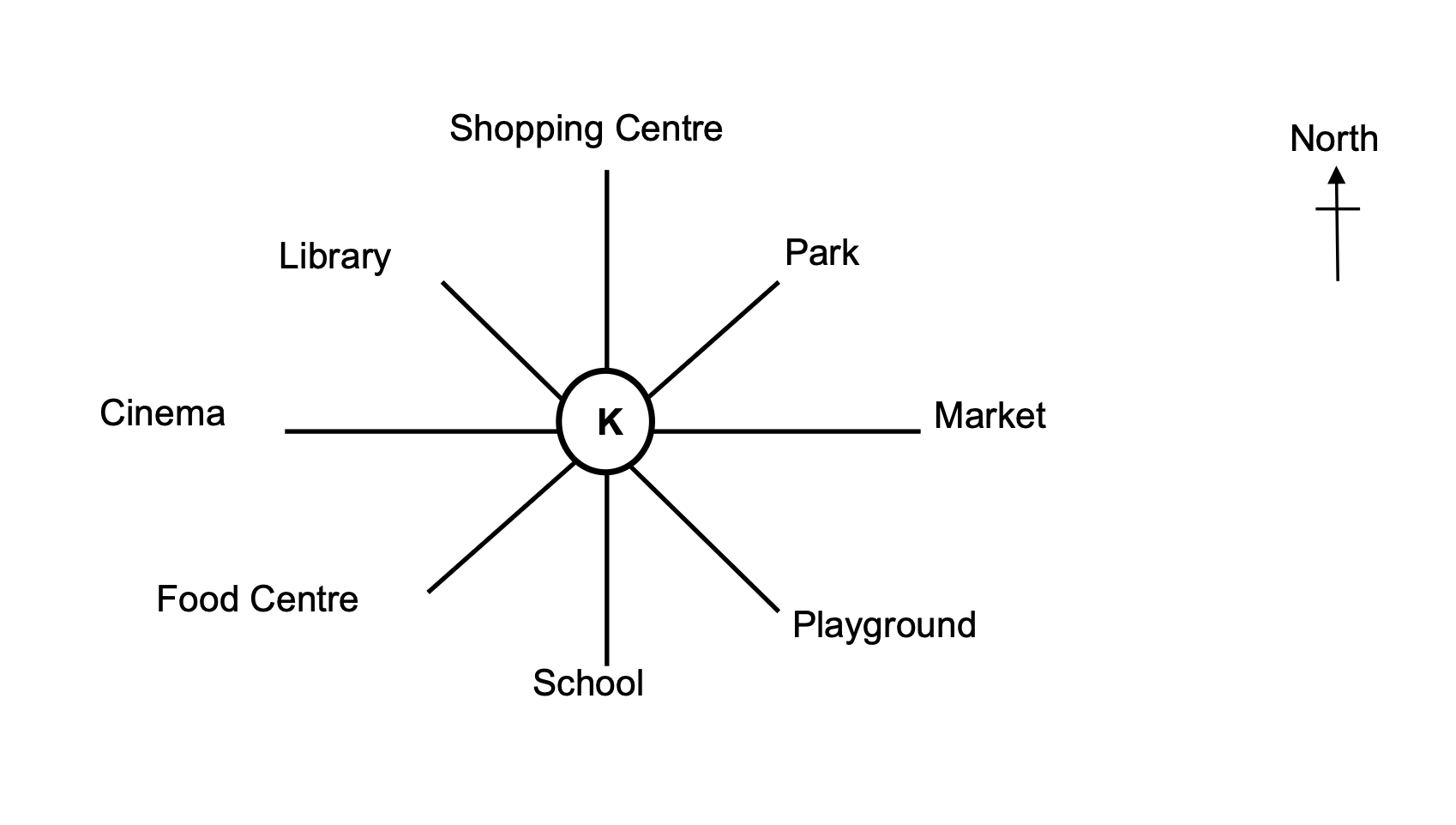
Kayden is standing at point K facing the park.
He makes a 135° clockwise turn followed by a 315° anticlockwise turn.
Where will he be facing now?
(Map around K, tentatively read as: Library=NW, Shopping Centre=N, Park=NE, Cinema=W, Market=E, Food Centre=SW, School=S, Playground=SE.)
Answer: 1
Confirmed from the map: Park = NE, Shopping Centre = N, Library = NW, Market = E, Cinema = W, Playground = SE, School = S, Food Centre = SW.
Starting bearing (facing Park) = 45°.
Net turn = 135° clockwise − 315° anticlockwise = −180°.
Final bearing = 45° − 180° = −135° = 225° = SW = Food Centre.
10
fractions
medium
Linda had 3 litres of milk.
She spilled 1/6 ℓ of milk and used 3/4 ℓ to bake some cookies.
How much milk did she have left?
Answer: 2
3 = 36/12 ℓ.
1/6 = 2/12 ℓ, 3/4 = 9/12 ℓ.
Left = 36/12 − 2/12 − 9/12 = 25/12 = 2 1/12 ℓ.
11
angles
medium
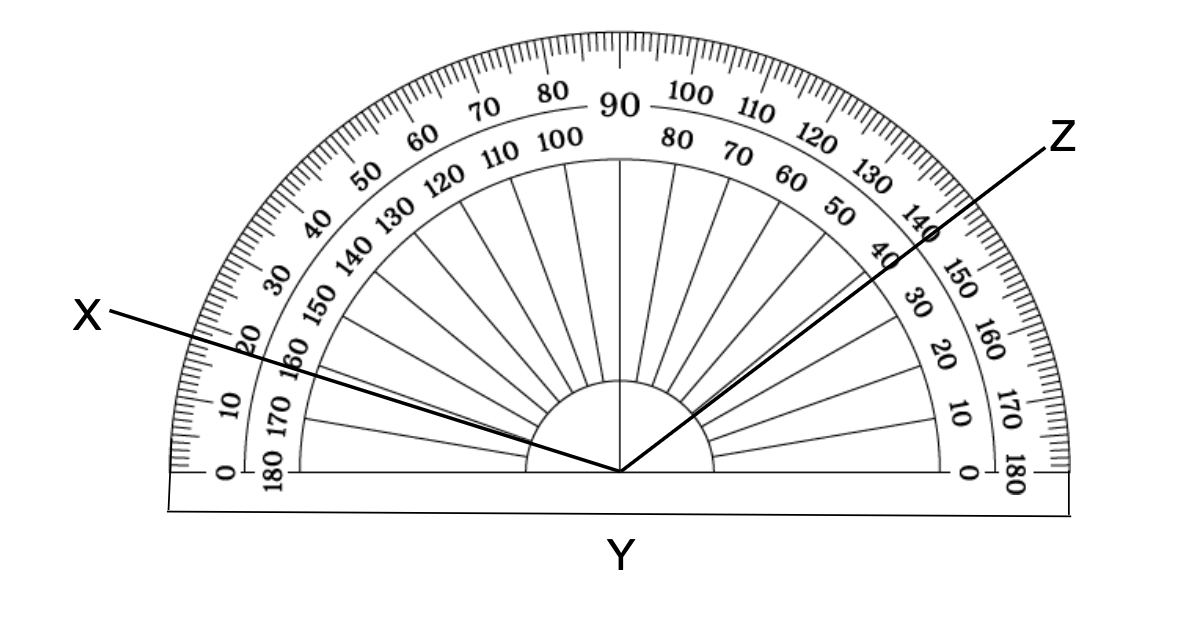
Find the value of ∠XYZ.
(Angle figure with points X, Y, Z — angle values are marked only in the figure, not given in the text.)
Answer: 3
Read directly from the protractor: ∠XYZ = 124°.
12
counting
medium
Mrs Bala wanted to sew 6 ribbons on each side of a square handkerchief as shown below.
There was a ribbon at each corner of the handkerchief.
How many ribbons did she sew in total?
Answer: 2
Each side has 6 ribbons, and the 4 corner ribbons are shared between 2 adjacent sides.
Total if counted separately = 4 × 6 = 24.
Each of the 4 corners is double-counted once, so subtract 4: 24 − 4 = 20.
13
time
medium
Mariam started her piano lesson at the time shown on the clock below.
The duration of the piano lesson is 75 minutes.
However, the lesson ended 10 minutes later.
What time did her lesson end?
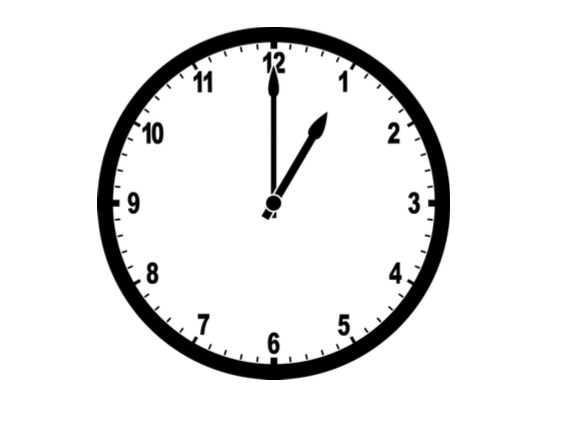
Answer: 4
The clock shows 1:00 (hour hand at 1, minute hand at 12).
Actual lesson duration = 75 + 10 = 85 minutes.
1:00 + 85 min = 2:25, i.e. 14:25.
14
data-graphs
medium
The graph below shows the number of watches sold by a shop from January to April.
The total number of watches sold from January to April was 4 times the number of watches sold in May.
How many watches were sold in May?
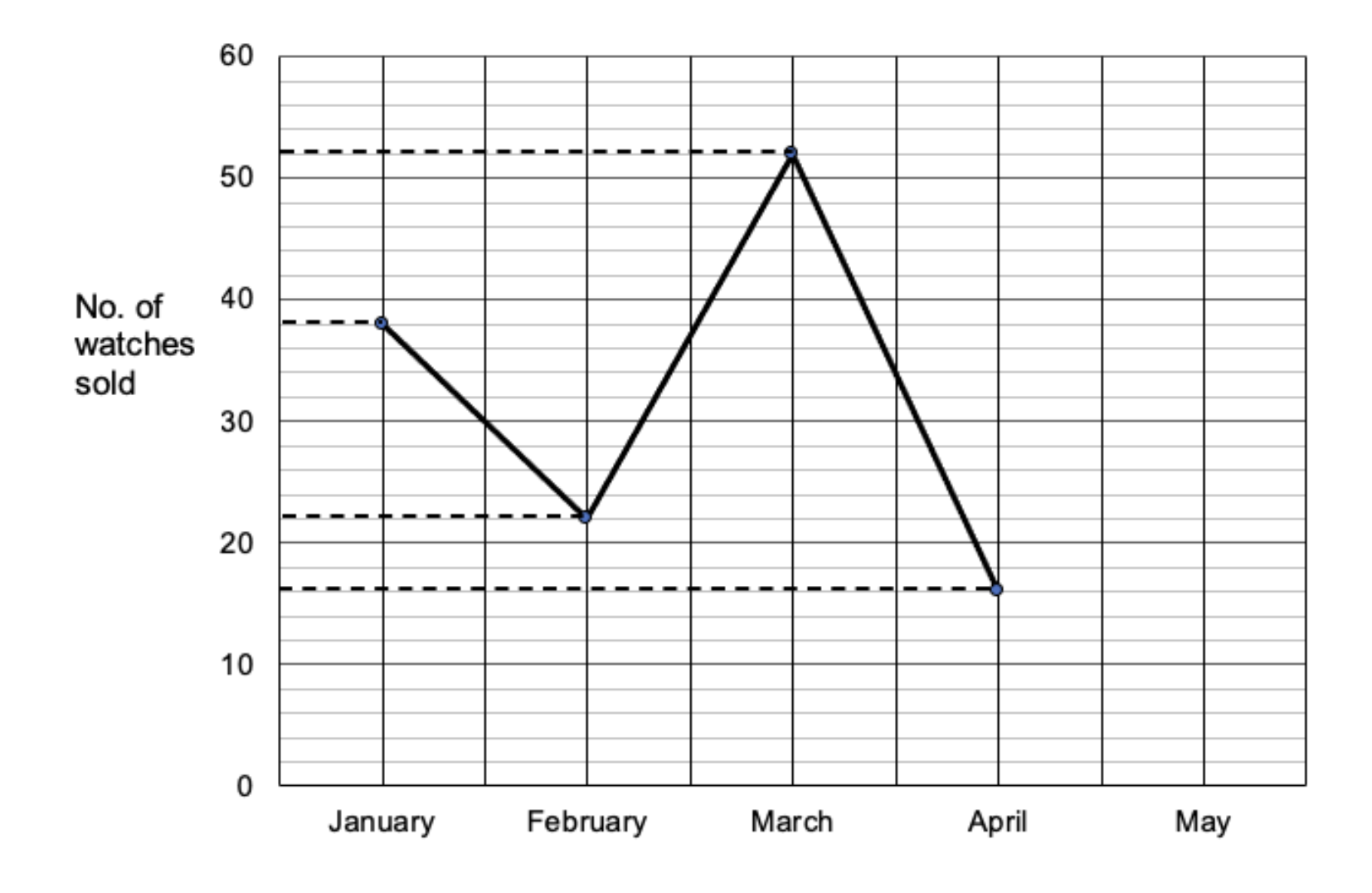
Answer: 2
From the graph: January = 38, February = 22, March = 52, April = 16.
Total Jan–Apr = 38 + 22 + 52 + 16 = 128.
This is 4 times May's sales, so May = 128 ÷ 4 = 32.
15
area
medium
A piece of paper is cut into Square A and Rectangle B.
The area of A is twice the area of B.
The breadth of Rectangle B is 14 cm.
(Square A and Rectangle B are side by side, sharing a common side length.)
What is the area of Square A?
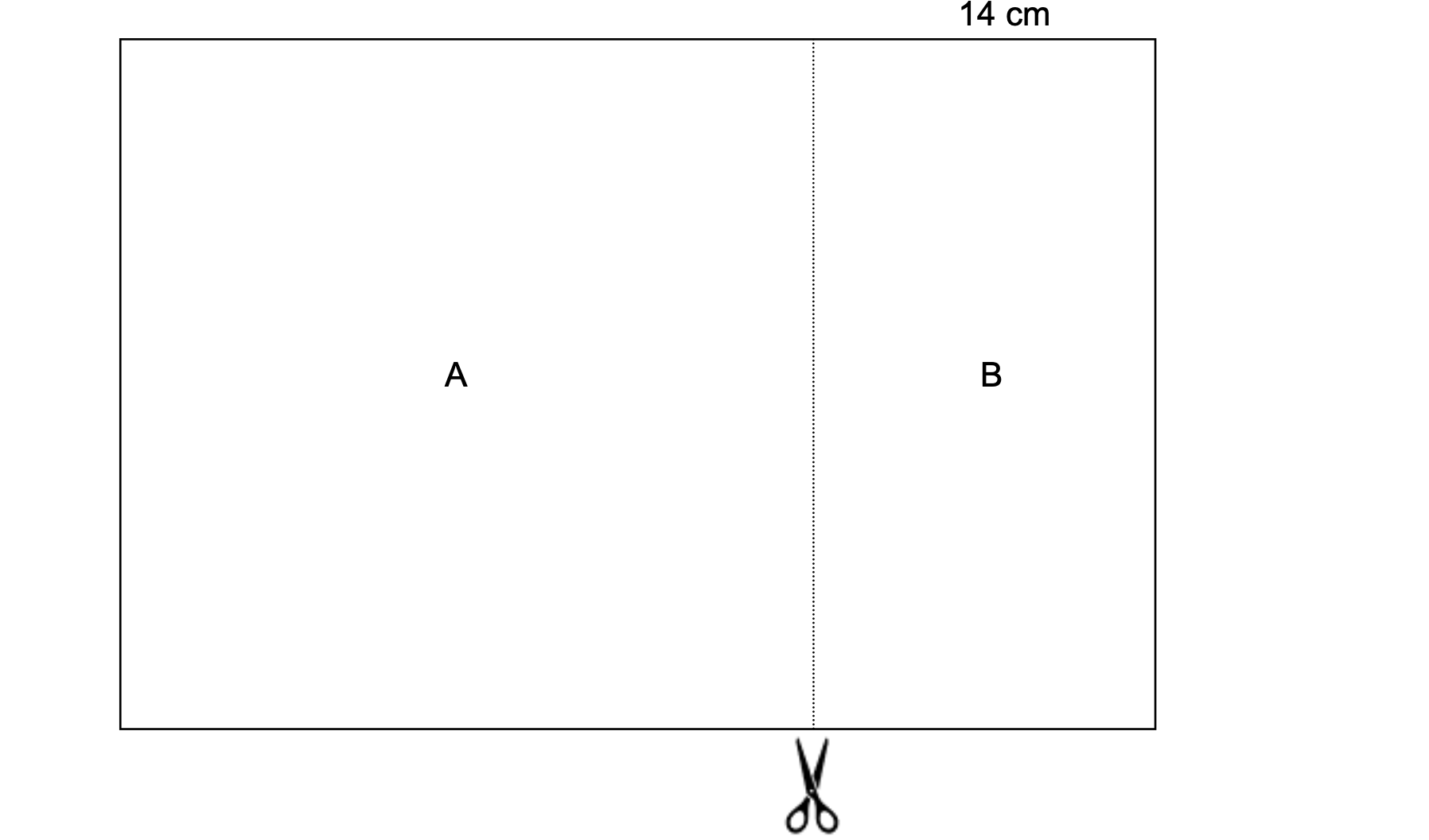
Answer: 4
Let the side of Square A = s.
Since A and B are cut from the same strip and placed side by side, Rectangle B's length = s (Square A's side), and its breadth = 14 cm.
Area of A = s × s = s².
Area of B = s × 14.
s² = 2 × (14s) → s = 28.
Area of Square A = 28 × 28 = 784 cm².
16
money
medium
A stall had a promotion: Buy 1 muffin for $3 each, or Buy 4 muffins at $11.
Mandy wanted to buy 50 muffins.
What was the least amount of money Mandy had to pay for all the 50 muffins?
Answer: 138
Buying in groups of 4 is cheaper per muffin ($2.75) than buying singly ($3).
50 ÷ 4 = 12 groups of 4 (48 muffins), remainder 2 muffins.
12 × $11 = $132 for 48 muffins.
2 muffins at $3 each = $6.
Total = $132 + $6 = $138.
(Buying an extra group of 4 to reach 52 muffins would cost 13 × $11 = $143, which is more, so $138 is the least.)
17
algebra
medium
Ashley is 10 years old and her mother is 46 years old.
In how many years' time will Ashley's mother be 4 times as old as Ashley?
Answer: 2
Let x = number of years.
46 + x = 4(10 + x)
46 + x = 40 + 4x
6 = 3x
x = 2.
18
angles
hard
In the figure below, ABCD is a rectangle and DEFG is a square.
∠CDG = 64º and ∠EDH = 33º.
DH is a straight line.
Find ∠ADH.
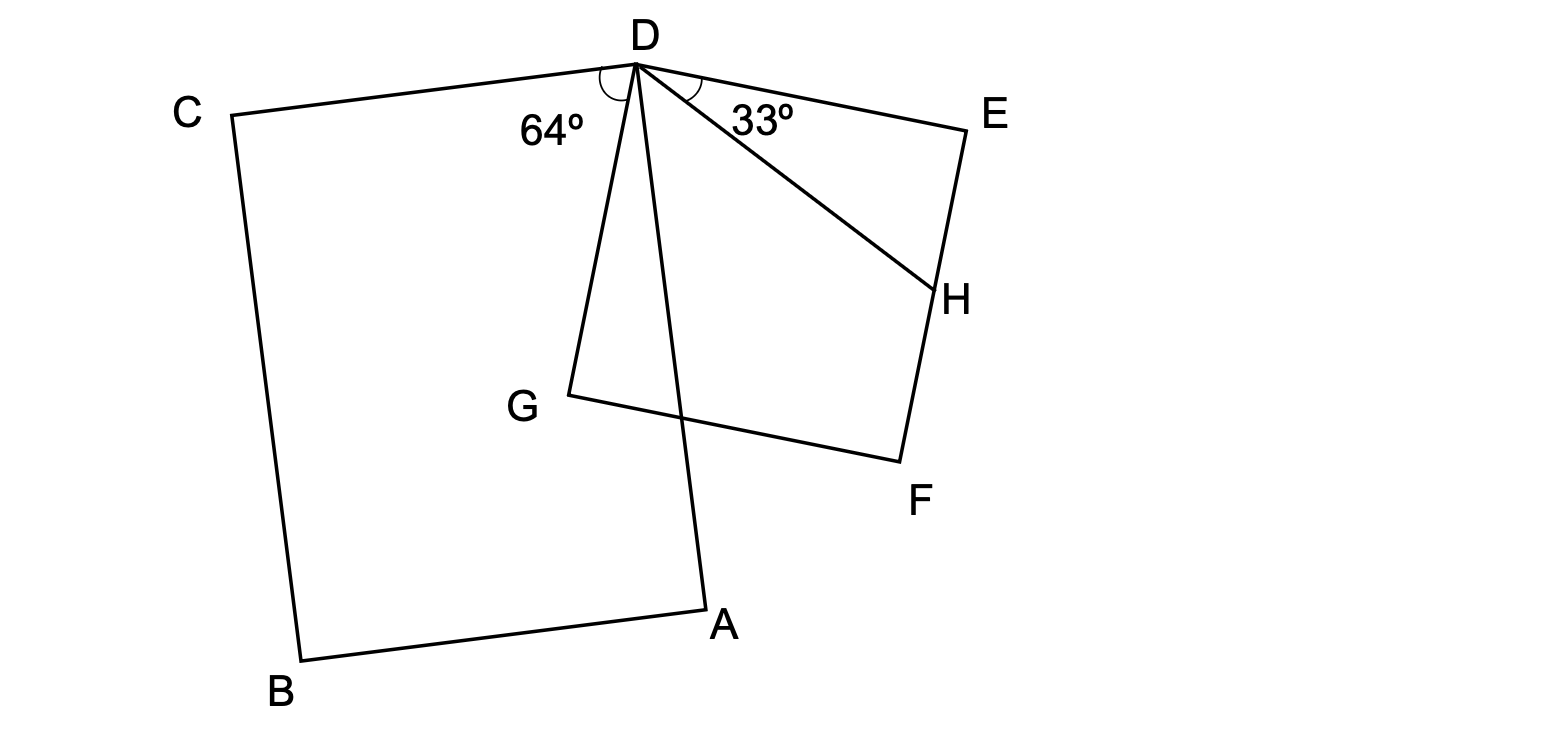
Answer: 31
∠CDA = 90° (rectangle corner).
∠CDG = 64° (given), so ∠GDA = 90° − 64° = 26°.
∠GDE = 90° (square corner), and since A lies between G and E: ∠ADE = ∠GDE − ∠GDA = 90° − 26° = 64°.
∠EDH = 33° (given), and H lies between A and E: ∠ADH = ∠ADE − ∠EDH = 64° − 33° = 31°.
19
algebra
medium
There were 163 ribbons in Box A and 115 ribbons in Box B.
Some ribbons were moved from Box A to Box B.
In the end, there were 26 more ribbons in Box A than Box B.
How many ribbons were there in Box A in the end?
Answer: 152
Total ribbons stays constant = 163 + 115 = 278.
Let A_end and B_end be the final amounts: A_end − B_end = 26 and A_end + B_end = 278.
Adding: 2 × A_end = 304 → A_end = 152.
20
area
hard
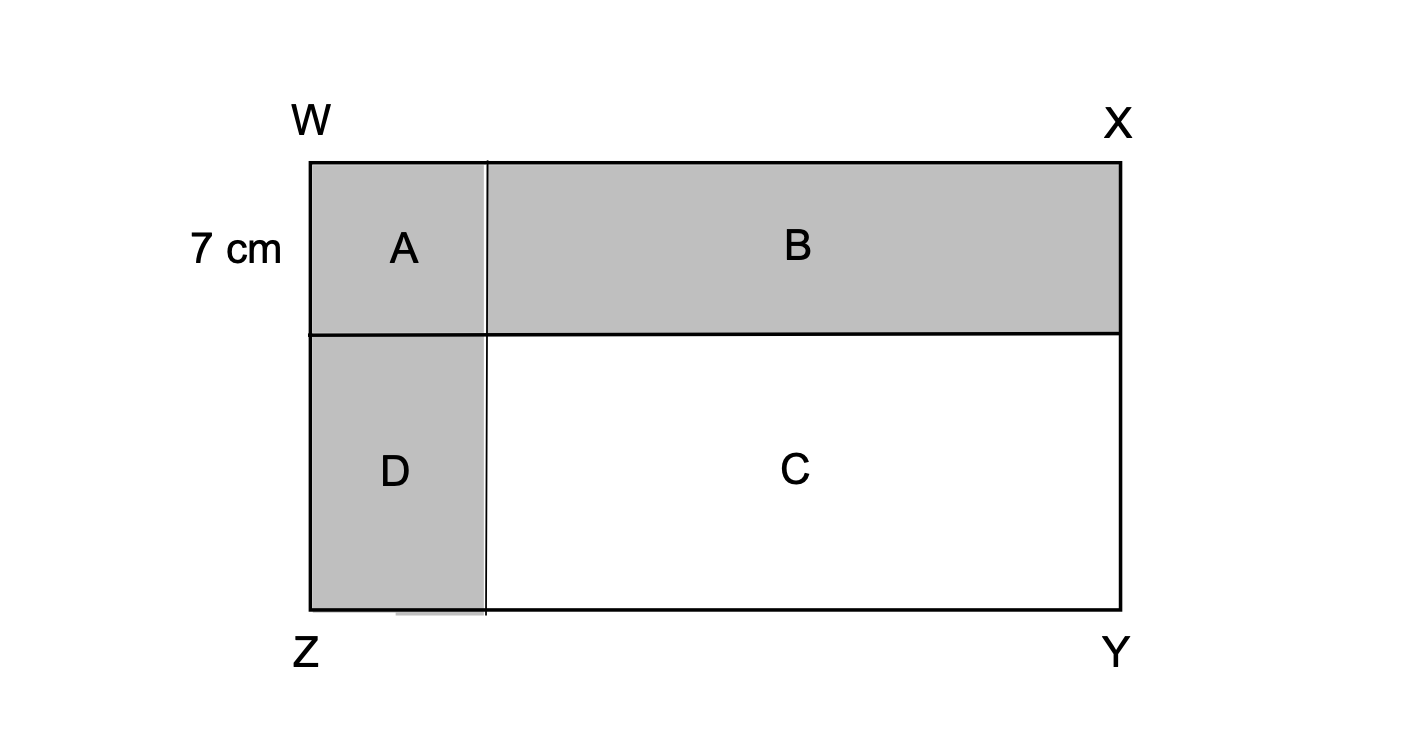
In the figure below, Square A and Rectangles B, C and D form the rectangle WXYZ.
Square A (top-left, side 7 cm), Rectangle B (top-right), Rectangle D (bottom-left), Rectangle C (bottom-right).
The area of Rectangle B is twice the area of Rectangle D.
The area of the shaded part is 385 cm².
Find the area of Rectangle C. Give your answer in cm².
Answer: 512
Confirmed from the figure: A and B (top row) and D (bottom-left) are shaded; C is unshaded.
Let the right column width = w and the bottom row height = h.
Area of A = 7 × 7 = 49.
Area of B = 7w, Area of D = 7h.
Area B = 2 × Area D → 7w = 14h → w = 2h.
Shaded = A + B + D = 49 + 7w + 7h = 385 → 7(w + h) = 336 → w + h = 48.
With w = 2h: 3h = 48 → h = 16, w = 32.
Area of Rectangle C = w × h = 32 × 16 = 512 cm².
21
fractions
hard
Julia had some beads in a jar.
1/4 of the beads were red and the rest of the beads were green.
After Julia put another 318 red beads into the jar, the fraction of green beads in the jar became 3/7.
What was the total number of beads in the jar at first?
Answer: 424
Let the total at first = T.
Red = T/4, Green = 3T/4 (unchanged, since only red beads were added).
New total = T + 318.
Green fraction: (3T/4) / (T + 318) = 3/7.
7 × (3T/4) = 3(T + 318)
21T/4 = 3T + 954
21T = 12T + 3816
9T = 3816
T = 424.
22
algebra
hard
David paid $7374 for 3 laptops and 2 headphones.
Kumar paid $5002 more than David for 5 laptops and 4 headphones.
What was the cost of 1 headphone?
Answer: 129
3L + 2H = 7374 ... (i)
Kumar's total = 7374 + 5002 = 12376 for 5L + 4H: 5L + 4H = 12376 ... (ii)
2 × (i): 6L + 4H = 14748.
Subtract (ii): L = 14748 − 12376 = 2372.
From (i): 3(2372) + 2H = 7374 → 2H = 7374 − 7116 = 258 → H = 129.
23
mass
medium
The total mass of a box and a watermelon was 7 kg 34 g.
When some strawberries were added into the box, the total mass became 8600 g.
The watermelon was 3 times as heavy as all the strawberries added.
Find the mass of the box. Give your answer in grams.
Answer: 2336
7 kg 34 g = 7034 g.
Mass of strawberries added = 8600 − 7034 = 1566 g.
Mass of watermelon = 3 × 1566 = 4698 g.
Mass of box = 7034 − 4698 = 2336 g.
24
patterns
medium
Jamie was asked to decorate a classroom for a party.
The classroom was a square with a length of 6 m 40 cm.
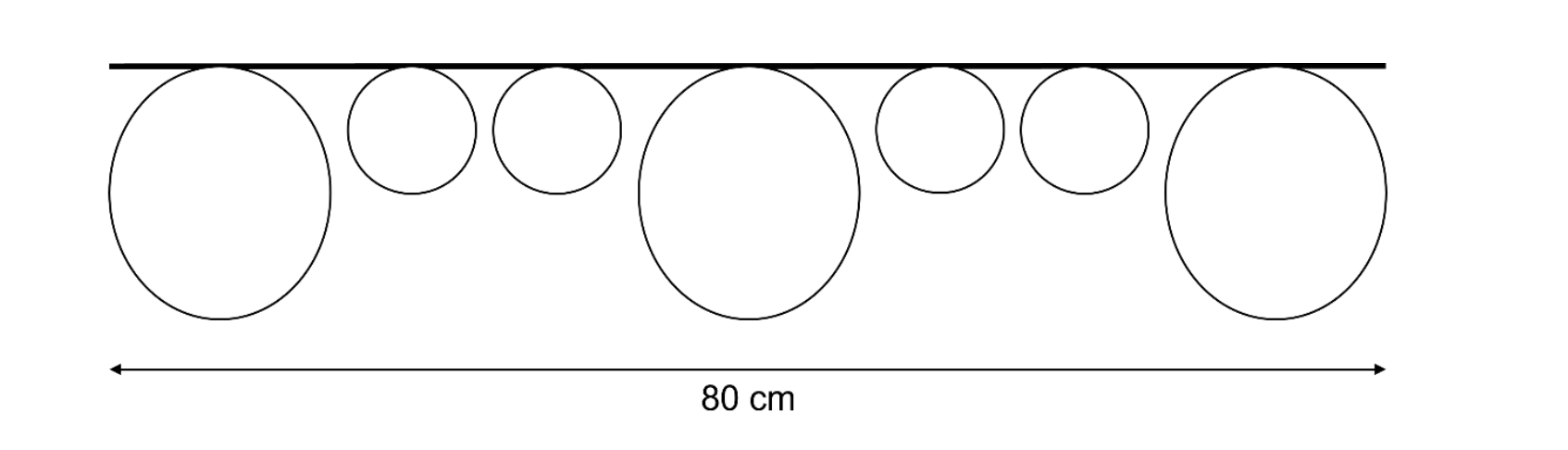
She tied balloons as shown in the pattern below repeatedly on a string and hanged the string around the classroom once.
How many small balloons did she use to decorate the 4 sides of the classroom?
Answer: 128
The pattern repeats every (1 big + 2 small) balloons, and the figure shows 2 full repeats spanning 80 cm (the 7th circle just marks the start of the next repeat), so 1 repeat = 40 cm.
Classroom perimeter = 4 × 640 cm = 2560 cm.
Number of repeats around = 2560 ÷ 40 = 64.
Small balloons = 64 × 2 = 128.
25
money
hard
At a fruit stall, mangoes are sold at 2 for $7 and the pears are sold at 3 for $5.50.
Mdm Fauziah bought the same number of mangoes and pears.
She paid $160 in total.
How many mangoes did she buy?
Answer: 30
Let n = number of mangoes = number of pears bought (n must be a multiple of 6 to divide evenly into groups of 2 and 3).
Let n = 6k.
Mango cost = (n/2) × 7 = 3k × 7 = 21k.
Pear cost = (n/3) × 5.50 = 2k × 5.50 = 11k.
Total = 21k + 11k = 32k = 160 → k = 5.
n = 6 × 5 = 30 mangoes.
26
mass
hard
Mr Lee had an apple, a papaya and a honeydew.
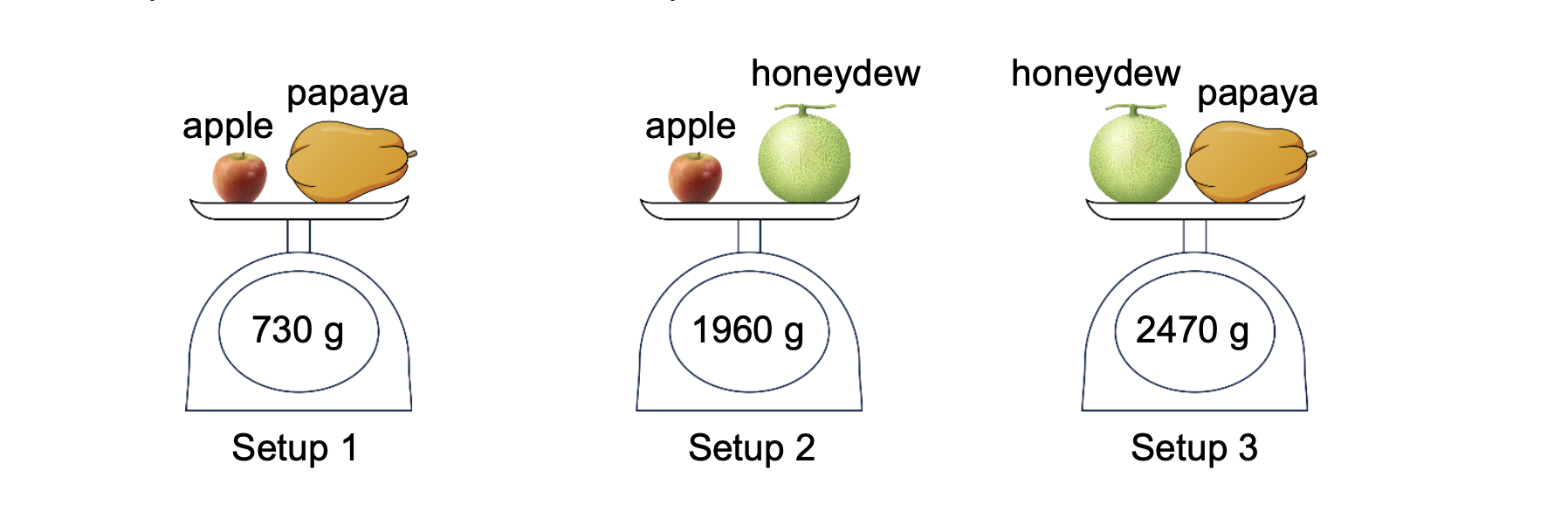
He placed the fruits in 3 different setups on a weighing scale:
Setup 1: apple + papaya = 730 g.
Setup 2: apple + honeydew = 1960 g.
Setup 3: honeydew + papaya = 2470 g.
What was the mass of the honeydew in grams?
Answer: 1850
Adding all three: 2 × (apple + papaya + honeydew) = 730 + 1960 + 2470 = 5160.
apple + papaya + honeydew = 2580.
Honeydew = 2580 − (apple + papaya) = 2580 − 730 = 1850 g.
(Check: apple = 2580 − 2470 = 110 g, papaya = 2580 − 1960 = 620 g, apple + papaya = 730 g ✓)
27
hcf
medium
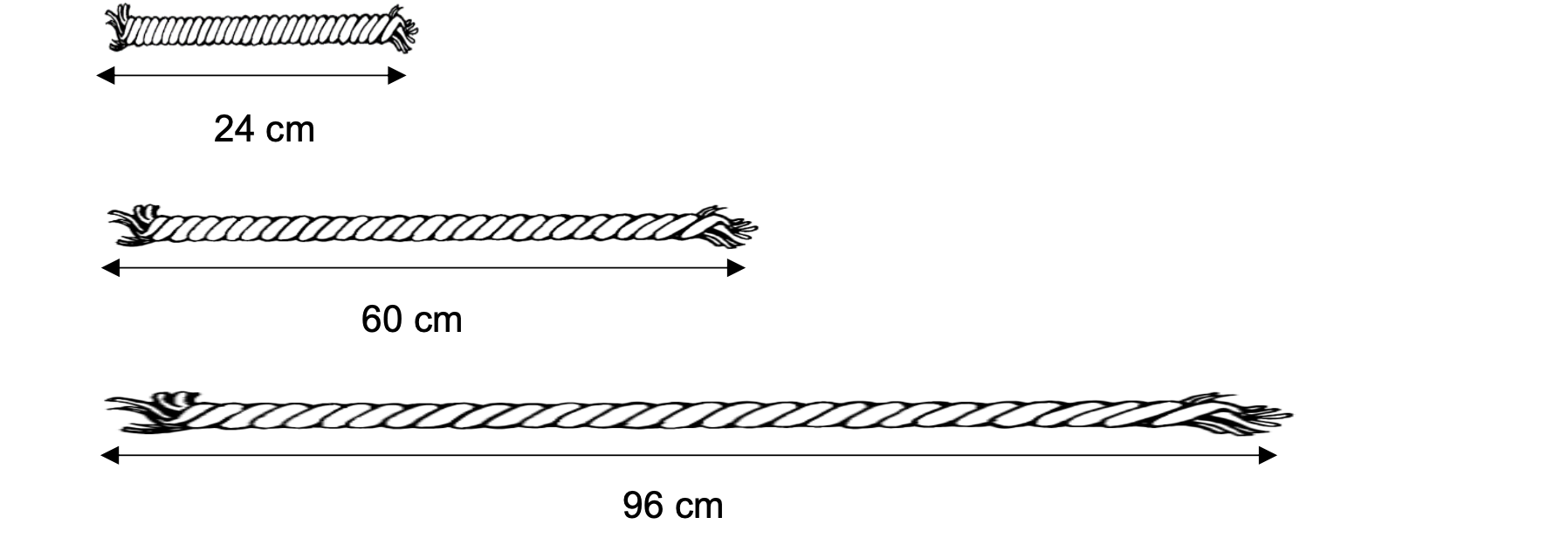
Kenny has 3 pieces of ropes of length 24 cm, 60 cm and 96 cm.
He wants to cut them into smaller pieces of equal length without any leftovers.
Each smaller piece must be cut into the greatest possible length.
How many of such pieces of ropes of equal length can he get?
Answer: 15
Greatest possible equal length = HCF(24, 60, 96).
24 = 2³ × 3, 60 = 2² × 3 × 5, 96 = 2⁵ × 3.
HCF = 2² × 3 = 12 cm.
Total number of pieces = (24 + 60 + 96) ÷ 12 = 180 ÷ 12 = 15.
28
perimeter
hard
Sam used Square X, Rectangle Y and Rectangle Z to form Figure A (a staircase-like shape).
Given dimensions: 5 cm, 9 cm, 14 cm, 3 cm, 4 cm (as marked in the figure).
What is the perimeter of Figure A? Give your answer in cm.
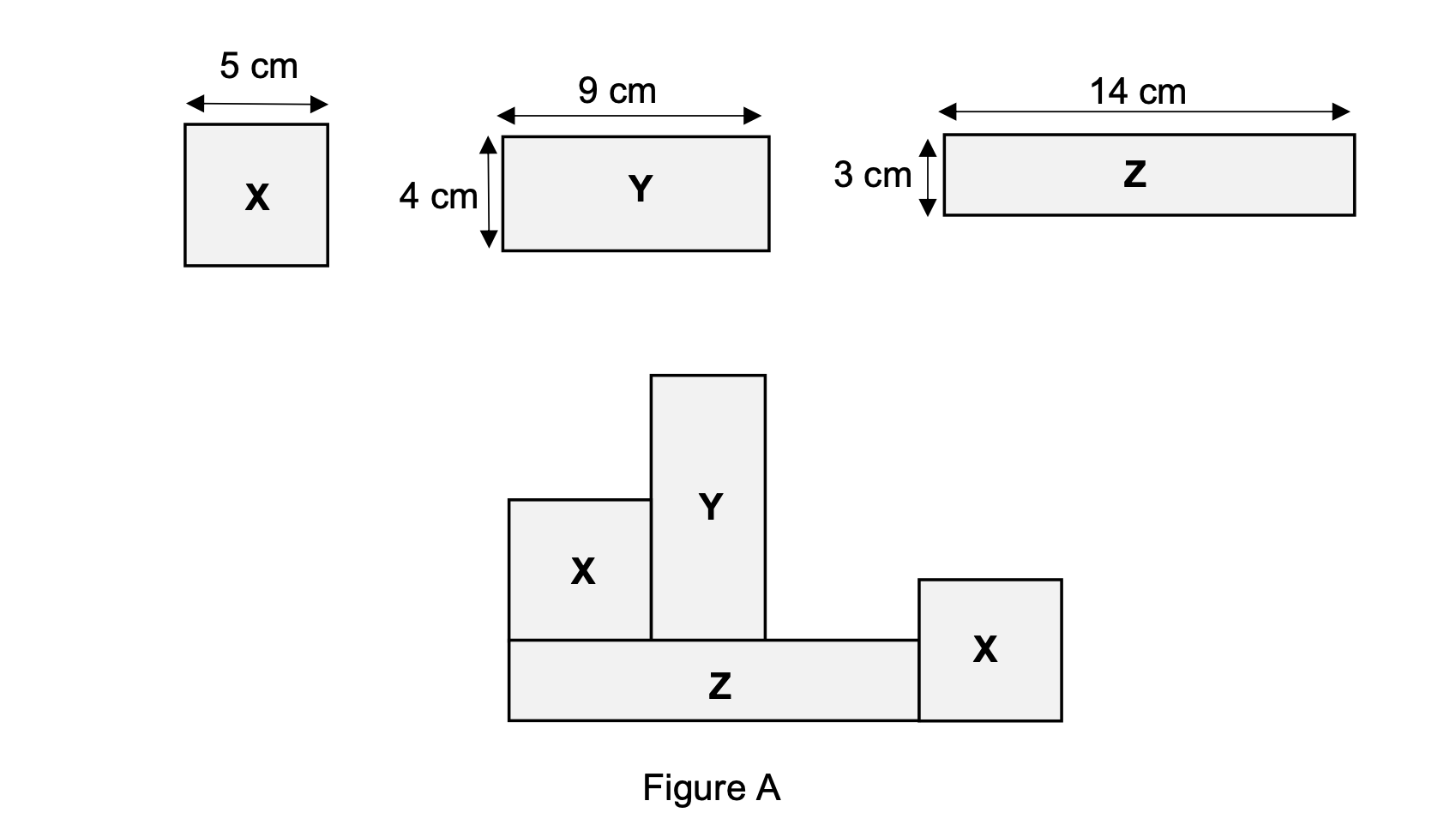
Answer: 66
Tracing the outline of Figure A (Z as the 14×3 cm base, X as a 5×5 square on top-left of Z, Y rotated to 4×9 cm standing on top of Z to the right of X, and a second 5×5 X sitting on the ground beside Z's right end) and summing every exposed edge:
19 (bottom) + 5 (right of 2nd X) + 5 (top of 2nd X) + 2 (step down to Z's ledge) + 5 (Z's exposed top) + 9 (right of Y) + 4 (top of Y) + 4 (left of Y down to X's top) + 5 (top of X) + 8 (left of X down to ground) = 66 cm.
29
fractions
medium
A spider was climbing to the top of a garden wall.
It started from the bottom of the wall.
After climbing up 1/3 of the wall, it began to rain.
During the rain, the spider slipped down 30 cm and stayed at the same spot until the rain stopped.
Then, the spider resumed to climb up the remaining 5/6 of the height of the wall to reach the top.
What was the total height the spider had climbed (before and after the rain)? Give your answer in cm.
Answer: 210
Let the wall height = H.
Position after first climb = H/3. After slipping down 30 cm: H/3 − 30.
It then climbs 5H/6 more to reach the top H:
(H/3 − 30) + 5H/6 = H
2H/6 + 5H/6 − 30 = H
7H/6 − H = 30
H/6 = 30 → H = 180 cm.
Height climbed before rain = H/3 = 60 cm.
Height climbed after rain = 5H/6 = 150 cm.
Total height climbed = 60 + 150 = 210 cm (the 30 cm slip is downward, not climbed).
30
area
hard
The figure shows a rectangular park measuring 54 m by 28 m.
A pedestrian path measuring 2 m wide and a cyclist path measuring 3 m wide are built along two (different, adjacent) sides of the park.
It costs $18 to construct each square metre of the cyclist path.
How much does it cost to construct the cyclist path?
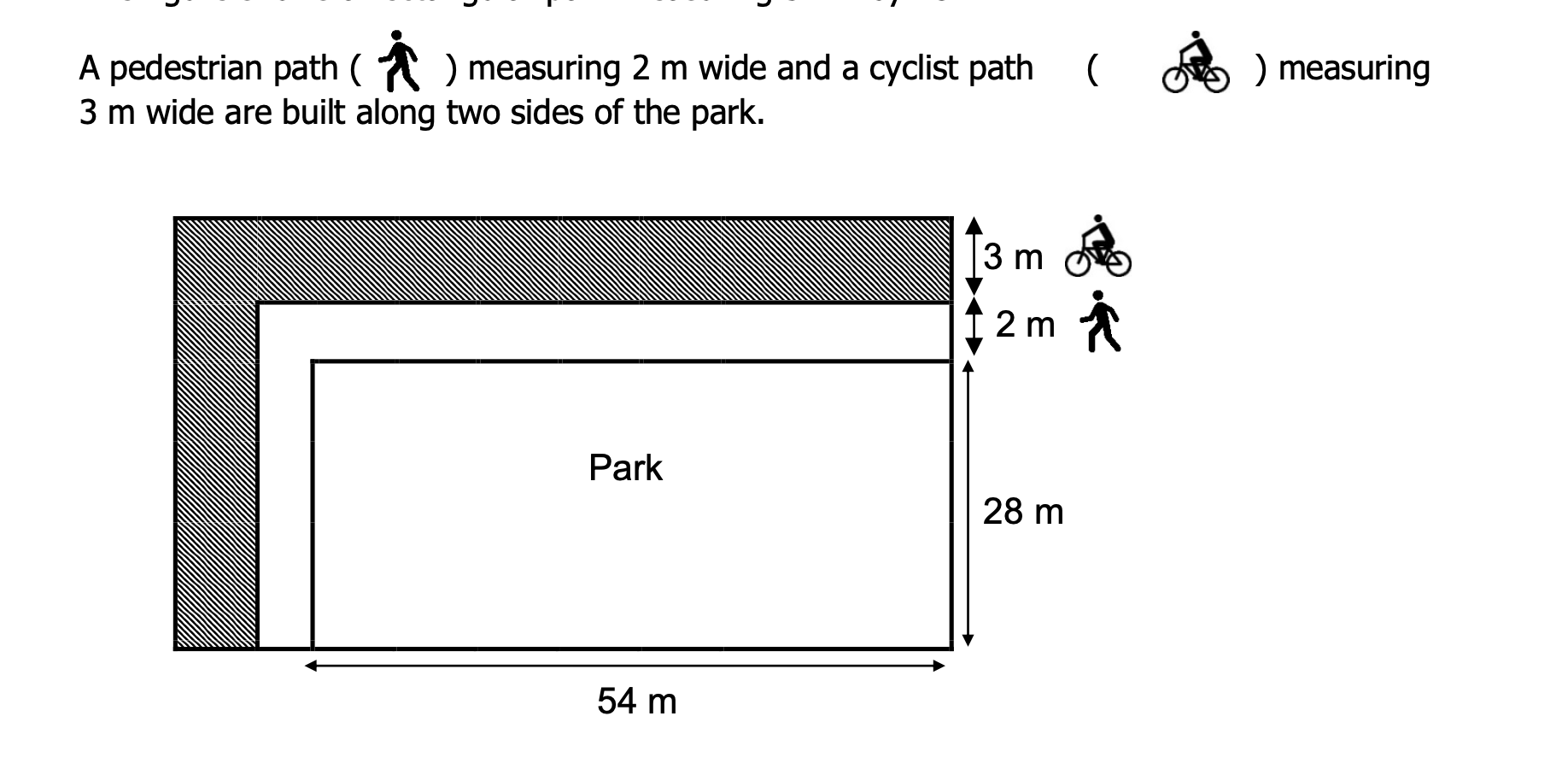
Answer: 4806
From the figure, both paths wrap around the same two sides (top and left) as a nested L: the 2 m pedestrian path sits directly against the park, and the 3 m cyclist path sits outside that, along the same two sides.
Park = 54 m × 28 m.
Park + pedestrian path block = (54 + 2) × (28 + 2) = 56 × 30 = 1680 m².
Park + pedestrian + cyclist block = (56 + 3) × (30 + 3) = 59 × 33 = 1947 m².
Area of cyclist path = 1947 − 1680 = 267 m².
Cost = 267 × $18 = $4806.
31
algebra
medium
In a library, there were some story books at first.
Betty, the librarian, added another 17 story books and removed 36 of them.
Then, Betty received 3 times as many new story books as what were left on the shelves.
She then arranged all the story books equally between 2 sections.
Each section had 458 story books in the end.
How many story books were in the library at first?
Answer: 248
Let B = number of books at first.
After adding 17 and removing 36: B + 17 − 36 = B − 19 left on shelves.
Betty received 3 × (B − 19) new books.
New total = (B − 19) + 3(B − 19) = 4(B − 19).
Total in 2 sections of 458 each = 916.
4(B − 19) = 916 → B − 19 = 229 → B = 248.