1
Arithmetic
easy
What is the value of the following sum?
2814 + 3700 + 4609 + 8211 + 9106 − 22900
Answer: 3
2814 + 3700 + 4609 + 8211 + 9106 = 28440.
28440 − 22900 = 5540.
2
Gears / Logic
medium
If Gear A rotates anti-clockwise, which of the following options is true? (Gears A, B, C, D, E, F are meshed in a row, each touching the next.)

Answer: 4
Meshed gears alternate direction: A anti-clockwise, B clockwise, C anti-clockwise, D clockwise, E anti-clockwise, F clockwise.
So A, C and E all rotate anti-clockwise (same direction as A).
Gear C rotates anti-clockwise — this statement is true.
3
Number patterns
medium
In the fictional "Odd Island", all the numbers contain only odd digits. The order of the counting numbers is the following
1, 3, 5, 7, …, 19, 31, 33, …
What is the 55th counting number in the island?
Answer: 4
1-digit odd-digit numbers: 1,3,5,7,9 — 5 numbers.
2-digit odd-digit numbers: each digit from {1,3,5,7,9}, 5×5 = 25 numbers.
So the first 30 terms are 1- and 2-digit numbers.
The 55th term is the (55−30) = 25th 3-digit odd-digit number.
3-digit odd-digit numbers with hundreds digit 1 are 111,113,...,199 — exactly 25 numbers, ending at 199.
So the 25th one (h=1) is 199, which is the 55th term overall.
4
Number sense
medium
How many four-digit numbers are there such that if we add 2020 to each of the numbers, the results are still four-digit numbers?
Answer: 3
Four-digit numbers n satisfy 1000 ≤ n ≤ 9999.
We need n + 2020 ≤ 9999, i.e. n ≤ 7979.
So n ranges from 1000 to 7979.
Count = 7979 − 1000 + 1 = 6980.
5
Grid logic
medium
In the grid below, the first row and the first column have been filled up with numbers from 10 to 19. The empty cells will be filled up with numbers by adding the topmost number in the column with the leftmost number in the row. (For example, A = 17 + 14 = 31 and B = 19 + 18 = 37.) After filling up all the empty cells, what will the sum of all the numbers in the grid be?

Answer: 1
Column headers (row 1): 10, 11, 13, 15, 17, 19 — sum = 85.
Row headers (column 1, rows 2–5): 12, 14, 16, 18 — sum = 60.
Each computed cell = column header + row header, for 5 column headers × 4 row headers.
Sum of computed cells = 5×(12+14+16+18) + 4×(11+13+15+17+19) = 5×60 + 4×75 = 300 + 300 = 600.
Total sum = 85 + 60 + 600 = 745.
6
Number sense
hard
Each of the numbers 138 and 243 has digits whose product is 24. How many three-digit numbers are there whose digits have a product of 24?
Answer: 5
Digit triples (1-9, none can be 0) multiplying to 24: {1,3,8}, {1,4,6}, {2,3,4}, {2,2,6}.
{1,3,8}, {1,4,6}, {2,3,4} each have 3 distinct digits → 3! = 6 arrangements each = 18.
{2,2,6} has a repeated digit → 3 arrangements.
Total = 18 + 3 = 21, which is not one of 8, 9, 12, 18.
So the answer is None of the above.
7
Calendar logic
medium
The month of December of a certain calendar year has exactly 5 Saturdays and 4 Sundays. On which day of the week does the first day of December fall?
Answer: 4
December has 31 days, so only the weekdays of Dec 1, 2 and 3 occur 5 times; all others occur 4 times.
For Saturday to occur 5 times, Saturday must be Dec 1, 2 or 3.
If Dec 1 = Saturday, Dec 2 = Sunday also occurs 5 times — not allowed (Sunday must occur only 4 times).
If Dec 1 = Friday, Dec 3 = Sunday also occurs 5 times — not allowed.
If Dec 1 = Thursday: Dec 1=Thu, Dec 2=Fri, Dec 3=Sat (occurs 5 times); Sunday is Dec 4, occurring only 4 times.
So December 1 falls on a Thursday.
8
Pattern recognition
medium
What is the missing number in the following pattern?
[1] = 9 (square)
(2) = 16 (hexagon)
(6) = 4 (octagon)
(1) = ? (pentagon)

Answer: 3
Rule: result = (number of sides of the shape − enclosed number)².
Square (4 sides), enclosed 1: (4−1)² = 9. Matches.
Hexagon (6 sides), enclosed 2: (6−2)² = 16. Matches.
Octagon (8 sides), enclosed 6: (8−6)² = 4. Matches.
Pentagon (5 sides), enclosed 1: (5−1)² = 16.
9
Sequences
medium
How many numbers are there in the list below?
6⅓, 7, 7⅔, 8⅓, …, 30⅓, 31
Answer: 3
This is an arithmetic sequence with common difference 2/3.
First term = 6⅓ = 19/3, last term = 31 = 93/3.
Number of terms n: 93/3 = 19/3 + (n−1)×(2/3).
74/3 = (n−1)×(2/3) → n−1 = 37 → n = 38.
10
Divisibility
easy
The five-digit number 25M48 is a multiple of 9. What digit does M represent?
Answer: 2
Digit sum = 2+5+M+4+8 = 19+M.
For the number to be a multiple of 9, 19+M must be a multiple of 9.
19+M = 27 → M = 8.
11
Geometry / figure comparison
hard
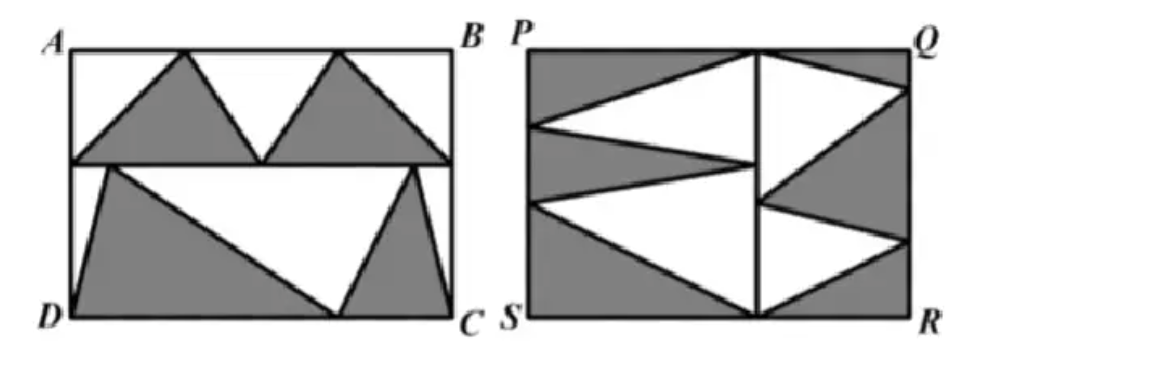
In the figure below, ABCD and PQRS are rectangles. AD = PS = 6 cm and AB = PQ = 10 cm. Compare the areas of the shaded region of rectangle ABCD and PQRS. Which of the following statements below is true?
Answer: 1
Split ABCD at its horizontal midline: in the top strip, the two shaded triangles have bases together spanning the full width AB and apexes on the midline, so shaded area = half the strip's area, regardless of exactly where the apexes sit.
The bottom strip's shaded shape is the same kind of construction (bases on DC, apexes on the midline), so it is also exactly half of its strip.
So the total shaded area of ABCD is always exactly half of the rectangle, no matter where the interior points are.
PQRS uses the same 'zigzag full-width' construction (just built off the two halves split by the vertical midline instead of horizontal), so its shaded area is also exactly half of the rectangle.
Since ABCD and PQRS are congruent rectangles, both shaded areas equal half of the same total area — they are equal.
12
Time / digit patterns
hard
The time now is 16:56 and Archie's 12-hour digital clock shows 4:56 P.M. He realizes that the digits of his digital clock are in increasing consecutive order. (When the time is 12:17 P.M. or A.M., the clock will show 12:17 P.M. or A.M. respectively.) How many minutes later will Archie's clock show digits again in increasing consecutive order?
Answer: 2
Times whose digits are increasing consecutive: 1:23, 2:34, 3:45, 4:56 (single-digit hour), and 12:34 (two-digit hour).
After 4:56, the next such time going forward is 12:34 (nothing else fits between 5:00 and 11:59).
From 16:56 to the next midnight (24:00) is 7 h 4 min = 424 minutes; plus 34 more minutes to 12:34 A.M. = 458 minutes.
13
Recycling / simulation
hard
Ali has 80 candles. He lights 1 candle every day. He can recycle the wax of four used candles to form a new candle. After how many days will he need to buy more candles?
Answer: 2
Burn 80 candles -> 80 used candles -> recycle into 20 new candles (80/4).
Burn those 20 -> 20 used -> recycle into 5 new candles.
Burn those 5 -> 5 used -> recycle into 1 new candle, 1 used candle left over.
Burn that 1 new candle -> now 2 used candles total (1 leftover + 1 just burned) -> not enough to recycle (need 4).
Total candles lit = 80 + 20 + 5 + 1 = 106. After day 106 he has only 2 used candles and must buy more.
14
Logic puzzle
medium
Among George, Helen and Irene, only one of them watched the movie 'Avengers'. When they were asked about the movie, they gave the following replies.
George said: Helen watched it.
Helen said: I have not watched it.
Irene said: I have not watched it.
If two of them lied, who watched the movie?
Answer: 3
Try Irene watched: George's claim "Helen watched" is false (lie). Helen's claim "I have not watched" is true. Irene's claim "I have not watched" is false (lie).
That gives exactly two liars (George and Irene), matching the condition.
So Irene watched the movie.
15
Spatial reasoning
hard
Which one of the following options is a missing piece of the cube on the right?
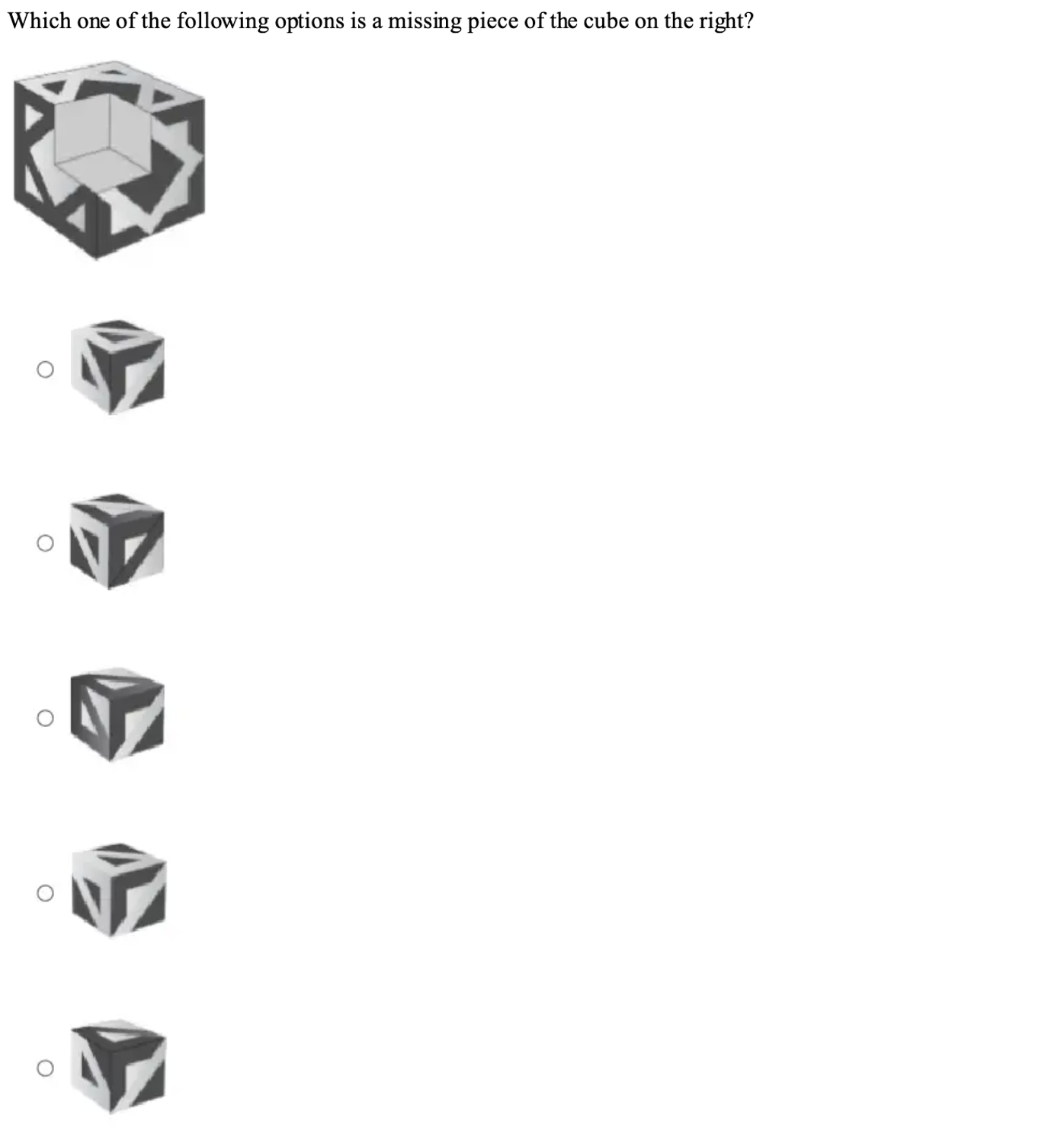
Options are 5 cube images shown in the figure.
Answer: 1
Option 1 correctly matches the cut-out triangular pattern of the reference cube.
16
Arithmetic
easy
What is the value of 95 × 37 + 95 × 42 + 21 × 95?
Answer: 9500
95 × 37 + 95 × 42 + 21 × 95 = 95 × (37 + 42 + 21) = 95 × 100 = 9500.
17
Counting figures
hard
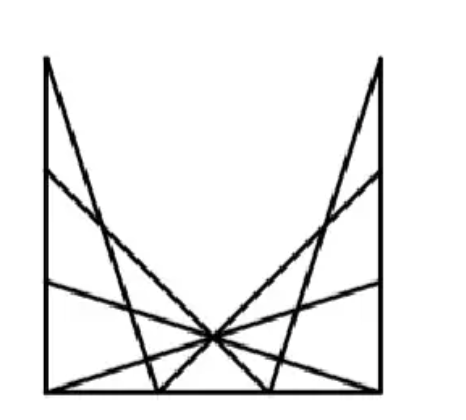
How many triangles are there in the figure below?
Answer: 42
Tracing every line in the figure precisely: the outline is 2 vertical sides + the bottom edge, plus 6 diagonal lines (3 fanning in from each side: the top corner, a point partway down the side wall, and the bottom corner on that side).
4 of the 6 diagonals (the two 'partway down the wall' lines and the two 'bottom corner' lines) are concurrent at one common interior point.
Counting every triple of lines that pairwise cross within the drawn segments (and aren't all concurrent at the same point) gives 42 triangles.
18
Algebra / word problem
medium
I am thinking of a number. If the number is added to 8, the sum is multiplied by 8, 8 is subtracted from the product, and the difference is divided by 8, it yields a quotient of 80. What is this number?
Answer: 73
Let the number be x.
((x + 8) × 8 − 8) ÷ 8 = 80.
(x + 8) × 8 − 8 = 640.
(x + 8) × 8 = 648.
x + 8 = 81.
x = 73.
19
Bar graph
hard
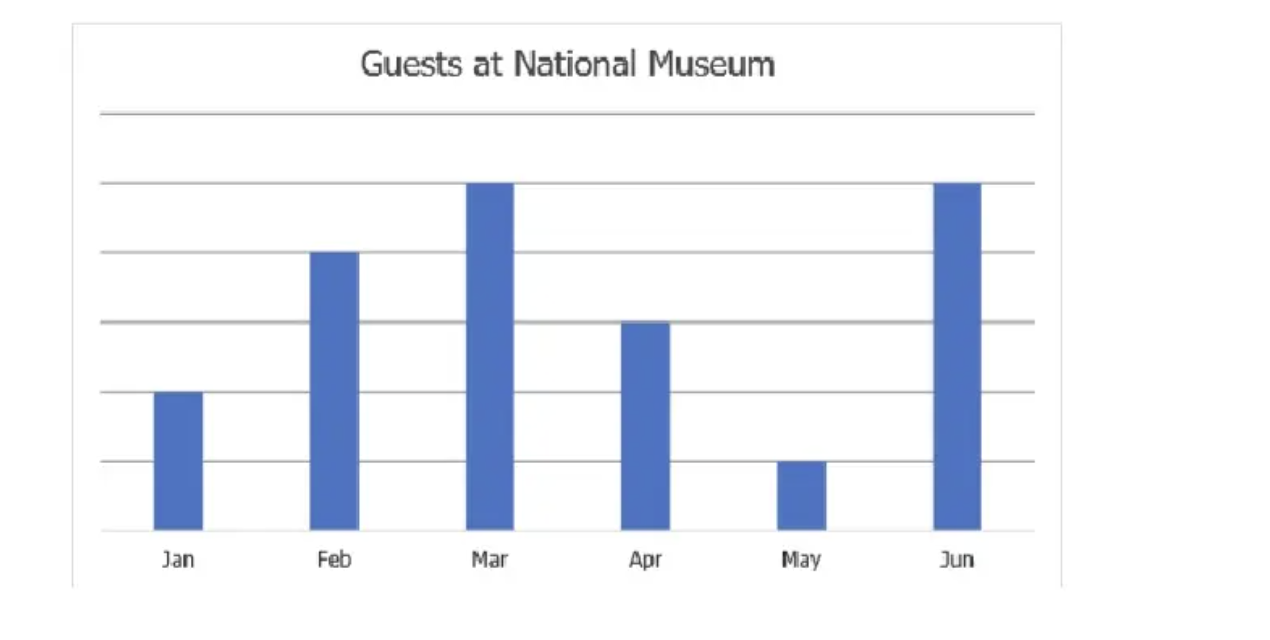
The graph below shows the number of guests who visited the National Museum during the first six months of 2019. All the horizontal lines are equally spaced. If the total number of guests who visited in January and May were 200 fewer than those in June, how many people visited the museum in total during the six months?
Answer: 2000
Reading the bar heights in grid-line units (measured precisely from the chart): Jan=2, Feb=4, Mar=5, Apr=3, May=1, Jun=5.
Jan + May = 2+1 = 3 units. Jun = 5 units.
3 units = 5 units - 200 (in guests) -> 2 units = 200 -> 1 unit = 100 guests.
Total over 6 months = (2+4+5+3+1+5) units = 20 units = 20 x 100 = 2000 guests.
20
Geometry / perimeter
medium
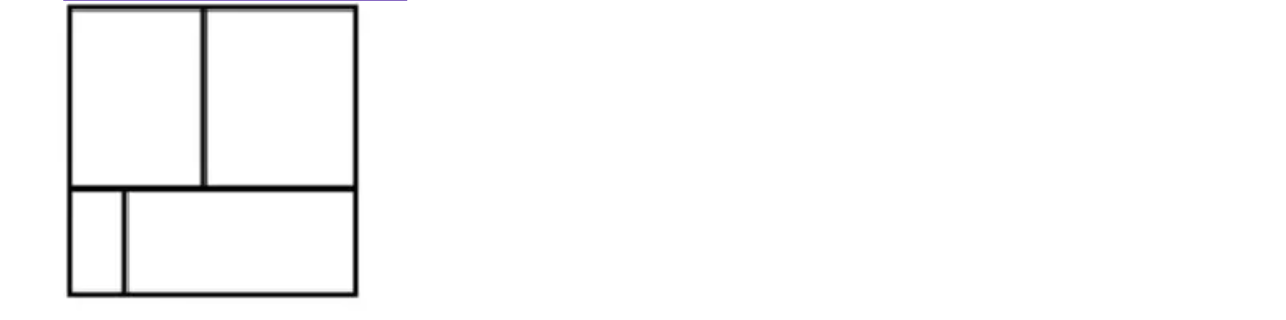
The following square is divided into four rectangles as shown. The sum of the perimeters of the four rectangles is 72 cm. Find the side length (in cm) of the square.
Answer: 9
Let the square's side be s, with the two rows of rectangles having heights h1 and h2 (h1 + h2 = s), and each row split into two widths that add up to s.
Sum of the 4 perimeters = 2×[(width parts summing to s, twice) + 2h1 + 2h2] = 2×[2s + 2s] ... simplifying: the widths in each row always add to s, so the sum of all 4 perimeters = 8s.
8s = 72 → s = 9.
21
Graph coloring
hard
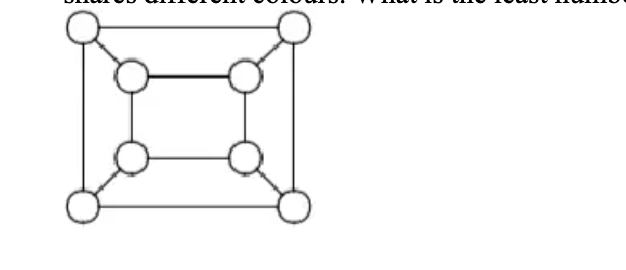
One wants to colour the circles in the figure below such that any pair of circles connected by a line segment shares different colours. What is the least number of colours needed for the colouring?
Answer: 2
The figure is a standard 2D cube wireframe (outer square + inner square + 4 connecting edges, 8 vertices, 12 edges) - confirmed from the image, this is a bipartite graph.
Colour the outer square's corners alternately, and each inner corner with the colour opposite to the outer corner it connects to.
This 2-colouring works for every edge, so the least number of colours needed is 2.
22
Algebra / word problem
medium
Ronald McDonald, a farmer, has chickens, goats and cows in his farm. He has 40 chickens and goats combined. He notices that 3 times the number of his chickens is 5 times the number of his cows. On the other hand, 2 times the number of goats is 10 times the number of his cows. Help Ronald McDonald determine the total number of animal feet in his farm.
Answer: 164
3 × chickens = 5 × cows → chickens = (5/3) × cows.
2 × goats = 10 × cows → goats = 5 × cows.
chickens + goats = 40 → (5/3)cows + 5cows = 40 → (20/3)cows = 40 → cows = 6.
chickens = 10, goats = 30.
Feet: chickens have 2 feet, goats and cows have 4 feet each.
Total feet = 10×2 + 30×4 + 6×4 = 20 + 120 + 24 = 164.
23
Algebra / word problem
medium
Kate bought some pieces of candy. She ate 1/3 at home and brought the rest to school. She shared the candy with her seven friends so that each friend received 26 pieces of candy. If Kate left with 22 pieces of candy, how many pieces of candy did she initially buy?
Answer: 306
Amount given to 7 friends = 7 × 26 = 182.
Amount brought to school = given to friends + kept by Kate = 182 + 22 = 204.
This 204 is 2/3 of the total (since she ate 1/3 at home).
Total = 204 ÷ (2/3) = 306.
24
Number sense
medium
A printer printed 237 digits for all the page numbers of a storybook. How many pages are there in the storybook?
Answer: 115
Pages 1–9: 9 pages × 1 digit = 9 digits.
Pages 10–99: 90 pages × 2 digits = 180 digits.
Running total after page 99 = 189 digits.
Remaining digits = 237 − 189 = 48, at 3 digits per page (pages 100+): 48 ÷ 3 = 16 pages.
Total pages = 99 + 16 = 115.
25
Cryptarithm
hard
In the following, all the different letters stand for different digits.
A B A C
+ D B E C
---------
A C E D C
Find the value of the 4-digit number DBEC.

Answer: 9480
Units column: C+C=C forces C=0 with no carry.
Ten-thousands column: the carry out of the thousands column must equal A, and since it's at most 1, A=1.
Thousands column: A+D+carry3=10 (since result digit is C=0) → 1+D+carry3=10.
Trying carry3=0 gives D=9; then tens column A+E=D gives E=8; hundreds column 2B=E gives B=4.
Check: ABAC=1410, DBEC=9480, sum=10890=ACEDC (A=1,C=0,E=8,D=9,C=0). It matches.
So DBEC = 9480.