1
decimals
easy
Express 2/25 as a decimal.
Answer: 1
2/25 = 2 × 4 / (25 × 4) = 8/100 = 0.08.
2
geometry
hard
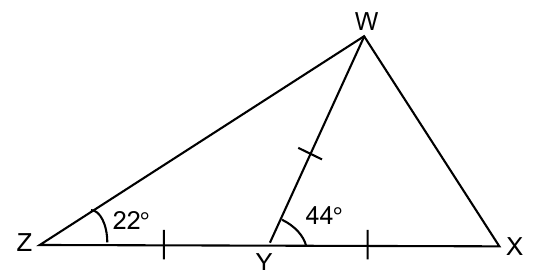
In the diagram below, WY = YX (tick marks) and Y lies on ZX. ∠Z = 22° and ∠WYX = 44°. What type of triangle is triangle WXZ?
Answer: 2
Since WY = YX, triangle WYX is isosceles with apex angle ∠WYX = 44°, so its base angles are ∠YWX = ∠YXW = (180° − 44°) / 2 = 68°.
∠WYZ = 180° − 44° = 136° (angles on a straight line at Y).
In triangle ZYW: ∠ZWY = 180° − 22° − 136° = 22°.
So the angle of triangle WXZ at W = ∠ZWY + ∠YWX = 22° + 68° = 90°.
Triangle WXZ has a 90° angle at W, so it is right-angled.
3
ratio
easy
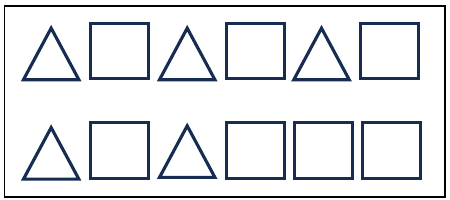
What is the ratio of the total number of shapes to the number of triangles to the number of squares?
Answer: 4
Row 1: 3 triangles, 3 squares. Row 2: 2 triangles, 4 squares.
Total triangles = 5, total squares = 7, total shapes = 12.
Ratio = 12 : 5 : 7.
4
measurement
medium
Which of the following distances are arranged from the shortest to the longest?
Answer: 3
1 4/5 km = 1.8 km. 1 km 405 m = 1.405 km. 1.45 km = 1.45 km.
From shortest to longest: 1.405 km, 1.45 km, 1.8 km, i.e. 1 km 405 m, 1.45 km, 1 4/5 km.
5
geometry
hard
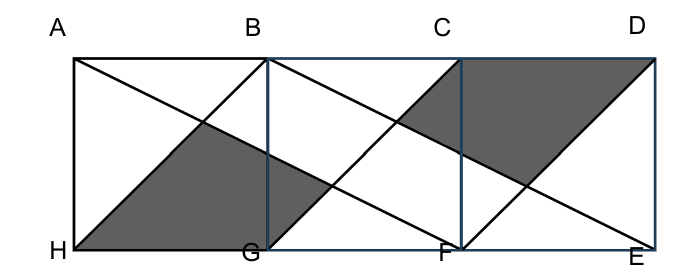
The figure is made up of three squares ABGH, BCFG and CDEF. What fraction of the figure ADEH is shaded?
Answer: 1
Let each square have side 1, so the figure ADEH has area 3.
The line from A to F and the line from H to C cross at the point directly above G, at height 0.5. This gives a shaded triangle with base HF = 2 and height 0.5, area = 0.5.
Similarly, the lines from B to E and from G to D cross directly above F at height 0.5, giving a second shaded triangle with base GE = 2 and height 0.5, area = 0.5.
Total shaded area = 0.5 + 0.5 = 1.
Fraction shaded = 1 / 3.
6
logic
medium
Adeline scored an average of 60 marks for her three tests. She scored the lowest for her last test. Which of the following cannot be her scores for the first two tests?
Answer: 2
Total of 3 tests = 60 × 3 = 180. The last test's score = 180 − (sum of first two), and it must be lower than both of the first two scores.
A: last = 180 − 135 = 45, lower than both 65 and 70 ✓.
B: last = 180 − 110 = 70, but 70 is not lower than 60 ✗ — impossible.
C: last = 180 − 130 = 50, lower than both 60 and 70 ✓.
D: last = 180 − 125 = 55, lower than both 60 and 65 ✓.
So 50, 60 cannot be the first two scores.
7
money
easy
Chicken pies were sold at the following prices at a shop: First 8 chicken pies $1 each, each additional chicken pie costs a fixed but unlisted price. Angela paid $11.20 for 12 chicken pies. What was the cost of each additional chicken pie?
Answer: 1
First 8 pies cost 8 × $1 = $8.
Remaining 4 pies cost $11.20 − $8 = $3.20.
Each additional pie = $3.20 ÷ 4 = $0.80.
8
averages
medium
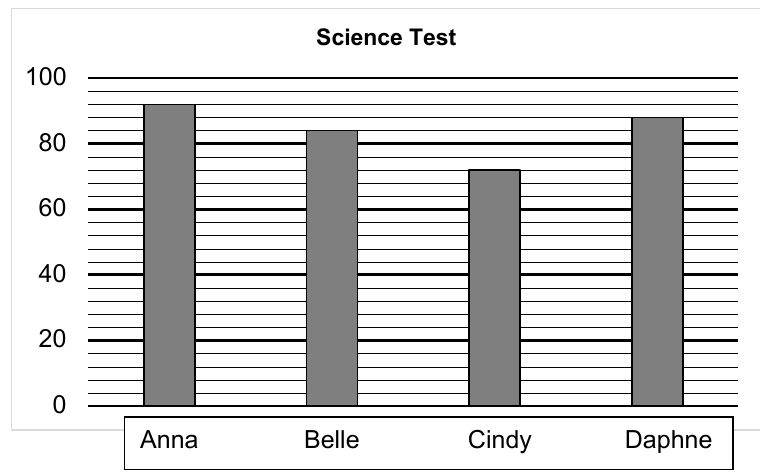
Four girls scored the following marks for their Science test (read from the bar graph). When one more girl joined their group, their average marks became 83.2. What was the score of the fifth girl?
Answer: 2
From the graph: Anna = 92, Belle = 84, Cindy = 72, Daphne = 88. Total = 336.
New total for 5 girls = 83.2 × 5 = 416.
Fifth girl's score = 416 − 336 = 80.
9
geometry
medium
The figure below shows a trapezium (only the top and bottom sides are parallel). Which of the following statement(s) is/are true?
i. ∠e = ∠h
ii. ∠e + ∠f = 180°
iii. ∠e + ∠g = 180°
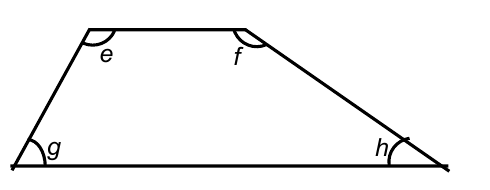
Answer: 2
Since the top and bottom sides are parallel, the left slanted side is a transversal, so co-interior angles ∠e and ∠g are supplementary: ∠e + ∠g = 180° (statement iii is true).
∠e and ∠h are not necessarily equal (the trapezium's legs are not symmetric), so statement i is false.
∠e and ∠f are the two top angles of a general (non-parallelogram) trapezium, and are not necessarily supplementary, so statement ii is false.
Only iii is true.
10
patterns
medium
Jane used stickers of four different shapes to make a pattern: smiley, cross, cube, pentagon, pentagon, cube, cross, smiley, smiley, cross, cube, pentagon, .... What is the shape of the 59th sticker?

Answer: 3
The pattern repeats every 8 stickers: smiley, cross, cube, pentagon, pentagon, cube, cross, smiley.
59 ÷ 8 = 7 remainder 3, so the 59th sticker matches the 3rd sticker in the cycle: cube.
11
money
medium
A pizza cost $14.50. Cindy bought 10 such pizzas and 30 identical bottles of soft drink. She gave the cashier $220 and received $3 change. How much did one bottle of soft drink cost?
Answer: 1
10 pizzas = 10 × $14.50 = $145.
Amount paid = $220 − $3 = $217.
30 bottles cost $217 − $145 = $72.
Each bottle = $72 ÷ 30 = $2.40.
12
data-tables
medium
During Library Week, students must read at least a certain number of books to get the Star Reader Award. The table below shows the number of books read by 300 students (0 books: 11 students, 1: 109, 2: 60, 3: 63, 4: 40, 5 or more: 17). 40% of the students received the Star Reader Award. What is the least number of books that must be read for the students to get the Star Reader Award?
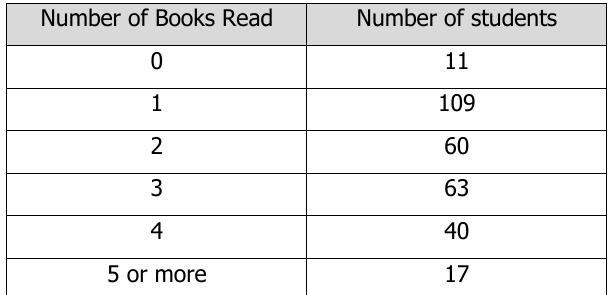
Answer: 2
40% of 300 = 120 students received the award.
Counting students from the top (most books read): 17 (5 or more) + 40 (4) + 63 (3) = 120.
So the least number of books needed is 3.
13
mass
easy
Mrs Ng bought 9.08 kg of flour to bake some cookies. She used 15 g of flour for each cookie. She made 500 cookies. How much flour was left?
Answer: 1
Flour used = 500 × 15 g = 7500 g = 7.5 kg.
Flour left = 9.08 kg − 7.5 kg = 1.58 kg.
14
mass
medium
The figure shows three objects on a balanced scale: A and B together balance C. The total mass of objects A, B and C is 5.7 kg. Object A weighs 50 g more than Object B. What is the total mass of Objects B and C?
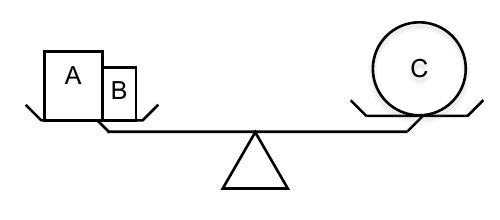
Answer: 3
Since the scale is balanced, A + B = C.
A + B + C = 5700 g, and A + B = C, so 2C = 5700 g → C = 2850 g.
A + B = 2850 g, and A = B + 50, so 2B + 50 = 2850 → B = 1400 g.
B + C = 1400 + 2850 = 4250 g = 4.25 kg.
15
data-graphs
medium
A group of children was asked to choose 1 cupcake each. The table shows the percentage who chose each flavour (Strawberry 30%, Butter 25%, Chocolate 35%, Vanilla 10%). The same data is shown in a bar graph (bars of 30, 36, 12 and 42 children) but the flavour names are not shown. How many more children chose Strawberry than Vanilla?
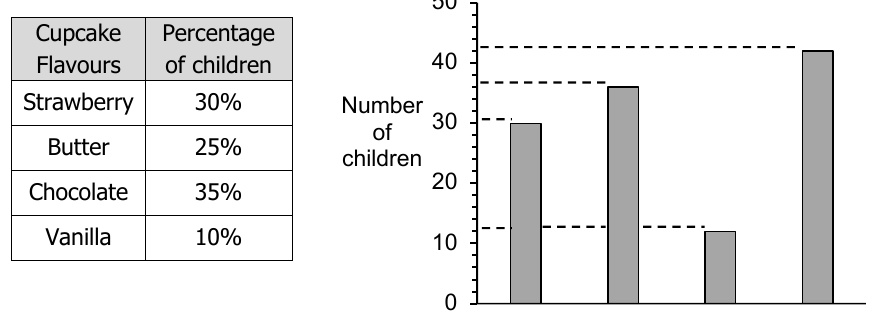
Answer: 3
Matching bar counts to percentages by proportion (count ÷ percentage must be constant): 42 ÷ 35% = 120, 36 ÷ 30% = 120, 30 ÷ 25% = 120, 12 ÷ 10% = 120. So total children = 120.
Chocolate = 42, Strawberry = 36, Butter = 30, Vanilla = 12.
Strawberry − Vanilla = 36 − 12 = 24.
16
money
medium
A pen cost 95¢ and a marker cost $1.40. Benson bought some pens and markers for $260.55. He bought 30 more markers than pens. How many markers did he buy?
Answer: 123
Let pens = p, markers = p + 30.
0.95p + 1.40(p + 30) = 260.55
0.95p + 1.40p + 42 = 260.55
2.35p = 218.55 → p = 93.
Markers = 93 + 30 = 123.
17
patterns
hard
A T-block is made up of 6 unit squares and has a perimeter of 14 cm. The pattern is made up of identical T-blocks joined in single rows (1-T Block, 2-T Block, 3-T Block, alternating between a bottom row and a top row of 5 squares, each with a 1-square stem into the other row, shifted 3 columns per block). What is the perimeter of the 55th T-Block?

Answer: 338
Each T-block contributes 6 unit squares. Within one block there are 5 shared (internal) edges (4 along its row of 5 squares, 1 for its stem).
Each new block connects to the previous one with 4 more shared edges (2 where the two rows' cells sit directly above/below each other, and 2 where a block's row-end sits next to the next block's stem).
For n blocks: total squares = 6n, total shared edges = 5n + 4(n − 1).
Perimeter = 4(6n) − 2[5n + 4(n − 1)] = 24n − 2(9n − 4) = 6n + 8.
Check: n = 1 gives 14 ✓, n = 2 gives 20, n = 3 gives 26 (all match the figure).
For n = 55: perimeter = 6 × 55 + 8 = 338 cm.
18
angles
hard
In the figure below, ABCD and DEFG are two parallelograms. AGB is a straight line. ∠DEF = 50°, ∠DAG = 77° and ∠CDE = 155°. Find ∠ADG.
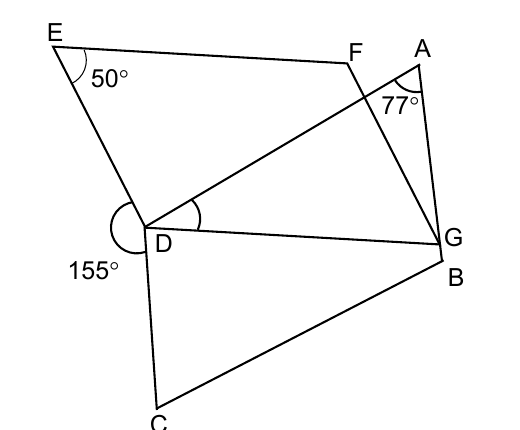
Answer: 28
In parallelogram DEFG, ∠GDE = 180° − ∠DEF = 180° − 50° = 130° (consecutive angles of a parallelogram are supplementary).
In parallelogram ABCD, ∠ADC = 180° − ∠DAG = 180° − 77° = 103° (since G lies on AB, ∠DAG = ∠DAB).
Around point D, the rays to G, A, E, C occur in that order, so ∠GDE = ∠GDA + ∠ADE and ∠ADC = ∠ADG + ∠GDC.
Let x = ∠ADG. Going fully around D: ∠GDA + ∠ADE + ∠EDC + ∠CDG = 360°, with ∠EDC = 155° given.
Using ∠GDA + ∠ADE = 130° and ∠ADG + ∠GDC = 103°, solving together with the 360° total gives ∠ADG = 28°.
19
patterns
medium
Lionel uses sticks to form a pattern made up of 5-sided figures (pentagons), where each new pentagon in the row shares one side with the previous one. A figure has a total of 753 sticks. What is the figure number?
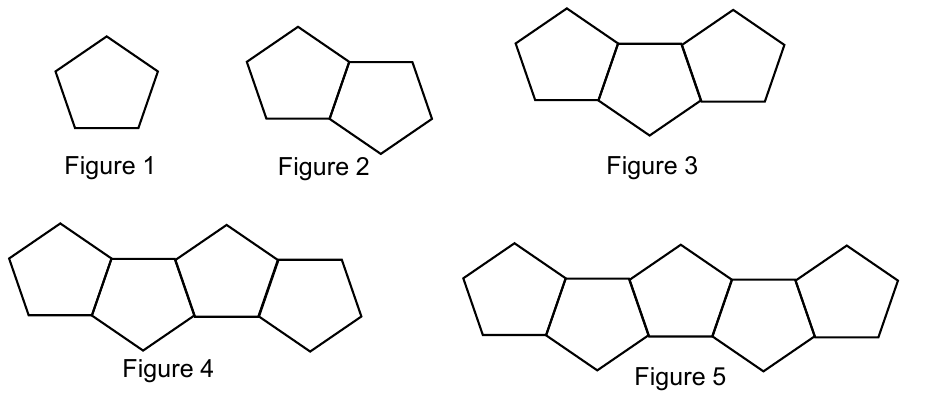
Answer: 188
Figure 1 has 5 sticks. Each additional pentagon shares 1 side with the previous one, adding 4 new sticks.
Sticks for figure n = 5 + 4(n − 1) = 4n + 1.
4n + 1 = 753 → 4n = 752 → n = 188.
20
fractions
hard
Mdm Pang baked some egg tarts and blueberry tarts. 1/4 of the tarts were egg tarts and the rest were blueberry tarts. She gave away 1/2 of the total number of tarts. 1/8 of the tarts given away were egg tarts. There were 70 blueberry tarts left. How many tarts did Mdm Pang bake in total?
Answer: 224
Let total = T. Blueberry tarts = 3T/4.
Tarts given away = T/2, of which 1/8 were egg tarts: egg given away = T/16.
Blueberry given away = T/2 − T/16 = 7T/16.
Blueberry left = 3T/4 − 7T/16 = 12T/16 − 7T/16 = 5T/16.
5T/16 = 70 → T = 224.
21
algebra
medium
In a contest, there were 50 questions. For every correct answer, contestants were awarded 3 points. 1 point was deducted for each question left blank and 2 points deducted for each question answered wrongly. Michael left nine questions blank and scored a total of 64 points. How many questions did he answer correctly?
Answer: 31
Answered questions = 50 − 9 = 41 = correct + wrong.
Blank deduction = 9 × 1 = 9, so 3(correct) − 2(wrong) = 64 + 9 = 73.
With wrong = 41 − correct: 3c − 2(41 − c) = 73 → 5c − 82 = 73 → c = 31.
22
geometry
hard
The figure is made up of Square ABCD and Rectangle DEFG. The perimeter of Square ABCD is 72 cm longer than the perimeter of Rectangle DEFG. FG = 10 cm and DC = 34 cm. What is the area of the shaded part? Give your answer in cm².
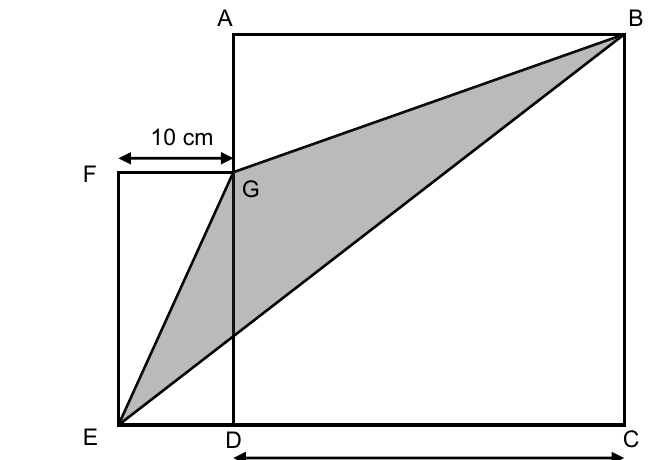
Answer: 484
Square ABCD has side 34 cm, so its perimeter = 136 cm.
Let the height of rectangle DEFG (ED) = h. Its perimeter = 2(10 + h).
136 = 2(10 + h) + 72 → 2(10 + h) = 64 → h = 22.
Set D = (0,0), C = (34,0), A = (0,34), B = (34,34), E = (−10,0), G = (0,22).
The shaded region is quadrilateral E, G, B, D. Using the shoelace formula on E(−10,0), G(0,22), B(34,34), D(0,0) gives an area of 484 cm².
23
geometry
hard
In the figure below, CDEF is a rectangle. CK, DK, FG and EG are straight lines. CD = 20 cm and DE = 12 cm. The area of GHKJ is 70 cm². What percentage of rectangle CDEF is shaded? Give your answer correct to the nearest whole number.
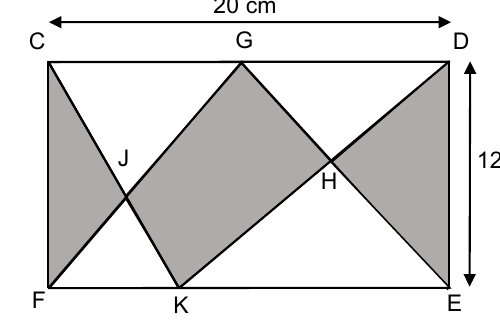
Answer: TBD
Not resolved: modelling G on CD and K on FE with triangles CKD (apex K, base CD) and FGE (apex G, base FE) gives quadrilateral GHKJ = the overlap of these two triangles, whose area can be shown to never exceed (rectangle area)/4 = 60 cm² for a 20×12 rectangle — yet the question gives GHKJ = 70 cm², which is inconsistent with that reading of the figure. This needs the answer from the official key or a re-check of how G, H, K, J relate to the rectangle; please fill in the correct answer directly.
24
ratio
medium
A box contains some coloured ribbons. 44% of the ribbons are yellow and the rest are pink and blue. The ratio of the number of pink ribbons to the number of blue ribbons is 3 : 5. There are 1748 more yellow ribbons than pink ribbons. How many ribbons are there altogether?
Answer: 7600
Remaining 56% is split pink:blue = 3:5, so pink = 56% × 3/8 = 21%, blue = 56% × 5/8 = 35%.
Yellow − pink = 1748 → (44% − 21%)T = 1748 → 0.23T = 1748 → T = 7600.
25
volume
hard
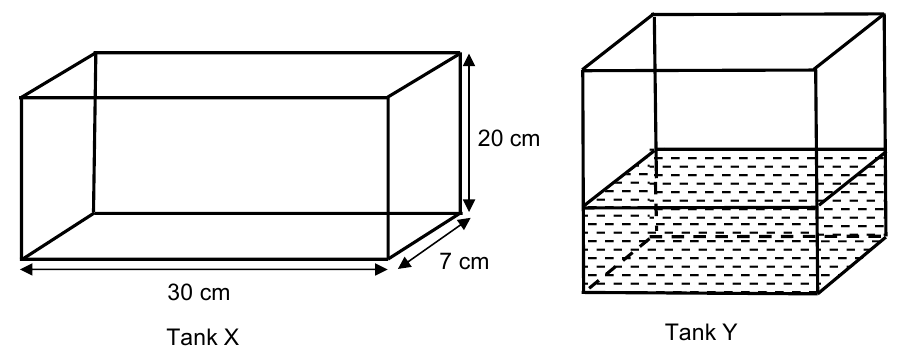
Tank X, a rectangular tank measuring 30 cm by 7 cm by 20 cm, was empty at first. Tank Y, another rectangular tank, was 1/3 filled with water at first. Some water from Tank Y was poured into Tank X until Tank X was 1/5 full. In the end, the amount of water left in Tank Y was 1860 cm³. What was the capacity of Tank Y? Give your answer in cm³.
Answer: 8100
Capacity of Tank X = 30 × 7 × 20 = 4200 cm³.
Water poured into X = 1/5 × 4200 = 840 cm³ (this equals the water removed from Y).
Water in Y at first = 840 + 1860 = 2700 cm³.
This was 1/3 of Y's capacity, so capacity of Y = 2700 × 3 = 8100 cm³.
26
algebra
hard
Aunt Susan collected $348.80 from the sale of milk shake and bubble tea. She sold 3 times as many cups of milk shake as bubble tea. She collected $131.20 more from the sale of milk shake than the sale of bubble tea. Each cup of bubble tea costs 90¢ more than a cup of milk shake. How many cups of milk shake did Aunt Susan sell?
Answer: 96
Let bubble tea cups = n, milk shake cups = 3n. Let milk shake price = p, bubble tea price = p + 0.9.
Total: 3np + n(p + 0.9) = 348.80 → 4np + 0.9n = 348.80.
Difference: 3np − n(p + 0.9) = 131.20 → 2np − 0.9n = 131.20.
Adding the two equations: 6np = 480 → np = 80.
Substituting: 160 − 0.9n = 131.20 → n = 32.
Milk shake cups = 3 × 32 = 96.
27
angles
hard
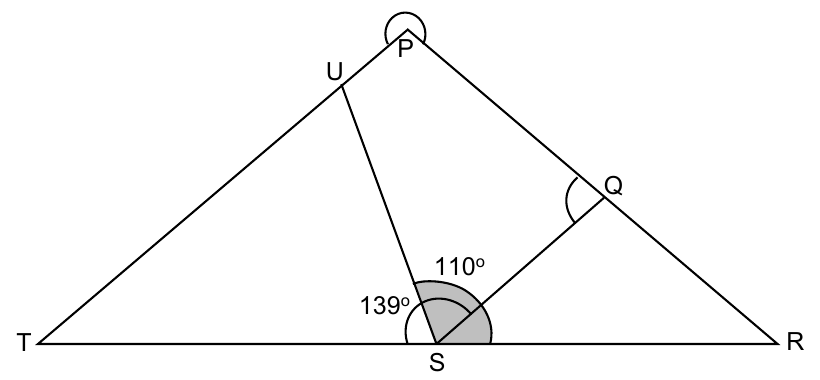
In the figure below, PRT is a triangle. TU = TS and QS = QR. ∠TSQ = 139° and ∠USR = 110°. Find the sum of ∠SQP and reflex ∠TPR.
Answer: 343
At S (on line TR): ∠TSQ = ∠TSU + ∠USQ = 139°, and ∠USR = ∠USQ + ∠QSR = 110°. Also ∠TSU + ∠USQ + ∠QSR = 180°, giving ∠QSR = 41°, ∠USQ = 69°, ∠TSU = 70°.
Since TU = TS, triangle TUS is isosceles: ∠TUS = ∠TSU = 70°.
Since QS = QR, triangle QSR is isosceles: ∠QRS = ∠QSR = 41°, so ∠SQR = 98°.
∠SQP = 180° − ∠SQR = 82° (P, Q, R are collinear).
Angle T of the main triangle = ∠UTS = 180° − 70° − 70° = 40°. Angle R of the main triangle = ∠QRS = 41°.
Angle P of the main triangle = 180° − 40° − 41° = 99°. Reflex ∠TPR = 360° − 99° = 261°.
Sum = ∠SQP + reflex ∠TPR = 82° + 261° = 343°.
28
money
medium
Gizelle made 32 identical big and 25 identical small bows from a roll of ribbon for a party. She made 15 of the big bows and 6 of the small bows using 14.88 m of ribbon. The length of ribbon used for 3 of the big bows was the same as 5 of the small bows. What was the length of ribbon Gizelle used to make all the bows? Give your answer in cm.
Answer: 3760
Let big bow = b m, small bow = s m. 3b = 5s → b = 5s/3.
15b + 6s = 14.88 → 15(5s/3) + 6s = 14.88 → 25s + 6s = 14.88 → s = 0.48 m, so b = 0.8 m.
Total ribbon = 32b + 25s = 32(0.8) + 25(0.48) = 25.6 + 12 = 37.6 m = 3760 cm.
29
geometry
hard
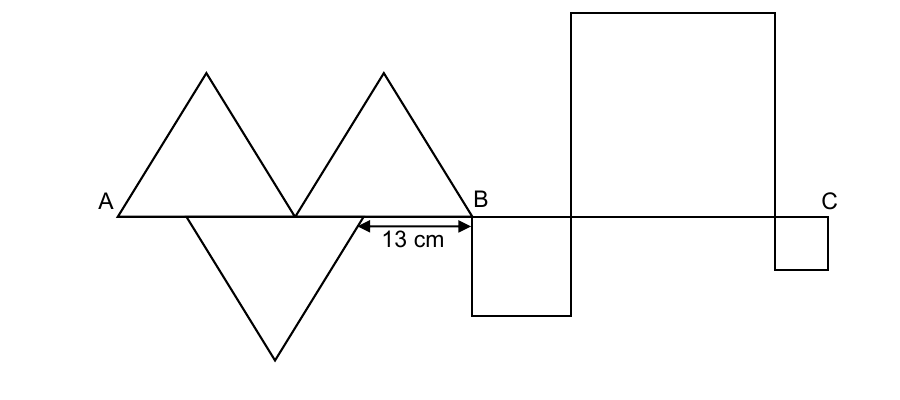
Joelle used some wire to form 3 squares and 3 identical equilateral triangles as shown in the figure below. AC is a straight line. B is the mid-point of AC. BC = 42 cm. She had 34 cm of wire left in the end. What was the length of the piece of wire Joelle had at first? Give your answer in cm.
Answer: TBD
Not resolved: AB = BC = 42 cm (B is the midpoint, AC = 84 cm). The exact placement of the 2 upward and 1 downward equilateral triangles between A and B (and the square dimensions between B and C) could not be pinned down confidently from the figure within a reasonable amount of time. Please fill in the correct answer directly.
30
money
medium
Miss Tan and Miss Ong went shopping at Happy Toy Shop, which had a sale: 1 toy at 10% discount, 2 toys and above at 20% discount. Miss Tan bought a Pokémon toy and paid $18.90 for it. Miss Ong bought a Pokémon and a Mario toy and paid $40 for them. What was the usual price of a Mario toy?
Answer: 29
Miss Tan bought only 1 toy (10% off): usual Pokémon price = 18.90 ÷ 0.9 = $21.
Miss Ong bought 2 toys (20% off): usual total price × 0.8 = 40 → usual total = $50.
Usual Mario price = 50 − 21 = $29.
31
money
hard
The table below shows the fare charges by a taxi company for its Premium taxis: Flag down (first km) $4.50; every 400 m thereafter or less up to 10 km, $0.35; every 350 m thereafter or less after 10 km, $0.35; every 45 seconds of waiting time, $0.35. Additional surcharges: Peak Period (6–9.29 a.m., 6 p.m.–11.59 p.m.) 25% of total charges; Late Night (midnight–5.59 a.m.) 50% of total charges. John took a taxi home at 12.10 a.m. and reached home at 12.35 a.m. The total distance travelled was 19.8 km. The total waiting time for the whole journey was 3 minutes. How much was the taxi fare? Round your answer to the nearest dollar.
Answer: 36
Flag down (first km) = $4.50.
From 1 km to 10 km (9 km = 9000 m) at $0.35 per 400 m or less: 9000 ÷ 400 = 22.5, rounds up to 23 charges = $8.05.
Beyond 10 km: 19.8 − 10 = 9.8 km = 9800 m at $0.35 per 350 m: 9800 ÷ 350 = 28 exactly = $9.80.
Waiting time: 3 min = 180 s ÷ 45 s = 4 charges = $1.40.
Subtotal = 4.50 + 8.05 + 9.80 + 1.40 = $23.75.
Journey is entirely within Late Night (midnight–5.59 a.m.): +50% → 23.75 × 1.5 = $35.625 ≈ $36.